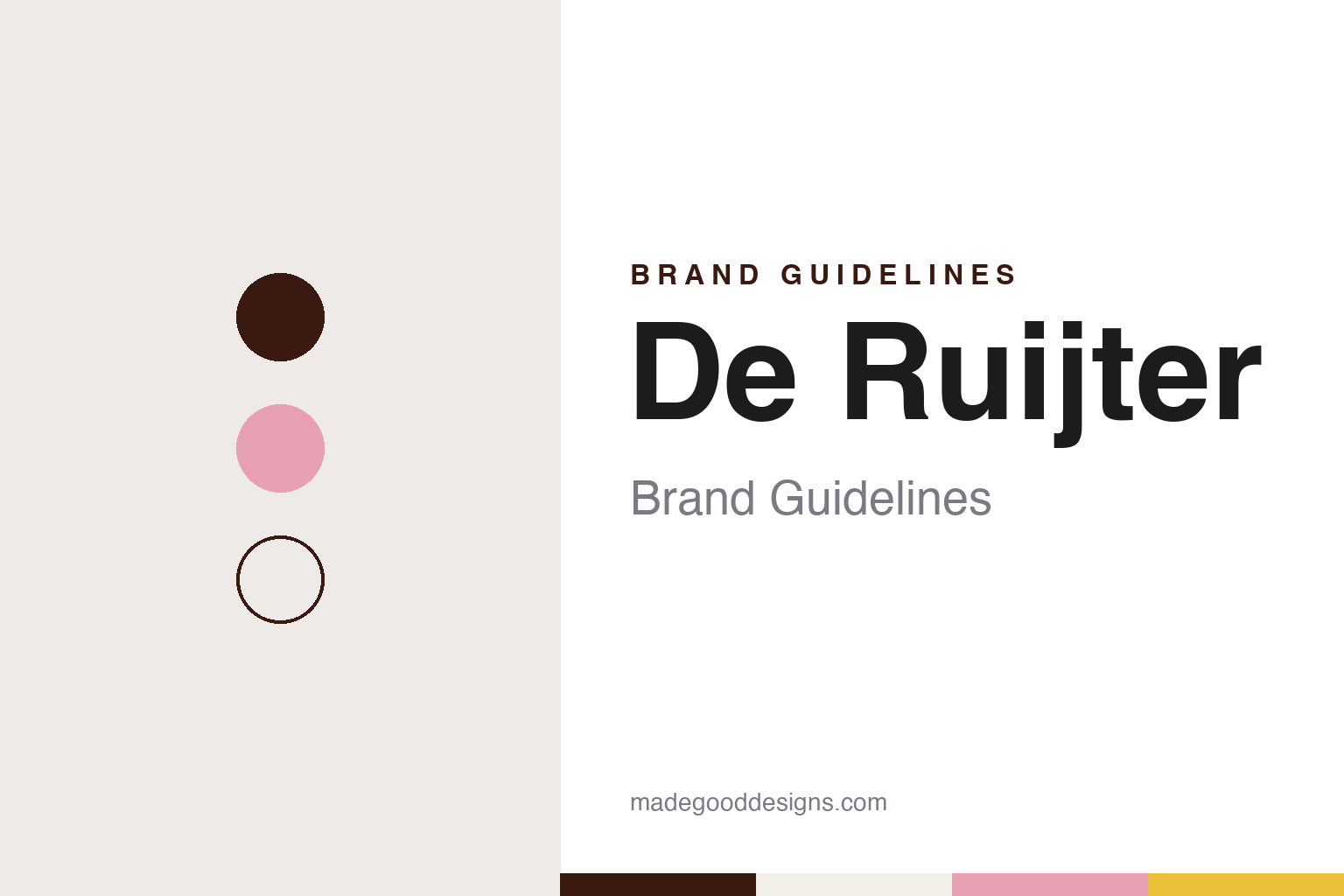
De Ruijter Brand Guidelines
The Baarn muisjes and hagelslag maker with a royal warrant.
Aa
Two constants: a chocolate brown, muisjes pink and tin yellow palette and a traditional display serif register. Abstract homage — not a De Ruijter product or mark; no pack, tin or logo is reproduced.
A pastry shop in Baarn
Sugared aniseed for every new baby.
De Ruijter began as a pastry shop. Dutch Wikipedia, citing the Historische Kring Eemnes and the Baarn local-history site Groenegraf, says the company was founded in 1860 by Cornelis Rutger de Ruijter, who opened a bakery in the Brinkstraat in Baarn and sold geboortemuisjes from it. The company’s own history, reproduced by Groenegraf in 2019 in consultation with De Ruijter’s consumer service, adds that he was 24, had learned the trade with a leading Utrecht pastry baker, and set up shop in the front of a former farmhouse.
Muisjes — “little mice” — are aniseed seeds coated in many layers of sugar, pink and white, eaten on buttered beschuit rusks to celebrate a birth. According to the company history, a variant followed soon after when older customers who found the sugared seeds hard on their teeth asked for them crushed, which gave rise to Gestampte Muisjes, a ground version for spreading. The same history says the founder’s son Petrus took over the business young, and that the royal household, then living at nearby Soestdijk, became customers. Dutch Wikipedia dates the appointment as purveyor to the court (hofleverancier) to 1883, under King Willem III.
The range widened in the twentieth century. In 1928, Dutch Wikipedia says, the factory was enlarged and moved within Baarn, and De Ruijter began making aniseed blocks and vruchtenhagel, the fruit-flavoured sugar sprinkles; the company history lists lemon, raspberry, orange and aniseed flavours. In 1946 came the first export order: vruchtenhagel for Dutch soldiers in the Dutch East Indies.
Colour
Tins, mice and orange for a princess.
Much of De Ruijter’s visual history sits in its tins. According to the company history, Maria de Ruijter, Petrus’s wife, started the practice of packing muisjes in decorative tins and designed one herself in red, green and gold with a border of white mice. Later she also designed the company’s trademark: the silhouette of a mother and child above the line “Kinderen zijn er dol op!” — “Children love it!” — printed on the familiar yellow tins of Gestampte Muisjes.
Royal births became part of the brand. The company history says that in 1937 the firm decided to make orange muisjes for the first child of Princess Juliana and Prince Bernhard, and that when Princess Beatrix was born on 31 January 1938, Cees and Piet de Ruijter took a giant tin of them to the palace, where photographs and newsreel footage were made. Offering orange muisjes at the birth of a prince or princess of Orange has been a tradition since, the company says.
Packaging nostalgia paid off later too. At the end of 1974, the company history says, Gestampte Muisjes went back temporarily into their round yellow tin and sold out; in 1980 a tin bearing portraits of Queen Juliana and the incoming Queen Beatrix was filled with orange sprinkles for the inauguration and proved even more popular. Until 1993, the history adds, muisjes were always pink and white; from 1994 De Ruijter also sold blue and white muisjes for the birth of a boy.
Chocolate came through acquisitions. De Ruijter bought the Van Campen chocolate business in Alkmaar in 1955 and began making chocoladevlokken, chocolate flakes, and in 1957 it took over machines and craftsmen from the closing Erven de Jong chocolate factory in Wormerveer and started making chocolate hagelslag, Dutch Wikipedia and the company history say. For its 150th anniversary in 2010, the company history says, most packs were restyled alongside new television and print advertising.
Typography
Design and documentation.
The seven brands in this group all make food, and all of them come from Denmark, Sweden or the Netherlands: Toms, Kelsen, Göteborgs Kex, Polarbröd, HAK, De Ruijter and Venz. Food brands from these countries sit at many different points in the trade, from family firms that still carry a founder’s surname to names that now belong to much larger food groups, and a single brand can be sold everywhere from a corner shop to a supermarket shelf.
A food brand’s identity is usually carried less by a single product than by a pack, a name and the meal or treat it promises, because the company behind the name may have changed hands, moved its factory or grown far beyond the town where it started. That makes the questions behind each name worth asking plainly: who started it, who owns it now, and where its food is actually made and packed.
Each guide separates what independent sources record from what the company says about itself — its founding story, its owners over time, where its food is made and how its packaging has changed — and marks plainly what rests only on the company’s own word.
Aa
A traditional display serif for a firm with a royal warrant and a tin of mice. (Specimen set in DM Serif Display, a serif STAND-IN; NOT the De Ruijter logo.)
De Ruijter
From a family firm to Kraft Heinz.
De Ruijter stayed in the family for more than a century, trading as P. De Ruijter & Zn. In 1983 it was taken over by the Dutch group CSM, Dutch Wikipedia says. Two years later, for its 125th anniversary in 1985, it received the predicate Koninklijk, or Royal, and after a merger with Zwaardemaker of Maarssen, another CSM business, the company was renamed Koninklijke De Ruijter in 1990, the company history says. Dutch Wikipedia adds that in 1990 De Ruijter also took in Zwaardemaker and the rival hagelslag brand Venz, of Vaassen.
CSM then sold its food division. Dutch Wikipedia says Koninklijke De Ruijter went to the American H.J. Heinz Company together with the vegetable brand HAK, Honig and other businesses; it dates the sale to 2001, while the Volkskrant, writing about HAK, put Heinz’s purchase of the CSM food division in December 2000. In March 2006 RTV Utrecht reported that the hagelslag and muisjes factory would move permanently from a residential district of Baarn, where it could not expand, to Heinz’s syrup factory on the Lage Weide industrial estate in Utrecht; Dutch Wikipedia dates the move to 2007. Heinz merged with Kraft in 2015 to form the Kraft Heinz Company, which still owns the brand: the De Ruijter website now leads to a Kraft Heinz page that says De Ruijter has made the Netherlands’ iconic hagelslag for 150 years.
The Utrecht factory itself changed hands. In a March 2017 announcement, the investment holding LIVIA Group said it had sold the co-packer Coflace Food to its management, and that Coflace had earlier acquired a drinks, bread-toppings and breakfast-cereal factory in Utrecht with a co-packing arrangement for Kraft Heinz, making products including De Ruijter and Venz chocolate sprinkles.
For a design guide, De Ruijter shows how a brand can be carried by ritual and by the tin: pink and white for a birth, orange for a royal baby, yellow for crushed aniseed. Compare it with its old stablemate in our Venz guide and the Haarlem cocoa tin in our Droste guide. For this guide we use chocolate brown, muisjes pink and tin yellow with a serif, an unofficial interpretation; no product or logo is reproduced.
Explore & save
Keep De Ruijter’s identity on hand — save it to a board in the Made Good inspiration library.
De Ruijter identity set
Pin the De Ruijter chocolate brown, muisjes pink and tin yellow palette and the traditional display serif register to your own board.