Tamek Brand Guidelines
The Bursa canner behind Turkey’s first ketchup.
Aa
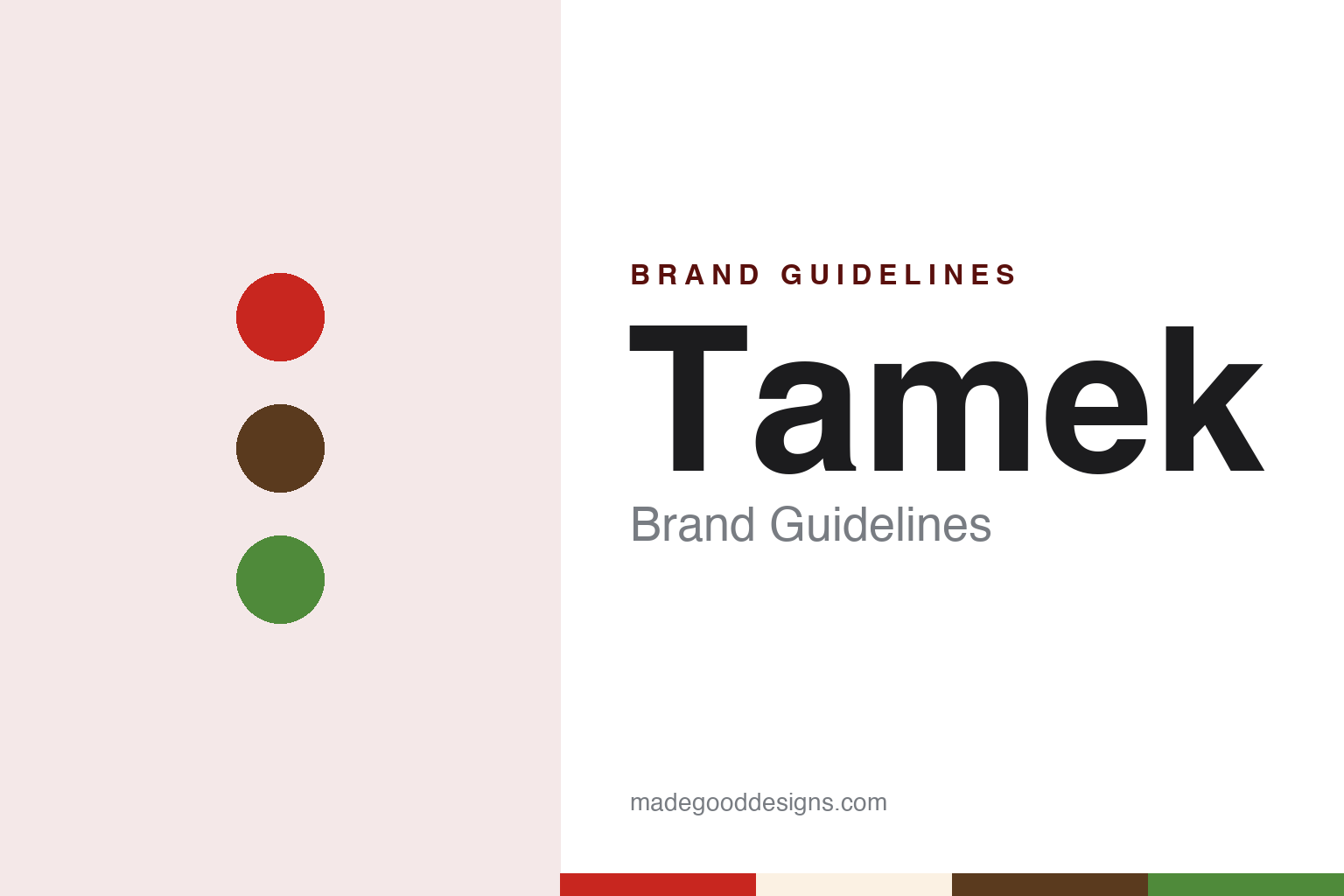
Two constants: a tomato red, bottle brown and leaf green palette and a sturdy grotesque sans register. Abstract homage — not a Tamek product or mark; no pack, logo or bottle is reproduced.
A Turkish-German start in Bursa
Fruit extracts, a German partner and a name made of initials.
Tamek was founded on 31 March 1955 at Demirtaş, then a village in the Osmangazi district of Bursa, in north-western Turkey, the company and English Wikipedia say. Its name is an acronym: the initials of the Türk Alman Meyve Ekstreleri Kumpanyası, the Turkish-German Fruit Extracts Company. The founder was Mehmet Sipahioğlu, who set up the business in technical cooperation with a German partner. The company says that at the time modern food-processing technology was scarce in Turkey; the German partner left after a year, and from then on, it says, Tamek was a food producer of entirely Turkish origin. English Wikipedia cites a 2011 report in the newspaper Milliyet for the same account of the partnership.
Tamek built its name on a run of Turkish firsts, all of them claimed by the company. In 1958, it says, it produced Turkey’s first ketchup and tomato juice; English Wikipedia cites a November 1957 item in the newspaper Akşam on ketchup tomato sauce. In 1959 came ready-to-eat dishes and stuffed vegetables in cans, and in 1974, the company says, the first boiled and canned pulses in Turkey. Later firsts included a sugar-free jam in 1992 and, according to English Wikipedia, Turkey’s first fruit juice in a can in 1993.
Fruit juice became the brand’s best-known line. In 1963, at its first plant in Demirtaş, Tamek began making fruit juice in brown glass bottles, which the company calls iconic. English Wikipedia, citing the company’s history, says Tamek returned its juices to the signature brown bottle in 2017, and the company’s website now marks the brand’s 70th anniversary.
Colour
Factories across the Marmara and Aegean regions.
As the range widened, Tamek moved production into bigger plants in the farming country of the Marmara and Aegean regions. In 1987 a factory at Karacabey, in Bursa province, began making tomato paste, canned vegetables and jam, the company says. In 1994 it opened a plant at Kızıksa, in the Manyas district of Balıkesir, for ketchup and mayonnaise, and English Wikipedia adds tomato paste and fruit concentrate to that list. A third plant at Salihli, in Manisa province, made tomato paste and ready meals; the company dates it to 2000, while English Wikipedia gives 2002. The original Demirtaş site was turned over to fruit juice alone, in 2001 according to English Wikipedia and 2002 according to the company.
Turkish Wikipedia, citing the company’s history page, says production today takes place at Karacabey and Salihli, on sites covering about 163,000 square metres with a capacity of roughly 205,000 tonnes a year. The company’s website notes that its Salihli plant holds a LEED Gold green-building certification.
Packaging has been a recurring theme in the brand’s list of firsts. English Wikipedia, drawing on the company’s history, says Tamek was the first in Turkey to sell tomato paste in a cardboard carton, in 2000; used full-body shrink sleeves on its ketchup and mayonnaise bottles from 2005; and in 2014 became the first Turkish user of a clear Tetra Pak carton for its juices. Its range today runs from tomato products, pastes and sauces to jams and marmalades, canned pulses and vegetables, pickles and ready meals, plus nectars, juices, iced teas and lemonades, with sub-brands including Gusto pasta sauces, Limo lemonade and the Kahvaltım breakfast drinks. A Superbrands Turkey profile in 2005 took its title from the brand’s slogan, “Tamek’se koy sepete” — roughly, “If it’s Tamek, put it in the basket.”
Typography
Design and documentation.
The seven brands in this group all make food, and they come from Saudi Arabia, Kuwait, Lebanon, the United States and Turkey: Almarai, Americana, Al Wadi Al Akhdar, Cortas, Ziyad, Tamek and Eti. Middle Eastern and Turkish food brands in general sit at many different points in the trade, from family firms that still carry a founder’s name to names that now belong to much larger food groups, and a single brand can be sold everywhere from a neighbourhood grocer to a supermarket shelf abroad.
A food brand’s identity is usually carried less by a single product than by a pack, a name and the meal or snack it promises, because the company behind the name may have changed hands, moved its factory or grown far beyond the town where it started. That makes the questions behind each name worth asking plainly: who started it, who owns it now, and where its food is actually made and packed.
Each guide separates what independent sources record from what the company says about itself — its founding story, its owners over time, where its products are made and how its packaging has changed — and marks plainly what rests only on the company’s own word.
Aa
A sturdy grotesque sans for a brand named after a company’s initials. (Specimen set in Archivo, a sans STAND-IN; NOT the Tamek logo.)
Tamek
Fruko, a family holding and the army pension fund.
For most of its history Tamek was a family company. Turkish Wikipedia describes it as Tamek Holding, an Istanbul-based food group, and in 2014 the Turkish central securities depository’s company register listed Mehmet Melih Sipahioğlu as chairman. The group also had a soft-drink business. Turkish Wikipedia says the fizzy-drink brand Fruko was created by Tamek in 1967, and that it passed to PepsiCo from 13 March 2002, citing PepsiCo’s Turkish drinks company; the business magazine Capital covered the sale in an article on what it called Tamek’s “second birth.”
Ownership changed in 2021. On 24 May 2021 the state news agency Anadolu Ajansı reported that OYAK — the Ordu Yardımlaşma Kurumu, the Turkish armed forces’ pension and mutual-aid fund — had applied to Turkey’s Competition Authority for approval to buy all the shares of the company that held Tamek’s assets and brands. The agency reported that it would be OYAK’s second food investment, after the Sagra group, and quoted OYAK’s general manager, Süleyman Savaş Erdem, as saying the fund aimed to multiply Tamek’s market share; about 30% of Tamek’s revenue then came from exports, the report said. Turkish Wikipedia says the purchase of all of Tamek Holding’s shares was completed in June 2021, and OYAK’s list of companies now includes Tamek Grup Gıda Üretim A.Ş.
Under OYAK the brand has kept its founding story at the centre. The company’s website marks 70 years of Tamek with the line “Generations have been Tamek for 70 years,” shows the OYAK name in its footer and lists newer drinks, such as the Chill mixology range and Limo lemonades, alongside the pastes, ketchups and jams on which it built its name. Its head office is in Istanbul, while the food itself is still made in Bursa and Manisa provinces.
For a design guide, Tamek shows how a company acronym and a brown glass bottle can carry a food brand through seven decades and a change of owner. Compare Eti, another Turkish household food name, and Mutti, the Parma tomato maker. For this guide we use a tomato red, a bottle brown and a leaf green with a sturdy sans, an unofficial interpretation; no product or logo is reproduced.
Explore & save
Keep Tamek’s identity on hand — save it to a board in the Made Good inspiration library.
Tamek identity set
Pin the Tamek tomato red, bottle brown and leaf green palette and the sturdy grotesque sans register to your own board.