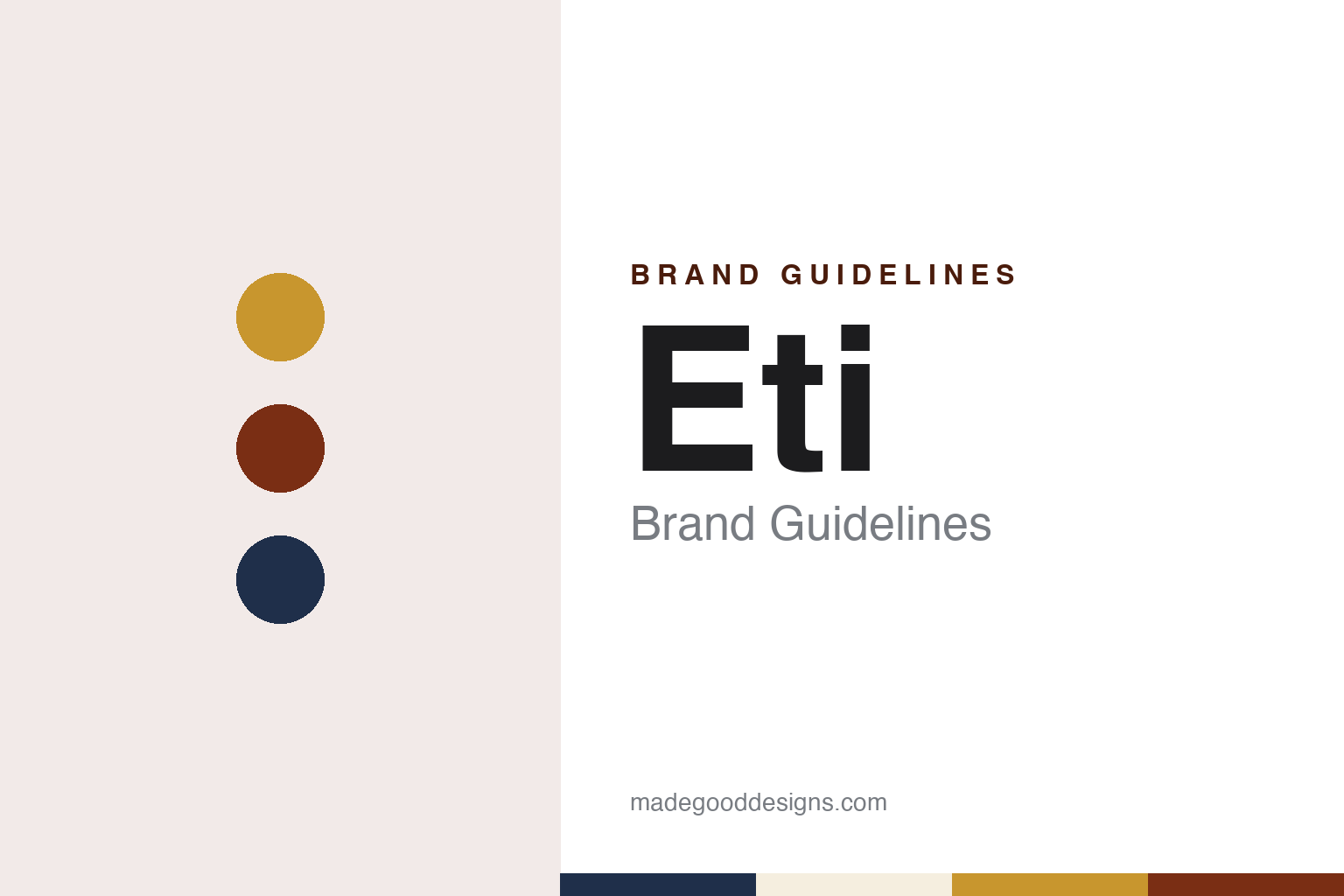
Eti Brand Guidelines
The Eskişehir biscuit maker under a Hittite sun.
Aa
Two constants: a sun-disc gold, terracotta and Anatolian navy palette and a sturdy grotesque sans register. Abstract homage — not an Eti product or mark; no pack, logo or biscuit is reproduced.
A biscuit plant in Eskişehir
One founder, twenty workers and a Hittite name.
Eti is a biscuit company from Eskişehir, in north-western Anatolia, and it has stayed there. Its founder was Firuz Kanatlı. The company’s own published history says that in 1961 Kanatlı set up a first plant to make biscuits under the ETİ name and registered it with the local chamber of commerce and industry, and that on 20 January 1962 the plant began production with 20 workers and a capacity of three tonnes a day. That is why English and Turkish Wikipedia both give 1962 as the founding year. The company also says Kanatlı drew up the project for that first plant himself. Its first products, it says, were plain biscuits such as Petit Beurre and Marie, sold loose in boxes of four to five kilograms.
The name carries its own history. In Turkish, Eti is a word for the Hittites, the Bronze Age people of central Anatolia, English Wikipedia notes, citing a dictionary entry published by the newspaper Sabah. Both Wikipedias say the company uses a Hittite sun disk as its logo.
The business grew quickly from that first plant. The company says a second plant followed in 1963, a first automatic tunnel oven in 1965 and, on 25 November 1967, an automatic biscuit plant built to the designs of Turkish engineers. On 13 March 1972 Kanatlı’s ETİ biscuit factory became a joint-stock company, Eti Gıda Sanayi ve Ticaret A.Ş., with members of his family as shareholders. Its first export, to Cyprus, came in 1974, and in 1975, it says, it moved from hand-packed to individually packaged products.
Colour
A jingle, a fibre biscuit and a marshmallow sandwich.
Eti’s best-known products arrived over the next two decades. The company dates Etimek, a ready-made toasted bread made at a new plant in Bozüyük, to 20 February 1978, and calls it the first of its kind in Turkey. Burçak followed the same year; the company and both Wikipedias describe it as Turkey’s first fibre biscuit. In 1979 came Eti Puf, a biscuit with a marshmallow filling and a granule coating. A cake business, Tam Gıda, was set up in 1980, and the company lists Browni in 1986, Topkek in 1990 and Popkek in 1999. Cin, a biscuit with an orange jelly and cocoa granules, is described in the company’s history as a long-standing favourite that gained a new mini format in November 2011.
Its advertising had a song attached from early on. The company says that from 1972 it used a jingle by the composer and lyricist Oktay Tem, “Bir bilmecem var çocuklar” (“I have a riddle, children”), and Turkish Wikipedia credits that song with making Eti products widely known. By 2005 the company was using the slogan “Eti Lezzet Uygarlığı” — roughly “Eti, a civilisation of flavour” — and Turkish Wikipedia records a later line ending “Eti Eti Eti!”, and the company’s website address repeats the name three times.
Some product changes were about pack design. The company says that from 2005 it printed Braille on 250-gram packs of Browni Gold so that blind and partially sighted shoppers could identify the product, and that the design went on to win several awards. It also says its Karam dark chocolate, launched in December 2010, received a label from the French Observeur du Design for 2012 for its domed shape. A product name changed for other reasons: in December 2021 Eti renamed Negro, a cream-filled chocolate biscuit it had made since 1990, as Nero, saying the word was used to express discrimination in some countries, BBC News Türkçe, Cumhuriyet and T24 reported at the time.
Typography
Design and documentation.
The seven brands in this group all make food, and they come from Saudi Arabia, Kuwait, Lebanon, the United States and Turkey: Almarai, Americana, Al Wadi Al Akhdar, Cortas, Ziyad, Tamek and Eti. Middle Eastern and Turkish food brands in general sit at many different points in the trade, from family firms that still carry a founder’s name to names that now belong to much larger food groups, and a single brand can be sold everywhere from a neighbourhood grocer to a supermarket shelf abroad.
A food brand’s identity is usually carried less by a single product than by a pack, a name and the meal or snack it promises, because the company behind the name may have changed hands, moved its factory or grown far beyond the town where it started. That makes the questions behind each name worth asking plainly: who started it, who owns it now, and where its food is actually made and packed.
Each guide separates what independent sources record from what the company says about itself — its founding story, its owners over time, where its products are made and how its packaging has changed — and marks plainly what rests only on the company’s own word.
Aa
A sturdy grotesque sans for a biscuit maker with an ancient name. (Specimen set in Archivo, a sans STAND-IN; NOT the Eti logo.)
Eti
A family company that stayed in its home city.
Eti is a privately held company headquartered in Eskişehir, The Plant Base noted in 2025. In September 2006, the company says, the Kanatlı family separated the roles of the board and the executive committee and withdrew from day-to-day management to sit on the board. Firuz Kanatlı died in October 2017, Yeni Şafak reported; the company says his son Firuzhan Kanatlı has since chaired its board.
The company’s history names plants in Eskişehir, including a modern biscuit plant in the city’s organised industrial zone opened in 1996, and in Bozüyük, in neighbouring Bilecik province, where Etimek, Browni and Topkek were first made. It added a chocolate and bar factory in 2003, when the Wanted bar appeared, and it says it set up its own machinery company, ETİ Makine, in 1978. From 2003 it adopted the Japanese total productive maintenance method across its factories, and it says its plants have won the Japan Institute of Plant Maintenance’s awards several times. Its marketing arm moved to Istanbul in 1997. English and Turkish Wikipedia both say Eti began making chilled dairy desserts in 2014, under names such as Süt Burger and Pastamia, and Turkish Wikipedia lists the frozen Alaska Frigo among its brands.
Recognition has come from the business press. Eti was voted first in the chocolate and biscuit sector in Capital magazine’s “En Beğenilen Şirketler” (most admired companies) list in 2013 and again in 2014, the company and both Wikipedias say, and it is the main sponsor of the city’s football club, Eskişehirspor. In November 2025 an affiliate of Eti agreed to buy Trubar, a plant-based protein bar company founded in Vancouver in 2019, with completion expected in the first quarter of 2026, The Plant Base and Turkey’s Dünya newspaper reported.
For a design guide, Eti shows how an ancient Anatolian name and a Hittite sun can carry a modern biscuit, cake and chocolate maker from a single Eskişehir plant in 1962 to a broad range of biscuits, cakes and chocolate. Compare Tamek, another Turkish food brand, and Parle, the Indian biscuit maker behind Parle-G. For this guide we use a sun-disc gold, a terracotta and an Anatolian navy with a sturdy sans, an unofficial interpretation; no product or logo is reproduced.
Explore & save
Keep Eti’s identity on hand — save it to a board in the Made Good inspiration library.
Eti identity set
Pin the Eti sun-disc gold, terracotta and Anatolian navy palette and the sturdy grotesque sans register to your own board.