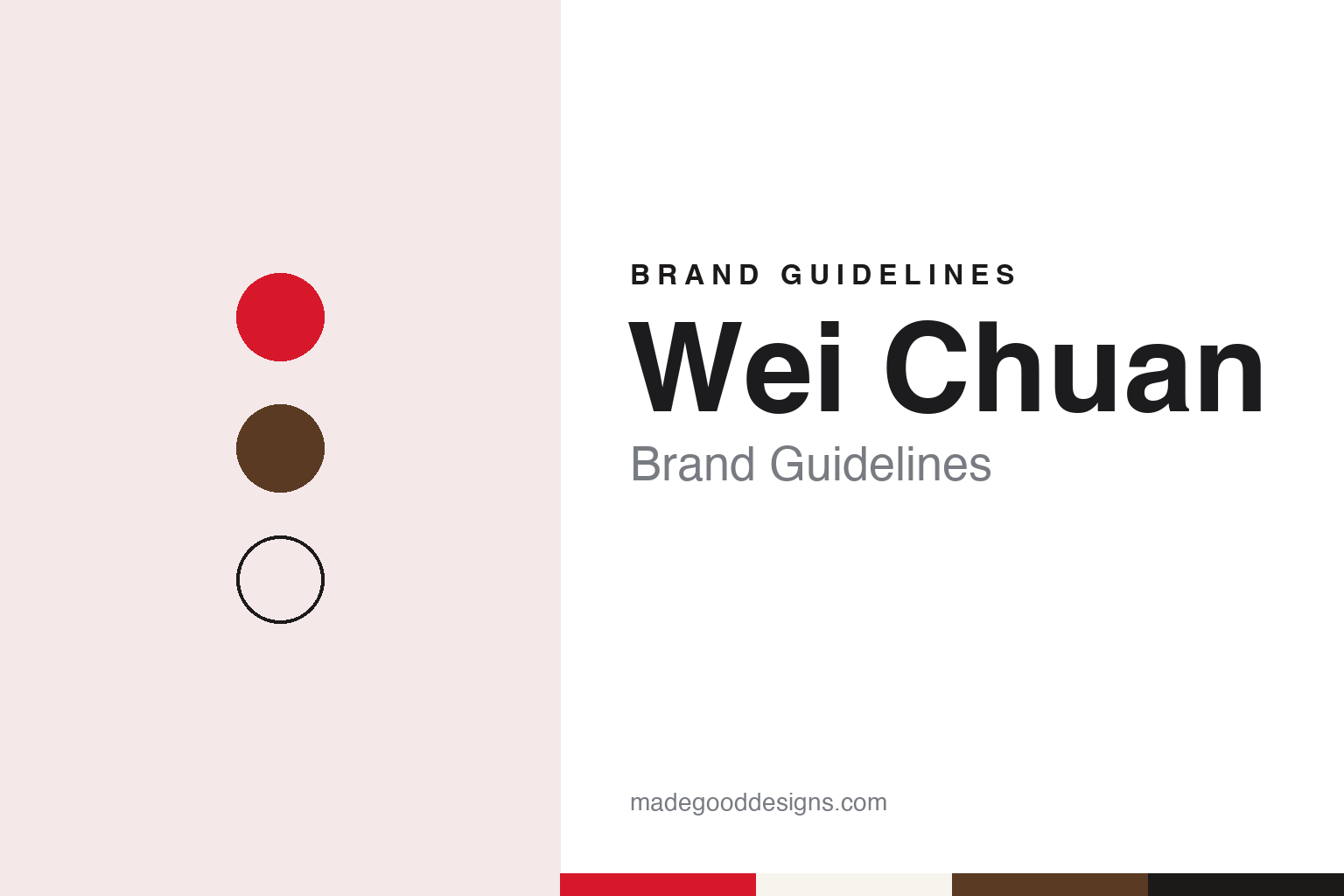
Wei Chuan Brand Guidelines
The Taipei seasoning maker with a five-dot “W.”
Aa
Two constants: a Wei Chuan red, soy brown and milk white palette and a traditional serif register. Abstract homage — not a Wei Chuan product or mark; no pack, logo or wordmark is reproduced.
Hotai Chemical
MSG, soy sauce and a dairy farm.
Wei Chuan — 味全 in Chinese — began in Taipei on 22 September 1953, when Huang Lieh-ho founded a company first called Hotai Chemical Industry. Chinese Wikipedia says he set it up with Japanese partners; the company’s own history names Huang as founder. Its first product was monosodium glutamate, the seasoning known as MSG, and in 1954 the business took the name Wei Chuan Foods and began planning soy-sauce production.
Growth came quickly. The company says it expanded its MSG plant and bought a ranch near Yangmei, in today’s Taoyuan, in 1955; began making soy sauce, pickles and canned food in 1956; set up a research laboratory in 1958 to develop MSG made by fermentation; and built a fermentation plant in 1959 that let it make the seasoning in volume. In 1960 it merged with Wei Chuan Dairy to form a dairy division, and in 1961 its shares were listed. Chinese Wikipedia calls it Taiwan’s first listed food company. A cannery and ice-cream plant in Taichung followed in 1962, a milk-powder factory in 1963, and in 1964 a joint venture making MSG for Thailand.
Those early lines still shape the brand. Wei Chuan’s soy sauces, pickled cucumbers and canned foods came first; then, as Chinese Wikipedia and the company both record, came dairy in volume. A second ranch at Linfengying, in Tainan County, opened in 1972, and its name is used for the company’s fresh-milk brand, Linfengying (林鳳營). The company says it launched Tetra Pak dairy drinks in 1978 and opened a dairy works in Douliu, Yunlin, in 1976. In 1980, Chinese Wikipedia says, the head office moved into the Wei Chuan Building on Songjiang Road in Taipei, where the company’s website still places it. In Taiwan’s food trade, that encyclopedia adds, people used to speak of “Uni-President in the south, Wei Chuan in the north.”
Colour
Five red dots and a “W.”
Wei Chuan’s mark is one of the few in this field with a documented design story. On its website the company says it was the first company in Taiwan’s food industry to adopt a full corporate identity system. The mark is built from five red dots that echo the “W” of Wei Chuan, and the company says it stands for food that is “round and tasty” and for having all five flavours. Chinese Wikipedia dates the system to 1967, credits the mark to the Japanese designer Hiroshi Ohchi, and says it replaced an earlier double-phoenix emblem. English Wikipedia says the separate Wei-Chuan USA uses a related logo of five red balls for the five basic flavours.
The product range widened through partnerships, many with Japanese firms. The company says it launched UCC canned coffee in 1984 with the coffee roaster UCC, worked with Morinaga Milk on dairy technology in 1986, and opened a Taichung prepared-food plant in 1989. Chinese Wikipedia adds a joint venture with Mitsui and Q.P. Corporation in 1988 and, in December 2012, a line at Douliu with Calbee to make potato snacks; the company says it sold its stake in that venture in 2016. Its current brands, Chinese Wikipedia says, include Linfengying milk and yogurt, Daily C juice, Bernachon coffee and Wei Chuan MSG.
Wei Chuan also tried retailing and sport. Chinese Wikipedia says it ran the Matsusei supermarkets with a Japanese partner from 1986 and brought the am/pm convenience-store chain to Taiwan with ARCO in 1988, closing it in 1995. Its baseball team, the Wei Chuan Dragons, joined Taiwan’s professional league in 1990, was disbanded in December 1999, and returned in 2021 after the league approved its comeback in 2019.
Typography
Seasonings and identity.
The seven brands in this group all make food or drink, and all of them come from China or Taiwan: Three Squirrels, Daoxiangcun, I-Mei, Kuai Kuai, Uni-President, Wei Chuan and C’estbon. Food and drink brands from China and Taiwan in general sit at many different points in the trade, from family firms that still carry a founder’s name to names that now belong to much larger groups, and a single brand can be sold everywhere from a corner shop to a supermarket shelf.
A snack or drink brand’s identity is usually carried less by a single product than by a pack, a name and the treat or refreshment it promises, because the company behind the name may have changed hands, moved its factory or grown far beyond the city where it started. That makes the questions behind each name worth asking plainly: who started it, who owns it now, and where its products are actually made and packed.
Each guide separates what independent sources record from what the company says about itself — its founding story, its owners over time, where its products are made and how its packaging has changed — and marks plainly what rests only on the company’s own word.
Aa
A traditional serif — the register of a mid-century seasoning maker. (Specimen set in Noto Serif TC, a serif STAND-IN; NOT the Wei Chuan logo.)
Wei Chuan
Two families and one name.
Ownership changed in 1998. English Wikipedia says the Ting Hsin International Group became the largest shareholder, with about 40 percent, after a dispute within the founding Huang family. Ting Hsin is the Wei family’s group behind Master Kong instant noodles in mainland China, and the company’s history says Wei Ing-hsing and Wei Ing-chung became chairman and vice-chairman that year. Master Kong noodles went on sale in Taiwan in 2002, and in 2003, the company says, a Master Kong noodle plant opened at Douliu.
The split also divided the name. English Wikipedia says the Huang family kept control of Wei-Chuan USA, founded in 1972, which holds the Wei Chuan brand in the United States, Europe and Australia; the Taiwanese company sold its stake in it in 2000, and the two are now separate businesses with different owners. Chinese Wikipedia says the Taiwanese company holds the rights to the name in Asia. The American company has its own website and products.
In 2013 and 2014 Taiwan’s cooking-oil scandals reached Ting Hsin companies; the Taipei Times reported on 15 November 2014 that Wei Chuan had a new chairman, Jason Lee, after the Wei family gave up management of the firm while keeping a stake of about 40 percent. The company’s history says it stopped making cooking oil and instant noodles in 2014. Its history since then lists food-safety certifications at its plants. Chen Hung-yu became chairman in 2019, and the company marked its 70th anniversary in 2023, when it set up an international division to sell its brands abroad. Its main factories are in Taichung, Douliu and Kaohsiung.
For a design guide, Wei Chuan shows how much a simple geometric mark can carry: five dots that read as a letter, a count of flavours and a seasoning maker’s promise all at once. Compare it with its old southern rival Uni-President and with its sister brand Master Kong. For this guide we use five-dot red, deep red, soy brown and milk white with a serif, an unofficial interpretation; no product or logo is reproduced.
Explore & save
Keep Wei Chuan’s identity on hand — save it to a board in the Made Good inspiration library.
Wei Chuan identity set
Pin the Wei Chuan red, soy brown and milk white palette and the traditional serif register to your own board.