Wong Lo Kat Brand Guidelines
The Guangzhou herbal tea behind China’s red can.
Aa
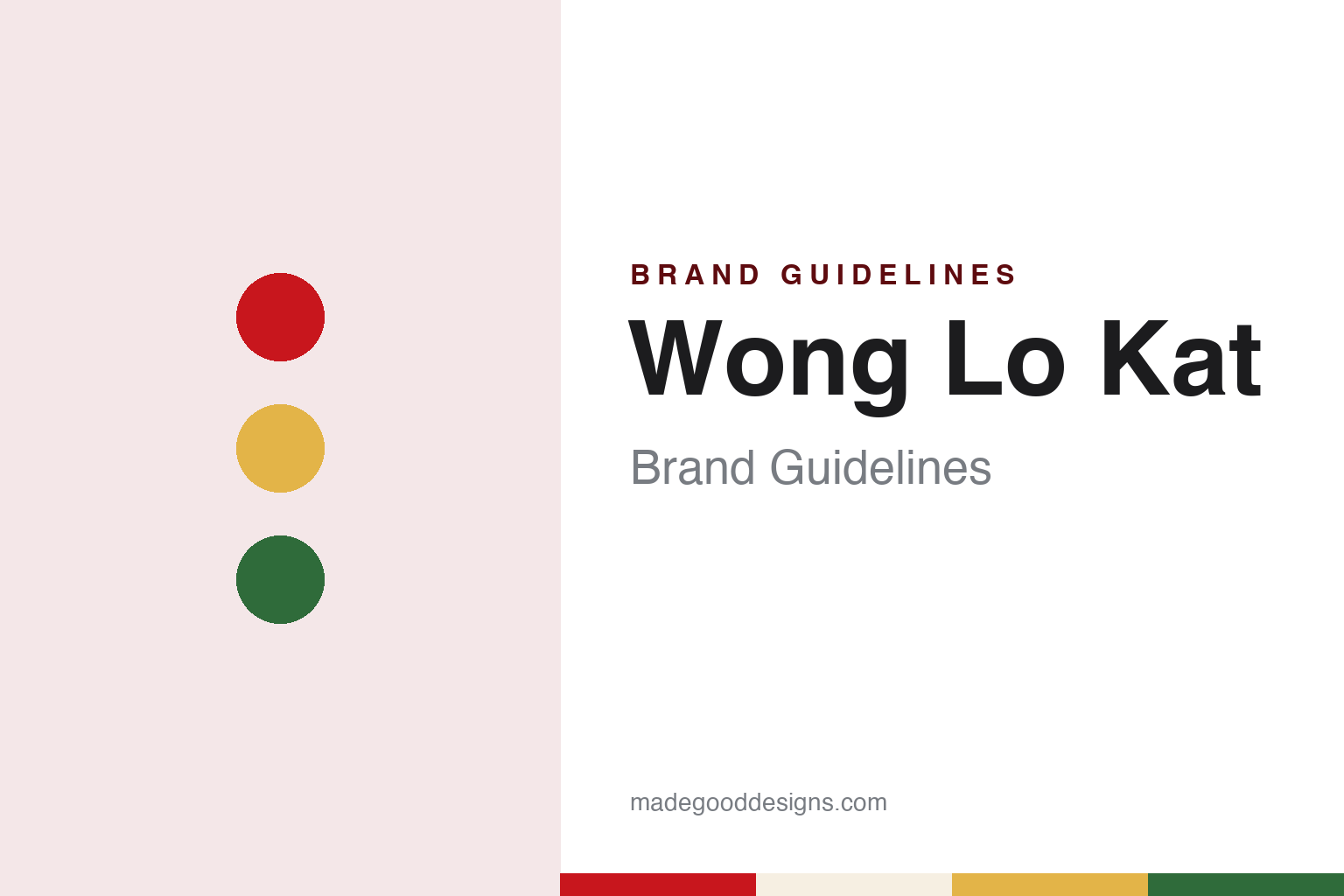
Two constants: a can red, temple gold and carton green palette and a heritage serif register. Abstract homage — not a Wong Lo Kat product or mark; no can, carton, logo or character is reproduced.
A tea shop in Guangzhou
A family recipe, a Hong Kong branch and a state factory.
Wong Lo Kat is the Cantonese spelling of 王老吉, written Wanglaoji in Mandarin pinyin. Its mainland maker, Guangzhou Wanglaoji Pharmaceutical, says the herbal tea was founded in 1828, in the Daoguang reign of the Qing dynasty, by a doctor named Wang Zebang, known in Cantonese as Wong Chat Bong. Chinese Wikipedia gives the date as “about 1828” and describes Wang as a native of Heshan in Guangdong who sold tea in Guangzhou from around 1830 and began selling packets of the dried herbs in the 1840s. The stories that attach the tea to an emperor or to the official Lin Zexu are legends, Chinese Wikipedia notes, not documented history.
The family business divided. According to Chinese Wikipedia, one branch opened a shop in Hong Kong in 1897 and registered the Wong Lo Kat gourd trademark there in 1911, while relatives kept the original shops in Guangzhou. The Hong Kong line kept the Cantonese name; the mainland line passed to the state.
After 1949 the Guangzhou business was taken into public ownership. In 1956 it was merged with seven other traditional medicine makers into a joint state-private factory that took the Wanglaoji name, because it was the largest of them, Chinese Wikipedia says. During the Cultural Revolution the factory was renamed Guangzhou Chinese Medicine Factory No. 9 in 1966 and the tea was relabelled simply “Guangdong herbal tea.” The factory became Guangzhou Yangcheng Pharmaceutical in 1982, the Wanglaoji mark was registered again in 1986, and in 1992 the state group began selling boxed Wanglaoji once more. In March 2004 the company was renamed Guangzhou Wanglaoji Pharmaceutical.
Colour
One name, two companies and a red can.
The red can that made the brand famous across China was not first made by the trademark owner. In March 1995 the state company licensed the Wanglaoji name for red paper packs and red cans of herbal tea to the Hong Kong Hung To Group, founded by the Dongguan-born businessman Chan Hung To; its subsidiary JDB (Jiaduobao) produced the cans, first in Dongguan, Chinese Wikipedia says. The Guangzhou company made its own version in green cartons, so the two products would not be confused. English Wikipedia records a licence agreement signed in 1997, renewed in 2000 to run until 2 May 2010, and two further extensions signed in 2002 and 2003 that pushed the term to 2013 and 2020. Both encyclopaedias record red-can sales growing far faster than the green carton through the 2000s.
In April 2011 Guangzhou Pharmaceutical Holdings took the dispute to the China International Economic and Trade Arbitration Commission, arguing that the two extensions were invalid because a former general manager, convicted in 2005, had taken payments around the time they were signed. On 9 May 2012 the commission ruled that the extensions were invalid and that the licence had expired on 2 May 2010, English and Chinese Wikipedia both record. JDB said it believed the term ran to 2013.
Within days the state group launched its own red can through a new subsidiary, Guangzhou Wanglaoji Great Health, set up in May 2012, using contract bottlers at first, Chinese Wikipedia says. A long run of court cases followed over advertising lines, recipes and packaging. In the packaging case, the Supreme People’s Court ruled on 16 August 2017 that both companies had made important contributions to the red-can design and could share the rights in it, provided they did not harm the legitimate interests of others. In July 2019 the same court set aside a 2018 damages judgment in the trademark case and sent it back to the Guangdong Higher People’s Court for retrial.
Typography
Design and documentation.
The seven brands in this group all make dairy products or drinks, and all of them come from China: Yili, Mengniu, Bright Dairy, Nongfu Spring, Wong Lo Kat, JDB and Tsingtao. Chinese dairy, water, herbal-tea and beer brands in general sit at many different points in the trade, from names with long local histories to companies that now belong to much larger groups or answer to many shareholders, and a single brand can be sold everywhere from a corner shop to a supermarket shelf.
A drinks or dairy brand’s identity is usually carried less by a single product than by a pack, a name and the everyday habit it promises, because the company behind the name may have changed hands, added new plants or grown far beyond the city where it started. That makes the questions behind each name worth asking plainly: who started it, who owns it now, and where its products are actually made and packed.
Each guide separates what independent sources record from what the company says about itself — its founding story, its owners over time, where its products are made and how its packaging has changed — and marks plainly what rests only on the company’s own word.
Aa
A heritage serif for a tea that counts its age in centuries. (Specimen set in Noto Serif SC, a serif STAND-IN; NOT the Wong Lo Kat logo or lettering.)
Wanglaoji
A state brand, a listed group and a new English name.
Today the Wanglaoji name belongs to the state-owned Guangzhou Pharmaceutical Holdings. Its Hong Kong- and Shanghai-listed arm, formerly Guangzhou Pharmaceutical Company, absorbed Guangzhou Baiyunshan Pharmaceutical and took the Chinese name Guangzhou Baiyunshan Pharmaceutical Holdings from August 2013, Chinese Wikipedia says. Two companies inside the group carry the name: Guangzhou Wanglaoji Pharmaceutical, which makes the boxed tea and herbal-tea granules alongside medicines, and Guangzhou Wanglaoji Great Health, which makes the red can. In 2004 Tongxing, a Hong Kong company chaired by Wang Jianyi, the Hong Kong descendant of the founder, took a 48% stake in the pharmaceutical company, equal to the state group’s, in a partnership due to run until 2014, Chinese Wikipedia says.
The English name has changed with the market. Wong Lo Kat, the old Cantonese postal spelling, stayed in use in Hong Kong and abroad, and on the red cans sold in the mainland until 2011, while the state company used Wanglaoji. English Wikipedia says the brand is now marketed internationally as Walovi; Chinese Wikipedia dates the change from 2023 and says the global renaming was finished in August 2025. In 2006 herbal tea, with Wanglaoji among the eighteen brands named, was added to China’s national list of intangible cultural heritage, Chinese Wikipedia says.
Outside the mainland the picture remains split. In September 2025 JDB said its affiliate Multi Access had won cases in the Federal Court of Canada and the EU General Court and that its Wong Lo Kat marks remained valid in more than sixty overseas territories; Guangzhou Pharmaceutical replied that it had registered Wanglaoji and Walovi marks in more than a hundred countries and regions, Chinese Wikipedia records.
For a design guide, Wong Lo Kat shows how a colour can outlive a licence: since 2017 China’s highest court has treated the red-can design as shared by two companies selling under two names. Compare JDB, which made the red can until 2012, and Wahaha, another Chinese drinks brand built on mass distribution. For this guide we use can red, temple gold and carton green with a serif, an unofficial interpretation; no product or logo is reproduced.
Explore & save
Keep Wong Lo Kat’s identity on hand — save it to a board in the Made Good inspiration library.
Wong Lo Kat identity set
Pin the Wong Lo Kat can red, temple gold and carton green palette and the heritage serif register to your own board.