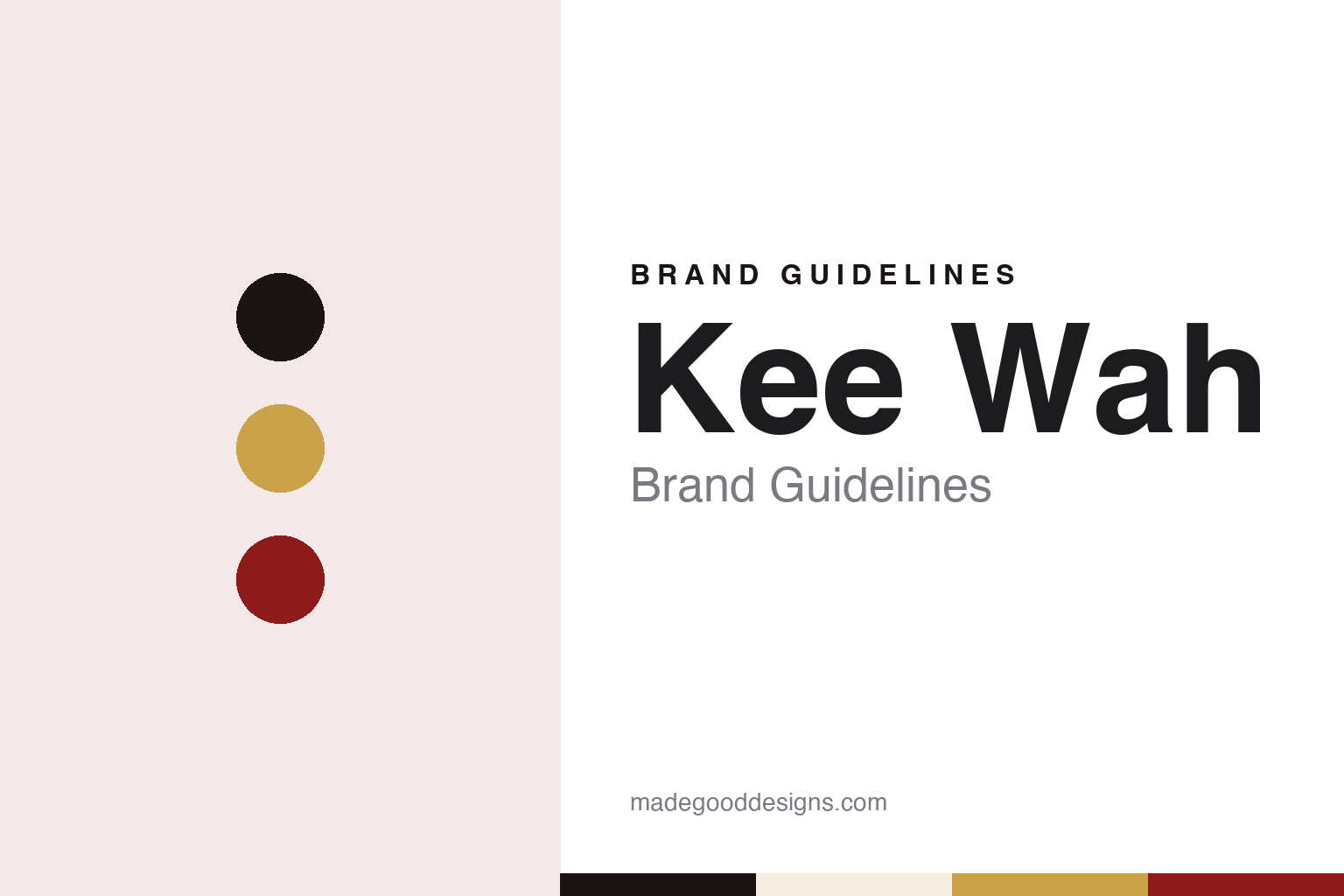
Kee Wah Brand Guidelines
The 1938 Hong Kong mooncake and bridal cake bakery.
Aa
Two constants: a Kee Wah black, gold and red palette and a classic serif register. Abstract homage — not a Kee Wah product or mark; no tin, logo or pastry is reproduced.
Shanghai Street
A grocery store and a barrel oven.
Kee Wah — 奇華 in Chinese — began in 1938 as a small neighbourhood grocery store on Shanghai Street in Yau Ma Tei, Kowloon, founded by Wong Yip Wing (黃業榮), according to the company and to English and Chinese Wikipedia. Chinese Wikipedia says the shop sold sweets and general goods and traded at first as Kee Wah Food Company.
The bakery came out of the war. The company says that during the Japanese occupation of Hong Kong, from 1941 to 1945, Wong and his staff fashioned an oven out of an old barrel and made white sugar cakes and almond biscuits from the few ingredients they had, selling them to their neighbours. English Wikipedia’s version, citing the company’s earlier history page, has an employee baking with simple tools and an old oil barrel and selling pastries to the boat dwellers of the harbour. The company’s 2017 timeline dates its first outlet with an on-site bakery to 1944, and Chinese Wikipedia says that in that year Wong opened a branch with a factory on Shanghai Street under the name Kee Wah Bakery, turning to traditional Chinese pastries.
The products it is known for followed quickly. The 2017 timeline dates the launch of mooncakes, Chinese bridal cakes and pastries to 1946, and the company’s current history says that after the war it opened its first factory, on Shanghai Street, with 10 staff. In 1950, it says, it introduced a “Guaranteed Exchange” return policy and replaced its delivery tricycle with a truck, and in 1962 it opened a second store, on Pei Ho Street in Sham Shui Po.
Colour
Ovens, egg rolls and a factory.
Kee Wah tells its growth through equipment. The company says it replaced its wood-burning stoves with electric ovens in 1971, and in 1980 brought in machinery to make individually packaged cakes and pastries, launching its egg rolls the same year, when the Pei Ho Street site was rebuilt as Goodwin Mansion. It went abroad in the 1980s: the company dates its first overseas bakery, in Taipei, to 1982, and its first American bakery, in Los Angeles, to 1984; English Wikipedia dates the California business to 1985.
In 1988, its fiftieth year, the company opened the Kee Wah Industrial Building on Castle Peak Road in Cheung Sha Wan, a factory and office that it still describes as its international headquarters; its 2017 timeline said the new plant meant all products were freshly made in Hong Kong. By then, the company says, it had 250 employees across 14 stores in Hong Kong, Taiwan and Los Angeles. A second plant, in the Tai Po Industrial Estate, began production in 2009, according to the company; Chinese Wikipedia dates the first phase to 2010.
Where the products are made is the company’s own claim. Kee Wah says “all Kee Wah products are proudly made in Hong Kong at our primary factory in Tai Po,” which it describes as certified to ISO 22000 and HACCP, and it adds that many products are still made at the Castle Peak Road site. Its range runs from mooncakes and Chinese bridal cakes to classics such as egg rolls, walnut cookies, winter melon pastries and panda cookies, alongside Chinese tea, seasonal gifts and Western-style snacks.
Typography
Hong Kong’s bakeries and food makers.
The seven brands in this group all make food, and all of them come from Hong Kong or Singapore: Garden, Kee Wah, Maxim’s, Bee Cheng Hiang, Koon Chun, Kowloon Dairy and Wing Wah. Food brands from the two cities in general sit at many different points in the trade, from family firms that still carry a founder’s name to names that now belong to much larger groups, and a single brand can be sold everywhere from a neighbourhood shop to an airport counter.
A food brand’s identity is usually carried less by a single product than by a pack, a name and the meal, gift or festival it promises, because the company behind the name may have changed hands, moved its kitchens or grown far beyond the street where it started. That makes the questions behind each name worth asking plainly: who started it, who owns it now, and where its food is actually made and packed.
Each guide separates what independent sources record from what the company says about itself — its founding story, its owners over time, where its food is made and how its packaging has changed — and marks plainly what rests only on the company’s own word.
Aa
A classic serif for a pastry house. (Specimen set in Noto Serif, a serif STAND-IN; NOT the Kee Wah logo.)
Kee Wah
A new look in the 1990s.
The identity Kee Wah uses today dates from the mid-1990s, and the sources give two years. The company’s current history says the original logo “underwent a redesign in 1995.” Its 2017 timeline says that in 1997 the business passed to the second generation and that Kevin S. Wong engaged the graphic designer Suen Siu Wah to overhaul the corporate identity, product packaging, shop interiors and staff uniforms. Chinese Wikipedia dates the handover to 1995, credits Suen together with the designer Yeung Chi-chiu (楊志超), and says mooncake packaging moved from paper boxes printed with classical female figures to black metal tins.
Advertising followed the packaging. The company says the actor Eric Tsang became its image ambassador in 2000, and that the Taiwanese actress Annie Liu became the face of its bridal cakes in 2005, the year its first mainland outlet opened, in Shenzhen. In 2004 it launched Kee Wah Gifts, a souvenir range with artwork by the Hong Kong artist Ah-Chung (Yim Yee King), and opened its first shop at Hong Kong International Airport. A Guangzhou store with on-site baking followed in 2010 and a Shanghai store in 2013.
Collaboration is part of the brand. English Wikipedia, citing Jing Daily (2012), says the Hong Kong lifestyle store G.O.D. worked with Kee Wah in 2008 on bottom-shaped mooncakes in eight designs, still filled with white lotus seed paste and salted yolks. In 2012 the company opened a nostalgia-themed shop in the “Old Hong Kong” area of Ocean Park, and from 2017 it opened the Kee Wah Tearoom, a flagship store and the Kee Wah Studio in a Grade III historic building in Wan Chai, it says. Its online shop also sells Disney and LINE FRIENDS collections.
Kee Wah Bakery Limited remains a family business, the company says, managed by the founder’s children and grandchildren, with about 100 stores and more than 2,000 employees; Chinese Wikipedia lists shops in Hong Kong, mainland China, Taiwan, Los Angeles, San Francisco and Singapore.
For a design guide, Kee Wah shows how a bakery can modernise festival packaging without letting go of the festival. Compare Garden, the Hong Kong bakery founded in 1926, and Wing Wah, another Hong Kong name in mooncakes and wedding cakes. For this guide we use black, lotus gold and a lacquer red with a serif, an unofficial interpretation; no product or logo is reproduced.
Explore & save
Keep Kee Wah’s identity on hand — save it to a board in the Made Good inspiration library.
Kee Wah identity set
Pin the Kee Wah black, gold and red palette and the classic serif register to your own board.