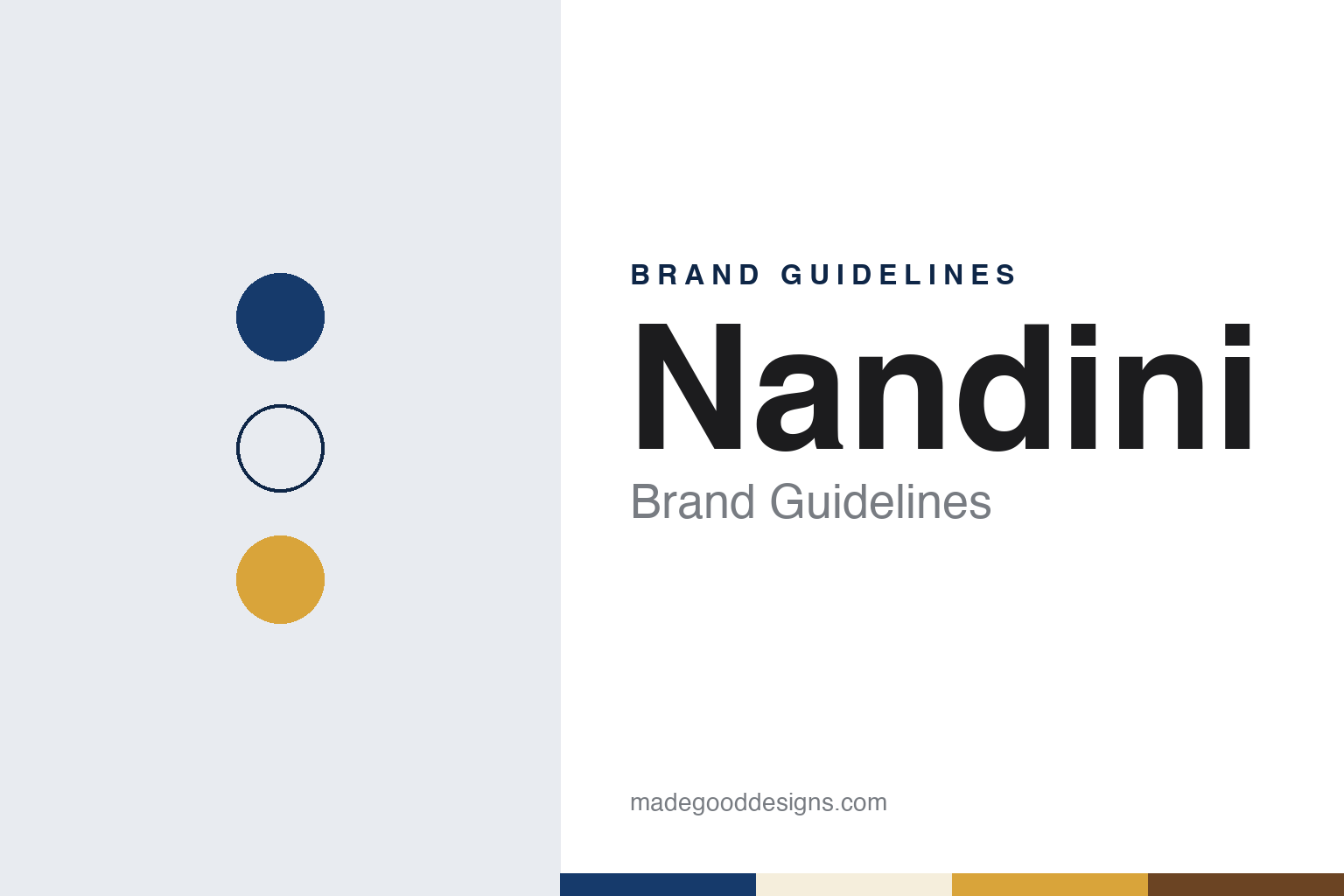
Nandini Brand Guidelines
The farmers’ co-operative brand that Karnataka treats as its own.
Aa
Two constants: a Nandini deep blue, cream and ghee gold palette and a rounded sans register. Abstract homage — not a Nandini product or mark; no pack, parlour or logo is reproduced.
Kudige, 1955
A pasteurisation scheme in Coorg and a World Bank project.
Nandini is not a company but a brand name shared by a federation of farmers’ co-operatives. It belongs to the Karnataka Co-operative Milk Producers’ Federation Limited, known as KMF, the apex body of the dairy co-operative movement in Karnataka, which sells milk and milk products from its member unions under the one name.
Its roots lie in a small town in the coffee hills. The Hindu reported in February 2025 that the first dairy co-operative behind KMF was started in 1955 at Kudige, in Kodagu district — then the separate state of Coorg. A plaque in the old building still records a “Milk Pasteurisation Scheme” inaugurated on 24 July 1955 by Lieutenant-Colonel Daya Singh Bedi, then Chief Commissioner of Coorg. A.S. Premnath, a former managing director of KMF who grew up in Kudige, told the paper that “Coorg Ghee” was once a sought-after product, like Coorg coffee and honey. The old dairy now lies derelict under the Hassan milk union, a member of KMF, with a modern plant about 500 metres away.
The federation itself came out of a larger project. KMF says the Karnataka Dairy Development Corporation (KDDC), the country’s first dairy development programme funded by the World Bank and its International Development Association, began organising village dairy co-operatives in 1974; another page of its 2016 website dates the formation of KDDC to 1975. Premnath told The Hindu that the KDDC was founded in 1974 and the World Bank-assisted project began in 1975, first covering Mysuru, Hassan, Tumakuru and Bengaluru districts. English Wikipedia and Premnath date the renaming as KMF to 1984; KMF’s own 2016 history said the apex body took shape in 1983.
Colour
The Anand pattern, adopted in the south.
The structure was borrowed from Gujarat. KMF says the “AMUL pattern” of dairy co-operatives began in Karnataka in 1974–75 with finance from the World Bank and from Operation Flood II and III, the national dairy programme. Its chairman, Bheema Naik, described the same three-tier Anand pattern to The Hindu in 2025: dairy co-operative societies in the villages, milk unions at district level, and the federation at state level. According to KMF’s 2016 history, the work began in eight southern districts, and Operation Flood II and III, from 1984 and 1987, carried it across the rest of the state.
The division of labour shapes the brand. Village societies collect the milk; district milk unions process it and sell liquid milk in their own areas; and the federation co-ordinates the unions and organises the marketing of milk products inside and outside Karnataka, all under the common name Nandini, KMF says. The number of unions has grown over time — 13 in KMF’s 2016 history, 14 on its 2016 “about” page, 15 in The Hindu’s 2025 report and 16 in English Wikipedia. KMF describes itself as the second-largest dairy co-operative in India; Wikipedia gives it the same rank, after Amul.
The range runs from pasteurised and toned milk, curd and buttermilk to ghee, butter, paneer, milk powder and chocolates, with milk sweets such as Mysore Pak; the long-life milk sold as Goodlife is part of it. The federation also runs its own units, which on its 2016 website included a product plant at Channarayapatna, an ice-cream plant at Bellary and a plant making packaging film. Milk is sold door to door through agents and through franchised Nandini milk parlours at bus stands, railway stations and roadside shops, English Wikipedia says.
Typography
Dairies and documentation.
The seven brands in this group all make food, and all of them come from India: Bikaji, Lijjat, Mother Dairy, Nandini, Aashirvaad, Kissan and Ching’s Secret. Indian food brands in general sit at many different points in the trade, from family firms and cooperatives to names that now belong to much larger food groups, and a single brand can be sold everywhere from a neighbourhood kirana shop to a supermarket shelf.
A food brand’s identity is usually carried less by a single product than by a pack, a name and the meal or snack it promises, because the company behind the name may have changed hands, moved its factory or grown far beyond the town where it started. That makes the questions behind each name worth asking plainly: who started it, who owns it now, and where its food is actually made and packed.
Each guide separates what independent sources record from what the company says about itself — its founding story, its owners over time, where its food is made and how its packaging has changed — and marks plainly what rests only on the company’s own word.
Aa
A rounded sans with Kannada support — our register for a Karnataka co-operative brand. (Specimen set in Baloo Tamma 2, a sans STAND-IN; NOT the Nandini logo.)
Nandini
Film stars, cricket and a name worth defending.
Nandini’s advertising has leaned on Kannada cinema. English Wikipedia says the actor Rajkumar served as brand ambassador free of charge and made his first and last television advertisement for it in 1996, and that Puneeth Rajkumar signed an agreement with KMF in December 2009, also without a fee; in 2014 the actor Shriya Saran was chosen to promote Nandini Goodlife in Tamil Nadu, Kerala, Telangana and Andhra Pradesh. In 2024, The Hindu reported, Nandini sponsored the Scotland and Ireland teams at the ICC Men’s T20 World Cup.
The brand has also moved into new formats and markets. Wikipedia records a high-end Nandini ice-cream parlour at Mantri Mall in Malleshwaram, Bengaluru, from August 2021; a restaurant chain, Nandini Cafe Moo, launched in Bengaluru in 2021, with a first branch abroad in Dubai in 2023; and exports to Australia, the United States and Saudi Arabia. The Hindu reported in 2025 that KMF had extended its presence to Delhi.
The name carries weight beyond the dairy aisle. In April 2023, ahead of state assembly elections, Hindustan Times reported a political row over Amul’s entry into the Bengaluru market, describing Nandini as closely tied to Kannadiga identity; opposition Congress leaders attacked the BJP-led state government, which said there was no proposal to merge Amul and KMF. In January 2026, the New Indian Express reported, the Madras High Court ruled for KMF in a trademark dispute with an incense maker that had sought to register “Nandini” for agarbattis, holding the word phonetically identical and the rival mark written in the same style as KMF’s, and setting aside a 2010 order of the Deputy Registrar of Trademarks.
For a design guide, Nandini shows how one shared name can unite many local co-operatives and become part of a region’s identity. Compare Amul, the Gujarat co-operative whose Anand pattern KMF adopted, and Mother Dairy, the Delhi dairy of the same Operation Flood era. For this guide we use deep blue, cream and ghee gold with a rounded sans, an unofficial interpretation; no product or logo is reproduced.
Explore & save
Keep Nandini’s identity on hand — save it to a board in the Made Good inspiration library.
Nandini identity set
Pin the Nandini deep blue, cream and ghee gold palette and the rounded sans register to your own board.