Kissan Brand Guidelines
A 1934 jam and ketchup brand named for the farmer.
Aa
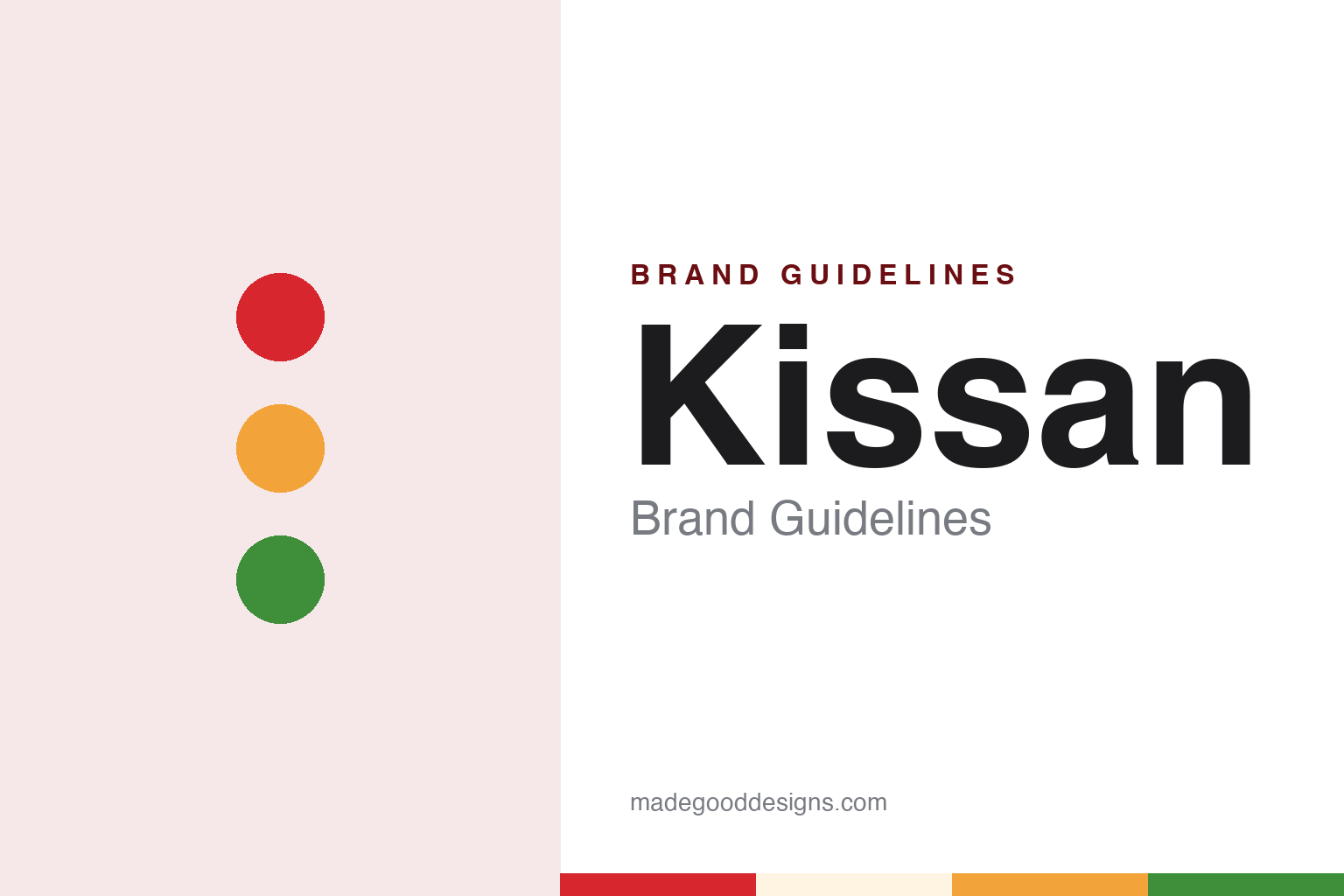
Two constants: a tomato red, mango and leaf green palette and a rounded friendly sans register. Abstract homage — not a Kissan product or mark; no pack, logo or bottle is reproduced.
A fruit stop on the Punjab line
The farmers’ brand, by its own account.
The story Kissan’s owner tells about the brand begins on the railway. Hindustan Unilever (HUL), which owns the brand today, says Kissan started in 1934. Its account, repeated on the Kissan website, goes like this: in the British era, trains passing through Punjab stopped at a processing unit where farmers sold freshly picked fruit, locals called the spot Kissan, and from there the name became a household one. The company does not name the people who set up that processing unit.
The word itself is the point. Kisan is the Hindi word for a farmer, and the brand has made that connection explicit. The Kissan website said in 2020 that the brand is called Kissan “because of the dedicated Kisans of India,” and that its commitment is to stand by them. The same page described the brand’s early years as a story of new food formats for Indian kitchens, such as canned fruits and vegetables and baked beans, before the range settled into the products it is known for now.
Those products are a short, steady list. On HUL’s brand pages and the Kissan website, Kissan has long meant jams, tomato ketchup and squashes. In 2020 the Kissan site listed mixed-fruit, pineapple and mango jams and an orange marmalade; a fresh tomato ketchup, a chilli tomato sauce, a sweet and spicy sauce and a no-onion, no-garlic tomato sauce; a peanut butter; and lemon, grape, mango and orange squashes. HUL said in 2012 that Unilever had launched the category of ketchups and jams in India under the Kissan name, and that the range had grown to include a mayonnaise-based Kissan Creamy Spread blended with Indian flavours.
Colour
Mitchell Bros., the UB Group, Brooke Bond and HUL.
Kissan has had three owners since 1950. The first documented sale came in 1950. The Kissan website said in 2020 that the UB Group, then under Vittal Mallya, acquired Kissan from Mitchell Bros. in that year. English Wikipedia’s article on Vittal Mallya gives the same date, saying the group’s move into food products started with the acquisition of Kissan Products in 1950, and adds that Mallya’s path onto the board of Cadbury India, which he later chaired, ran through Cadbury Schweppes, described as international associates of Kissan Products. Wikipedia’s article on the United Breweries Group likewise marks the group’s expansion into agro-based industries by Mallya’s purchase of Kissan Products.
Kissan stayed with the UB Group for more than four decades. Then, in 1993, it moved into the Unilever family. HUL’s corporate history, as published on its website in 2009, says that in 1993 Brooke Bond — the tea company whose Indian presence dated back to 1900 and which had joined Unilever in 1984 through an international acquisition — acquired the Kissan business from the UB Group, in the same year that it bought the Dollops ice-cream business from Cadbury India. It was part of a run of food and beverage deals in the early 1990s, which also included the Kothari General Foods instant-coffee business in 1992.
Two mergers then brought Kissan into Hindustan Unilever itself. In 1994, HUL’s history says, Brooke Bond India and Lipton India merged to form Brooke Bond Lipton India Limited, and that company in turn merged with Hindustan Lever, as HUL was then called, with effect from 1 January 1996. HUL describes Kissan today as an integral part of the company. The Kissan name has also been used beyond jams: English Wikipedia’s HUL article says the company’s Annapurna salt and atta were formerly known as Kissan Annapurna.
Typography
Design and documentation.
The seven brands in this group all make food, and all of them come from India: Bikaji, Lijjat, Mother Dairy, Nandini, Aashirvaad, Kissan and Ching’s Secret. Indian food brands in general sit at many different points in the trade, from family firms and cooperatives to names that now belong to much larger food groups, and a single brand can be sold everywhere from a neighbourhood kirana shop to a supermarket shelf.
A food brand’s identity is usually carried less by a single product than by a pack, a name and the meal or snack it promises, because the company behind the name may have changed hands, moved its factory or grown far beyond the town where it started. That makes the questions behind each name worth asking plainly: who started it, who owns it now, and where its food is actually made and packed.
Each guide separates what independent sources record from what the company says about itself — its founding story, its owners over time, where its food is made and how its packaging has changed — and marks plainly what rests only on the company’s own word.
Aa
A rounded friendly sans for a jam and ketchup brand that talks to children. (Specimen set in Baloo 2, a sans STAND-IN; NOT the Kissan logo.)
Kissan
“100% Real”, Kissanpur and tomato farms.
Under HUL, Kissan’s communication has been aimed at children and their mothers. HUL described the brand in 2012 as being about kids eating happily and growing up happily, and said it had launched a Kissan 100% Real campaign built on the company’s statement that its jams and ketchups are made from real fruit and tomatoes. The pack range of the period included squeezable Jam Squeezee bottles in flavours such as mango, pineapple and strawberry.
The brand then took the “real” idea outdoors. In 2013 HUL described a programme called Kissanpur, a world the brand had created to get children away from screens and into nature; it said almost 80,000 children had taken part the year before, and that Kissanpur 2 would spend three months helping children grow tomatoes at home, from sowing the seeds to tending the saplings.
The farmer in the name has also become the brand’s sourcing story. The Kissan website said in 2020 that a public–private partnership between HUL and the government of Maharashtra for the sustainable sourcing of tomatoes began in 2012 and became self-sustaining in 2015, with HUL offering farmers a buy-back guarantee and advice on seeds, irrigation and cultivation. It said that around 8,000 farmers across India grew tomatoes for HUL in 2019, and that 76% of the tomatoes used in Kissan ketchup that year came from sustainable sources. The company also says its other ingredients come from farms across India, naming oranges from Nagpur, pineapples from Kerala, grapes from Karnataka and peanuts from Gujarat.
For a design guide, Kissan shows how a single word — the Hindi for farmer — can carry a brand from a Punjab fruit stop to a national ketchup and jam label. Compare Hellmann’s, its Unilever stablemate in sauces, and Maggi, Nestlé’s sauce and noodle brand. For this guide we use tomato red, a mango orange and a leaf green with a rounded sans, an unofficial interpretation; no product or logo is reproduced.
Explore & save
Keep Kissan’s identity on hand — save it to a board in the Made Good inspiration library.
Kissan identity set
Pin the Kissan tomato red, mango and leaf green palette and the rounded friendly sans register to your own board.