Ching’s Secret Brand Guidelines
The Mumbai sauce brand that named its own cuisine Desi Chinese.
Aa
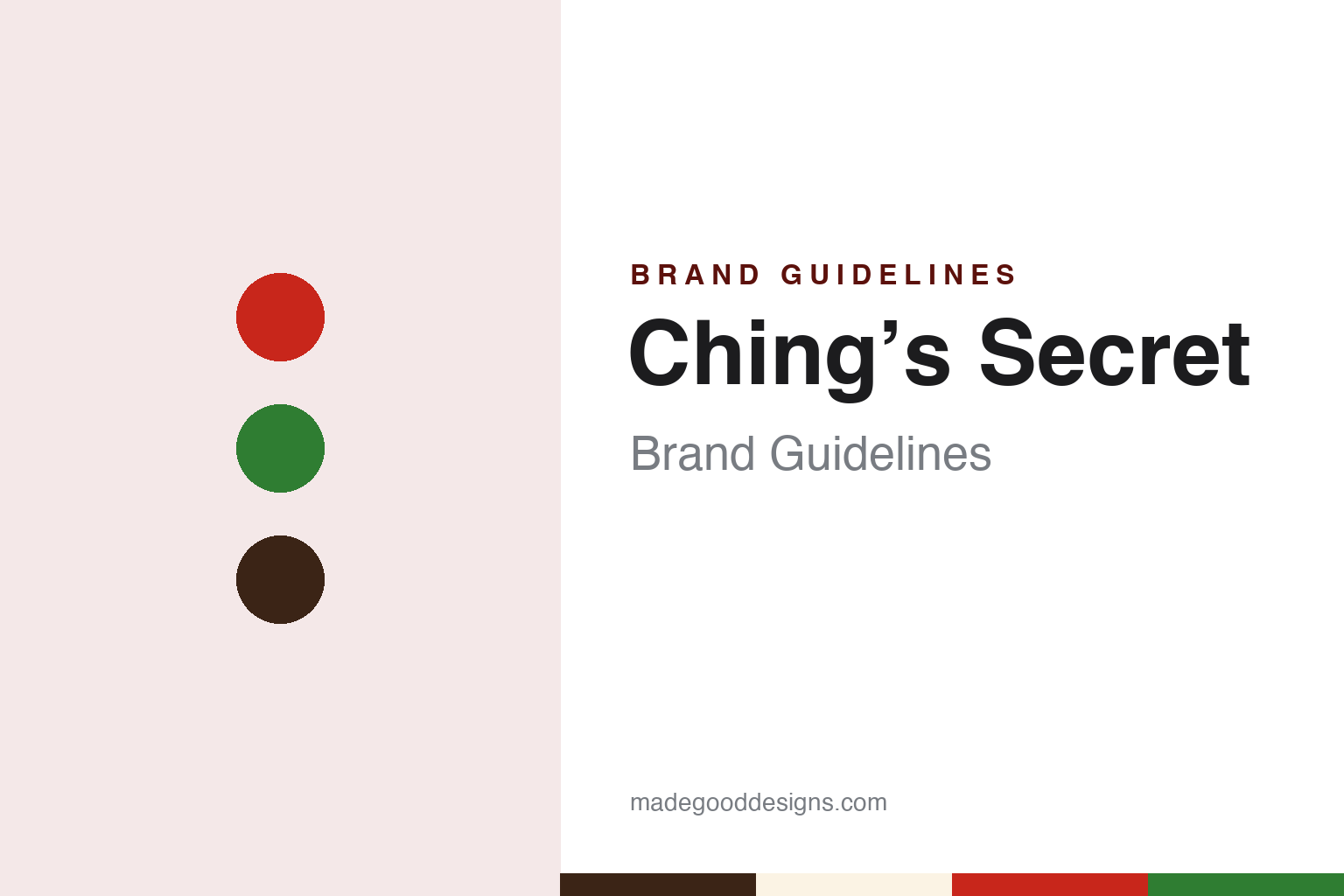
Two constants: a chilli red, green chilli and soy brown palette and a bold street-food sans register. Abstract homage — not a Ching’s Secret product or mark; no pack, bottle or logo is reproduced.
Three bottles of sauce
An adman, a Mumbai company and a cuisine with no brand.
Ching’s Secret belongs to Capital Foods, a Mumbai company founded by Ajay Gupta. The company dates itself to 1996, and English Wikipedia gives the same year for the brand. According to the company’s own account of its founder, Gupta had set up an advertising agency, Forefront, while still in college and worked on a campaign for a rice brand in the United States before turning to food. The private company that now carries the Capital Foods name was registered in Maharashtra in 2003, according to the corporate identity printed on its website.
The idea, as the company tells it, came from Gupta predicting the popularity of Chinese food in India — the cuisine known as Indian Chinese, which the company later branded Desi Chinese. Capital Foods says Ching’s Secret started in 1996 with soy sauce, green chilli sauce, red chilli sauce and chilli vinegar, the chilli vinegar sold with a real green chilli inside the bottle. When Tata Consumer Products announced its purchase of the company in 2024, Gupta described the brand’s growth as a journey from “3 bottles of sauces” to an entire Desi Chinese cuisine block, Business Today reported.
Gupta launched a second brand alongside it. Smith & Jones, which Capital Foods says began with a ginger-garlic paste in 1996, covers Italian and other Western dishes cooked at home, and it later added pasta masalas and a pizza ketchup. Capital Foods calls the two its umbrella platform brands.
Colour
Hakka noodles, Schezwan Chutney and a pack for every street dish.
Noodles came next. Capital Foods says that in 1998 it named its packaged noodles Hakka to set them apart from loose, unbranded noodles, and it calls itself the first company to sell branded Hakka noodles in India. Its timeline then adds a product almost every year or two: instant noodles in Desi Chinese flavours in 2008, blended masalas for dishes such as Schezwan fried rice in 2010, single-serve soups in five flavours in 2013 and, also in 2013, Schezwan Chutney, a garlic and Sichuan-pepper paste sold as a dip, spread and cooking ingredient. The company says it created that category; a no-onion, no-garlic Jain version followed in 2023, alongside a green Dragon Fire Chutney in 2022 and a Sriracha-style green chilli sauce in 2023.
The phrase Desi Chinese became the brand’s organising idea. CNBC-TV18, in a 2018 report on why Ching’s Secret had become synonymous with the cuisine, and English Wikipedia both date the company’s push to make Desi Chinese its own category to 2015. The brand’s slogan, on Capital Foods’ website, is “I love, you love, we all love Desi Chinese!”, and its product pages there carry short taglines in a mix of Hindi and English.
Advertising made the name famous. Capital Foods says the actor Ranveer Singh became the brand’s ambassador in 2014, appearing as “Ranveer Ching” in a music-video advertisement, afaqs! reported. In August 2016 the brand followed it with Ranveer Ching Returns, a short action-comedy film of about five and a half minutes directed by Rohit Shetty, made with Yash Raj Films and co-starring Tamannaah Bhatia. It opened on 19 August 2016 in cinemas and on YouTube, with a television premiere on Sony Entertainment Television and dubbed versions in Tamil, Telugu, Kannada and Malayalam, afaqs! reported; Gupta told the magazine it was the most expensive advertising film ever made. Singh played two parts, Ranveer Ching and his mother, “Maa Ching”, a character Gupta said was added at the actor’s suggestion.
Typography
Design and documentation.
The seven brands in this group all make food, and all of them come from India: Bikaji, Lijjat, Mother Dairy, Nandini, Aashirvaad, Kissan and Ching’s Secret. Indian food brands in general sit at many different points in the trade, from family firms and cooperatives to names that now belong to much larger food groups, and a single brand can be sold everywhere from a neighbourhood kirana shop to a supermarket shelf.
A food brand’s identity is usually carried less by a single product than by a pack, a name and the meal or snack it promises, because the company behind the name may have changed hands, moved its factory or grown far beyond the town where it started. That makes the questions behind each name worth asking plainly: who started it, who owns it now, and where its food is actually made and packed.
Each guide separates what independent sources record from what the company says about itself — its founding story, its owners over time, where its food is made and how its packaging has changed — and marks plainly what rests only on the company’s own word.
Aa
A bold street-food sans for a brand built on restaurant dishes. (Specimen set in Rubik, a sans STAND-IN; NOT the Ching’s Secret logo.)
Ching’s Secret
Private investors, three plants and a Tata parent.
Business Today reported in January 2024 that its investors included the private-equity firm General Atlantic, which had bought a stake in 2018. On 12 January 2024 Tata Consumer Products, the Tata group’s food and beverage company, announced definitive agreements to buy all of Capital Foods in phases: 75% of the shares upfront and the remaining 25% within three years, according to its stock-exchange filing as reported by Business Today. On the same day Tata Consumer announced a separate deal for the herbal-tea company Organic India. Tata Consumer described Ching’s Secret as a leader in Desi Chinese chutneys, blended masalas, sauces and soups, and said Capital Foods held first or second place in five large categories. Capital Foods now describes 2024 as the year it was acquired by Tata Consumer Products, and Tata Consumer lists Ching’s Secret and Smith & Jones among its food brands.
Gupta is still named on Capital Foods’ website as founder, chairman and managing director. The company says its products are made in its own automated plants at Nashik in Maharashtra and at Kandla and Vapi in Gujarat; that is the company’s account of its manufacturing. It also says it exports Ching’s Secret to Indian communities abroad, in North America, Europe, the Gulf, Africa, Southeast Asia and Australasia. The brand’s consumer website, chingssecret.com, carries recipes rather than corporate information.
For a design guide, Ching’s Secret shows how a brand can name a cuisine and then make its packs, its slogans and even a short film around that name. Compare Tata Tea, its sister brand at Tata Consumer Products, and Lao Gan Ma, the Chinese chilli-sauce brand. For this guide we use a chilli red, a green chilli and a soy brown with a bold sans, an unofficial interpretation; no product or logo is reproduced.
Explore & save
Keep Ching’s Secret’s identity on hand — save it to a board in the Made Good inspiration library.
Ching’s Secret identity set
Pin the Ching’s Secret chilli red, green chilli and soy brown palette and the bold street-food sans register to your own board.