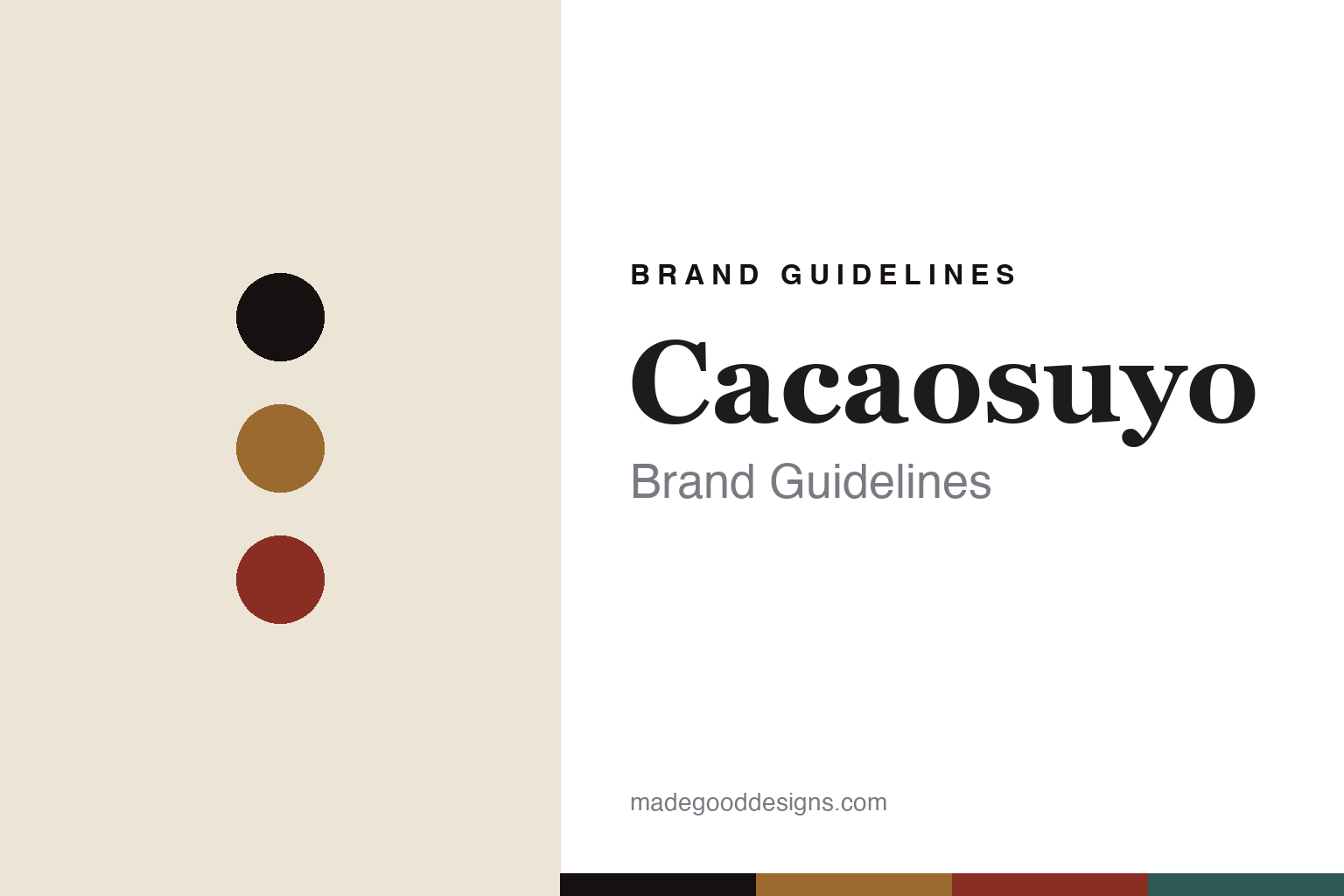
Cacaosuyo Brand Guidelines
The secret of the Incas.
Aa
Two constants: an Inca-gold-and-red palette and a heritage serif register. Abstract homage — not the Cacaosuyo packaging.
The secret of the Incas
Cacaosuyo built Andean heritage into every part of the design.
Cacaosuyo is a lesson in heritage as identity. Founded in 2012 in Lima by a Peruvian team, it is an independent, multi-award-winning maker whose whole identity is rooted in the Andes — its own tagline calls it “the best-kept secret of the Incas.”
Its identity is Andean heritage, expressed in design: a custom display typeface literally named AndesNeue, pre-Columbian geometric ornament and gold, and a name that carries the story — Cacaosuyo joins cacao with suyo, the Quechua word for a region of Tahuantinsuyo, the Inca empire. The bars are award-winning single origins — Piura Select, Chuncho, Lakuna — led by Piura Milk, named the world’s best milk chocolate at the International Chocolate Awards.
(Honest notes: the house dates itself to 2012, so we don’t say 2014. We don’t name individual founders as fact, describing it as a Lima-based team (its documented chocolate maker is Gladys Ramos), and it should not be confused with any large conglomerate — it reads as independent. “Piura Blanco” is a cacao variety, not a bar (the bar is Piura Select). There’s no official brand hex, so these tones are an unofficial interpretation.)
Colour
Cacaosuyo lives in an Inca-gold-and-red palette. Click a swatch to copy the hex.
Cacaosuyo’s identity is heritage, warm and Andean — an Inca gold, an ink, an Andean red, a jade, and a sand. The palette pairs an Inca gold with an Andean red — the register of pre-Columbian ornament. It signals heritage and craft rather than novelty. The honest caveat: with no published brand hex, these tones are an original, unofficial interpretation, not first-party values.
The lesson is a gold with an Andean red signals pre-Columbian heritage. Cacaosuyo’s world is the Andes, translated to a wrapper. For designers, it is a reminder that a gold-and-red palette with geometric ornament reads as heritage and premium — right for an origin-country maker. The takeaways: build the heritage into the type (a custom face); carry the story in the name; use gold and ornament with intent; and treat any single hex as unofficial.
Typography
The register is a heritage serif — elegant, ancient, Andean.
Cacaosuyo’s identity carries an elegant, ancient, Andean spirit — a pre-Columbian pattern and an Inca-empire name. A heritage serif captures the mood: it is inscriptional and dignified, the register of an ancient culture. Set in an Inca-gold-and-red palette, the heritage serif feels elegant and ancient — exactly the personality Cacaosuyo carries. It is dignified rather than loud, mirroring a gilded, ornamented wrapper. (Cacaosuyo’s real packaging and custom type are works we describe but do not reproduce, and the exact typeface is not ours to use.) Because it is not ours to use, the honest description is “a heritage serif spirit,” shown here in a stand-in. The type behaves like the brand: elegant, ancient and Andean.
Aa
A heritage serif spirit — elegant and ancient. (Specimen set in Marcellus, an inscriptional serif STAND-IN; NOT the Cacaosuyo packaging.)
Heritage as identity
Cacaosuyo stands for the Andes in a bar.
Cacaosuyo is a lesson in making heritage the identity. An Inca-gold-and-red palette, a heritage serif and a custom Andean typeface make pre-Columbian culture the whole brand — elegant, ancient, Andean. The heritage is the differentiator. The differentiator is an origin-country, Inca-rooted identity.
For designers and brand-builders, Cacaosuyo offers a clear takeaway: let a real heritage design the brand. The lessons: build the culture into the type (AndesNeue); carry it in the name (the four suyus); win on the product (world-best awards); and be honest about the story. It is also a reminder to stay accurate: it’s from 2012, it’s an independent Lima team, and the palette here is an unofficial interpretation. Cacaosuyo made Andean heritage the brand — proof that a real culture can be the difference.
Explore & save
Keep Cacaosuyo’s identity on hand — save it to a board in the Made Good inspiration library.
Cacaosuyo identity set
Pin the Inca-gold-and-red palette and the heritage-serif register to your own board.