Rathfinny Brand Guidelines
The Drivers’ Alfriston estate and its “Sussex Origin” shield.
Aa
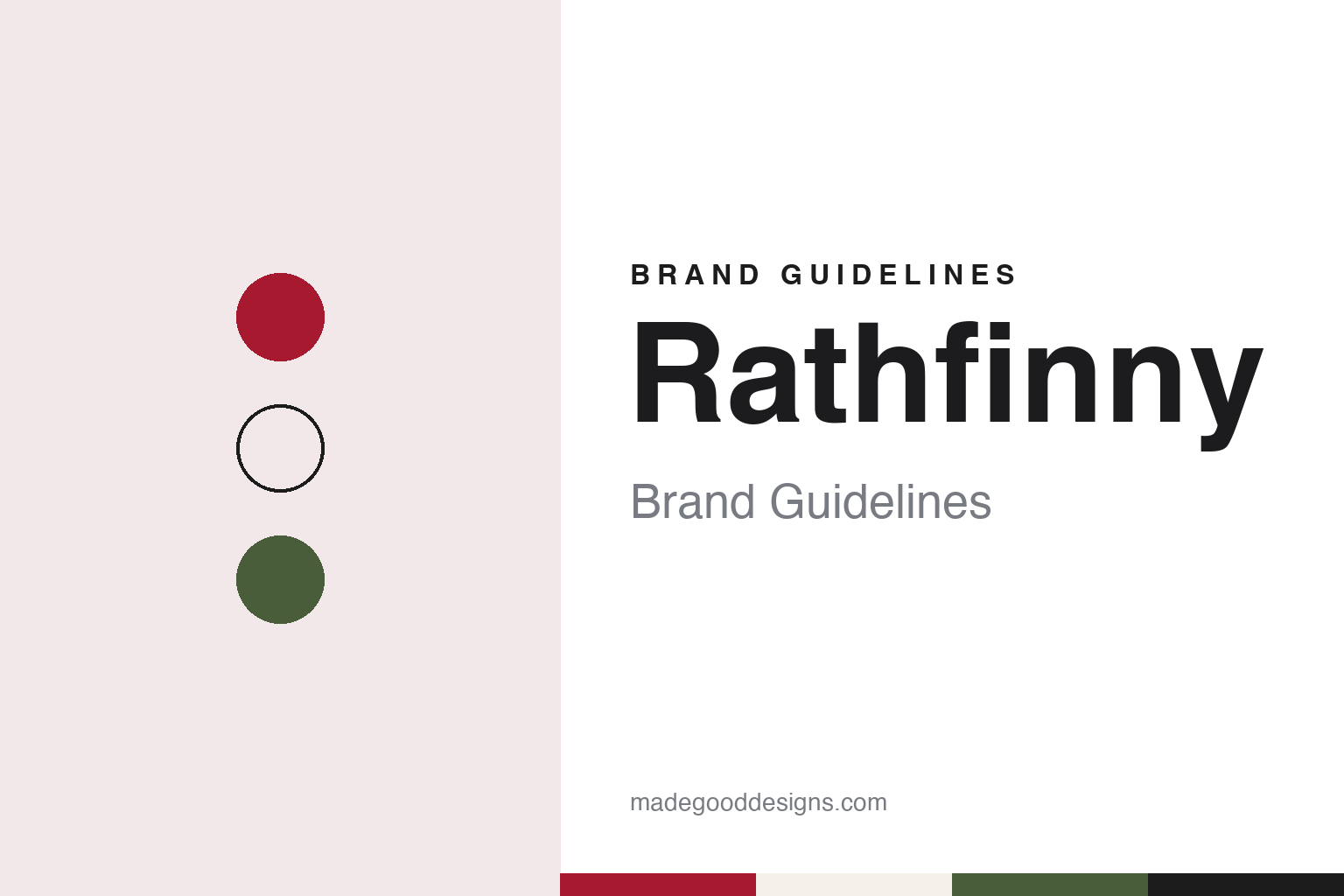
Two constants: a shield red, chalk white and Downland green palette and a humanist sans register. Abstract homage — not a Rathfinny product or mark; no label, logo or bottle is reproduced.
An arable farm on the Downs
A hedge-fund manager, a solicitor and a south-facing slope.
Rathfinny Wine Estate sits on the South Downs just outside Alfriston, in East Sussex. The company says husband and wife Mark and Sarah Driver established it in 2010 on a working arable farm, with the aim of making traditional-method sparkling wine, and its website still names the couple as the estate’s owners. Neither came from wine. Decanter reported in October 2012 that Mark Driver had given up a career as a hedge fund manager in the City to pursue the project; The World of Fine Wine, in a February 2023 profile by Margaret Rand, said he had been a hedge-fund manager at Horseman Capital Management and, before that, a stockbroker, and that Sarah Driver had worked as a property solicitor.
According to that profile, Mark Driver left the City in 2009, signed up for a winemaking course at Plumpton College and began looking for vineyard land; a site in Hampshire was rejected, and in 2010 Rathfinny came up, with existing grain barns and a set of flint-walled buildings. The magazine reported that the project was self-funded, without bank or outside partners. The estate says it lies about three miles from the English Channel, on the same band of chalk that runs under the Paris Basin.
Planting began in 2012. The company says its first 50 acres of vines went in that April; Decanter, reporting the same year, gave the first 20 hectares as planted in March, a mix of Chardonnay, Pinot Noir and Pinot Meunier for sparkling wine and Riesling for still wine. The World of Fine Wine reported that the Drivers planted about 50 acres a year for three years and then paused, and that the Riesling, Pinot Blanc and Auxerrois were later replaced. The estate now gives its vineyard as 93 hectares on a single site, planted mainly to Pinot Noir, Chardonnay and Pinot Meunier, with some Pinot Gris.
Colour
A county shield, Eric Gill’s letters and a line of cliffs.
Rathfinny’s identity was commissioned years before there was wine to sell. Pentagram’s project page says its London partner John Rushworth devised the brand strategy and visual identity in the run-up to the estate’s first release in 2018, working with Deborah Taffler on a strategy built on the notion of a “Sussex Origin” — positioning Sussex as a sparkling-wine region to be compared with Champagne. The identity across its applications, Pentagram says, was detailed and implemented by Aloof Studio in Lewes.
The mark is heraldic. Pentagram describes a logomark that borrows the shield of the East Sussex coat of arms and replaces its six martlets with grapes. Writing for Great British Wine in May 2020, Hannah Gray, who had worked at the estate for the 2019 vintage, described the same mark as a red shield with the martlets replaced by white grapes, chosen to stand for the chalk. Both sources say the typefaces are by Eric Gill, the sculptor and letter designer who lived and worked for years at Ditchling, elsewhere in Sussex.
The labels came from another studio. Great British Wine reported that the Drivers went to the packaging agency Stranger & Stranger, which had also designed labels for Wiston Estate in West Sussex. The couple had first hoped for something quirkier, the article said, but were advised that English sparkling wine needed clear premium cues such as foil. The result, as Gray described it, has a cut-out top edge that follows the line of the Seven Sisters chalk cliffs, Gill lettering and a label paper with a chalky texture, a reference to the soils of the South Downs.
The same regional thread runs through the estate’s buildings. Pentagram credits the Sussex architect Martin Swatton with the site masterplan, and Decanter reported in 2012 that the winery was being built with local materials, solar panels and a roof planted with wild flowers.
Typography
Design and documentation.
The seven brands in this group are all English sparkling-wine producers: Nyetimber, Chapel Down, Ridgeview, Gusbourne, Hambledon, Camel Valley and Rathfinny. They span several decades of planting. Hambledon, in Hampshire, says Major-General Sir Guy Salisbury-Jones planted its first vines in 1952; English Wikipedia says Stuart and Sandy Moss planted Nyetimber’s first vines in West Sussex in 1988, and that Eric Heerema took the estate over in 2006; Camel Valley says Bob and Annie Lindo planted their first vines in Cornwall in 1989; Ridgeview says Mike and Christine Roberts planted at Ditchling Common, in East Sussex, in 1995; Gusbourne says its first vines went into the ground at Appledore, in Kent, in 2004; and Rathfinny says Mark and Sarah Driver founded their estate near Alfriston, East Sussex, in 2010.
Their ownership varies as widely. Chapel Down, based at Tenterden in Kent, said in October 2024 that it would remain a standalone company listed on London’s AIM market after a strategic review, Just Drinks reported. In November 2023 Hambledon was acquired by Berry Bros & Rudd and Symington Family Estates as a 50:50 joint venture, Food Manufacture reported.
Place is part of the label. In June 2022 Decanter reported that Sussex had been recognised as a Protected Designation of Origin for still and sparkling wine, a campaign begun in 2015 by producers including Rathfinny and Ridgeview. Each guide separates what independent sources record from what the company says about itself — who planted the vines, who owns the estate now and how its labels have been designed — and marks plainly what rests only on the company’s own word.
Aa
A humanist sans, nodding to the Eric Gill letters on the labels. (Specimen set in Alegreya Sans, a sans-serif STAND-IN; NOT the Rathfinny logo or Gill’s typefaces.)
Rathfinny
A glass of Sussex.
The wines took several years to reach the market. Decanter reported in 2012 that the estate aimed to release its first sparkling wines in 2016; the company’s own timeline gives the first harvest in 2014 and the first release of its Sussex Sparkling in 2018, followed by a full range of vintage wines in 2020. The estate now lists four vintage, traditional-method wines — a Blanc de Noirs, a Blanc de Blancs, a Rosé and a Classic Cuvée — all from grapes grown and hand-harvested on the estate, it says. Still wines from the estate’s grapes are sold under a second label, Cradle Valley — the company says the estate occupies the main part of the Cradle Valley, near the Cuckmere — and the company says its Seven Sisters spirits are made with Silent Pool distillery from the third pressing of its grapes.
The word on the label matters as much as the shield. Decanter reported in June 2022 that Rathfinny, Ridgeview and Bolney had set out in 2015 to make Sussex an appellation, and that the Department for Environment, Food and Rural Affairs had recognised Sussex as a Protected Designation of Origin for still and sparkling wine, entering the register on 5 July 2022. Sussex sparkling wine must be made by the traditional method, mainly from Chardonnay, Pinot Noir and Pinot Meunier grown in East or West Sussex, the magazine said. Mark Driver told Decanter he looked forward to the day a bar would ask: “would you like a glass of Champagne or a delicious glass of Sussex?” — a line the company still uses on its website.
The estate has also become a place to visit. The company says the Flint Barns were first restored to house grape pickers at harvest and now operate as a restaurant with rooms, and in 2023 it announced that it had been certified as a B Corp. The World of Fine Wine reported in 2023 that the idea of wine tourism took hold while the winery was being built in 2013.
For a design guide, Rathfinny shows how a new producer can borrow the authority of a place — a county shield, a local letter-cutter’s type, the outline of its own coast — before it has a history of its own. Compare Nyetimber, another Sussex sparkling-wine estate, and Taittinger, a Champagne house from the region the “Sussex Origin” strategy takes as its point of comparison. For this guide we use shield red, chalk white and a Downland green with a sans, an unofficial interpretation; no product or logo is reproduced.
Explore & save
Keep Rathfinny’s identity on hand — save it to a board in the Made Good inspiration library.
Rathfinny identity set
Pin the Rathfinny shield red, chalk white and Downland green palette and the humanist sans register to your own board.