Jackson-Triggs Brand Guidelines
The 1993 wine brand named for Allan Jackson and Donald Triggs.
Aa
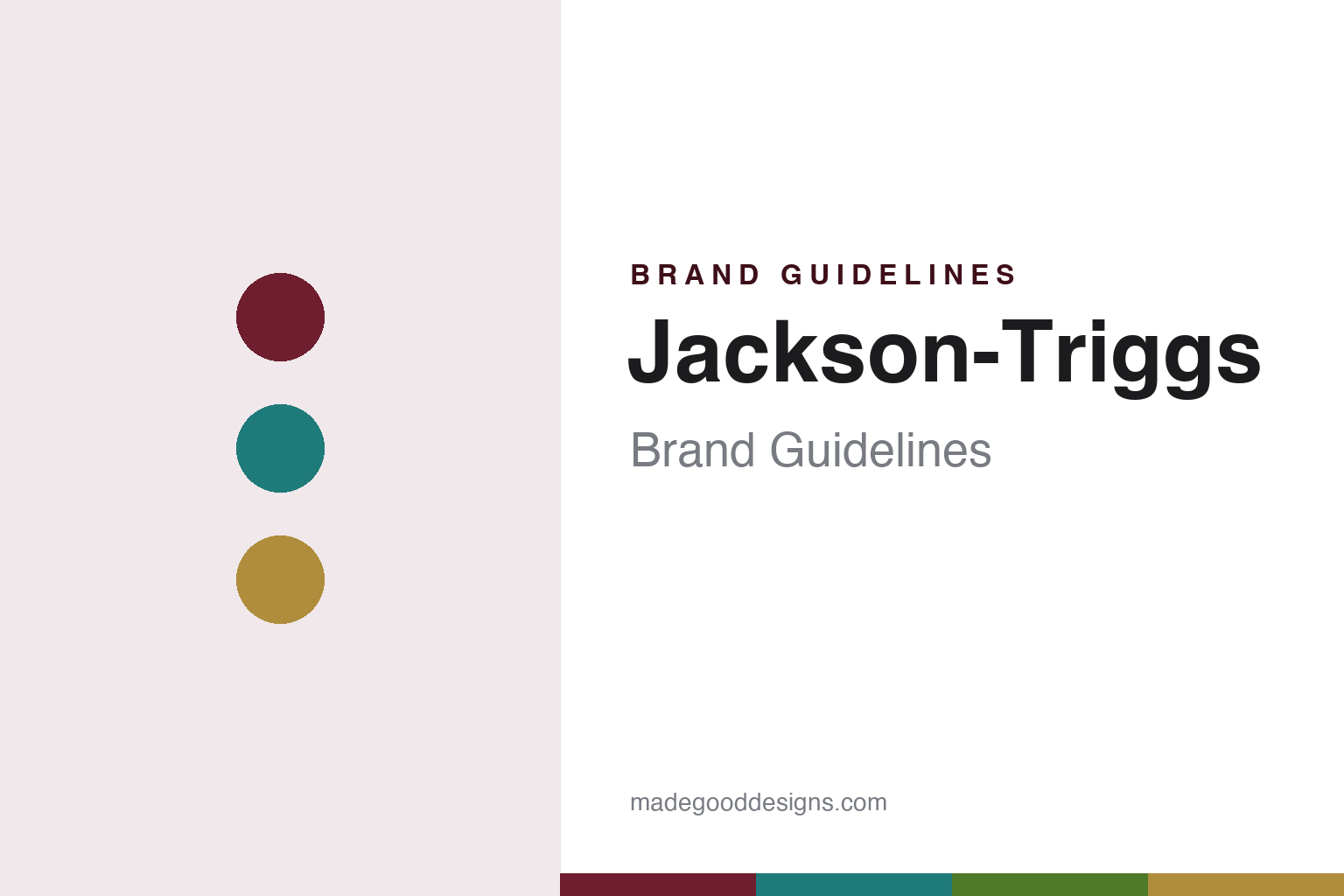
Two constants: a burgundy, teal, green and medallion gold palette and a contemporary geometric sans register. Abstract homage — not a Jackson-Triggs product or mark; no label, logo or bottle is reproduced.
A buyout in 1989
Two Labatt managers, their colleagues and a wine business for sale.
Jackson-Triggs carries the surnames of two former managers of the brewer John Labatt. In 1989 Allan Jackson and Donald Triggs led the purchase of Labatt’s Canadian wine business; Wines in Niagara reported in January 2026 that Triggs, three friends and 26 fellow employees pooled their savings to buy it. Accounts name that business differently. English Wikipedia, citing Arterra, calls it Cartier Wines, while Wines in Niagara, in October 2025, named Labatt’s wine division as Ridout Wines and said Jackson had been vice-president of operations at Chateau Gai, then part of Labatt. According to English Wikipedia, the company traded as Cartier, merged with Inniskillin in 1992 and with T.G. Bright & Co. in 1993, and became Vincor.
The brand itself dates from 1993, when Vincor created it. It began with two wines: a Cabernet Sauvignon and, depending on the account, a Sauvignon Blanc (Canadian Business, 2002, as cited by English Wikipedia) or a Chardonnay (Wines in Niagara, 2025). The wine writer Jamie Goode, reporting on a 2018 visit, wrote that Jackson-Triggs started with International Canadian Blends — Canadian wine mixed with imported bulk wine — and in 2000 launched a VQA range made from Niagara-grown grapes.
Wines in Niagara reported Allan Jackson’s death on 4 October 2025, and on 1 January 2026 the same publication reported that Donald Triggs had been appointed an Officer of the Order of Canada.
Colour
A gravity-flow winery and a medallion on every tier.
The brand has two homes. In Niagara-on-the-Lake the Jackson-Triggs Niagara Estate Winery was designed by the architects KPMB and completed in 2001 for Vincor, according to the practice: a 45,000-square-foot building under a single continuous roof carried on full-span wooden trusses, with a two-storey Great Hall whose motorised glass doors open at each end, and a gravity-flow winemaking process that the visitor tour follows. KPMB calls it “a model of sustainable architecture.” In British Columbia the Okanagan Estate winery stands just north of Oliver; the company said in 2016 that many of its vineyards there had been leased from the Osoyoos Indian Band since 1998, among them SunRock, Bull Pine and Bear Cub. At the Niagara estate the company described, in 2017, an 11.5-acre vineyard of Chardonnay, Pinot Noir and Riesling, with a demonstration plot of seven grape varieties in front of the winery as part of its visitor programme.
The labels have been rebuilt as families. In July 2012 Wines in Niagara reported new packaging across every tier by the San Francisco firm HKA Design, complementing a Proprietors’ Selection label reintroduced in October 2011. HKA’s Lynn Keller described a medallion, a centred arrangement of information and a vertical accent on each label: textured black paper with a pewter script for Reserve, a tobacco-bronze ground for Grand Reserve, an intense yellow on rock grey for SunRock, a soil-brown label with the blue of the Niagara River for Delaine, and a shimmering stock with silver and gold stamping for Icewine. The brand’s marketing director at the time, Franco Timpano, told the publication the design was meant to be “contemporary and bold,” carrying the brand’s heritage while speaking to the quality and value of its VQA wines.
For the brand’s 30th anniversary the Proprietors’ Selection range was redesigned again by Jacknife, Marketing News Canada reported in June 2023, after a two-year project with Arterra’s marketing team. The wordmark moved to a more contemporary typeface and the emblem was simplified. Each grape kept its familiar colour — teal for Pinot Grigio, burgundy for Cabernet Sauvignon, green for Sauvignon Blanc — now paired with a second shade and gold accents, and the 4-litre cask was brought into line. The magazine noted a QR code on the back label leading to a page with product details and a winemaker video, and messaging from The Right Amount, a moderate-drinking resource on serving sizes. Jacknife’s creative director, Kim Norwich, said “a refreshed logo and emblem kept the iconic elements” of the brand while modernising it.
Typography
Design and documentation.
The seven brands in this group are all Canadian wineries: Inniskillin, Jackson-Triggs, Peller Estates and Cave Spring from Ontario’s Niagara Peninsula, and Mission Hill, Quails’ Gate and Burrowing Owl from British Columbia’s Okanagan Valley. Some still carry a founding family’s name or are run by that family; others now sit inside much larger wine companies, and two of the Niagara names reach into the Okanagan as well.
Ownership is the clearest dividing line. Inniskillin, founded by Donald Ziraldo and Karl Kaiser with a first planting in 1974, and Jackson-Triggs, launched in 1993 by the company Donald Triggs and Allan Jackson built from the old Cartier wines, both passed through Vincor and Constellation Brands and today trade under Arterra Wines Canada, the name the business took in 2017 after Constellation sold its Canadian wine arm, English Wikipedia says. Peller Estates belongs to Andrew Peller Ltd of Grimsby, Ontario, which agreed in June 2026 to be taken private by Fairfax Financial Holdings, Canadian Grocer reported. In the Okanagan, Anthony von Mandl bought the Mission Hill estate in West Kelowna in 1981; Quails’ Gate grew from land the Stewart family began planting in 1956 and relaunched as a winery in 1989; and Burrowing Owl, near Oliver, began when Jim Wyse bought vineyard land in 1993, with the winery itself built in 1998, the company says. Cave Spring’s first vintage came in 1986, from vines the Pennachetti family planted in 1978.
A Canadian wine brand’s identity is usually carried by a label, a place name and a story about the land, because the company behind the name may have merged, been sold or grown far beyond its first vineyard. Each guide separates what independent sources record from what the winery says about itself — its founding story, its owners over time, where its wine is grown and made, and how its labels and buildings present it — and marks plainly what rests only on the company’s own word.
Aa
A contemporary geometric sans for a refreshed wordmark. (Specimen set in Jost, a sans-serif STAND-IN; NOT the Jackson-Triggs logo.)
Jackson-Triggs
From Vincor to Constellation to Arterra.
Ownership followed Vincor’s path. Wine Spectator reported in April 2006 that Constellation Brands had bought Vincor, and in July 2012 Wines in Niagara reported that Jackson-Triggs and the other former Vincor Canada wineries had taken the Constellation Brands name. In December 2016 Constellation announced that it had completed the sale of its Canadian wine business, which it said included Jackson-Triggs and Inniskillin, to the Ontario Teachers’ Pension Plan. The business was renamed Arterra Wines Canada, headquartered in Mississauga, Ontario, and the Jackson-Triggs website carries the Arterra name today.
Triggs later built an Okanagan estate of his own: Wines in Niagara reported that he and his family named their Golden Mile Bench property Culmina and sold it to Arterra in July 2019, bringing it under the same owner as the brand that bears his name.
For a design guide, Jackson-Triggs shows how a broad range can be held together by one medallion and a colour for each grape. Compare Inniskillin, its Arterra stablemate in Niagara, and Mission Hill, another Okanagan winery. For this guide we use Cabernet burgundy, Pinot Grigio teal and medallion gold with a sans, an unofficial interpretation; no product or logo is reproduced.
Explore & save
Keep Jackson-Triggs’s identity on hand — save it to a board in the Made Good inspiration library.
Jackson-Triggs identity set
Pin the Jackson-Triggs burgundy, teal, green and medallion gold palette and the contemporary geometric sans register to your own board.