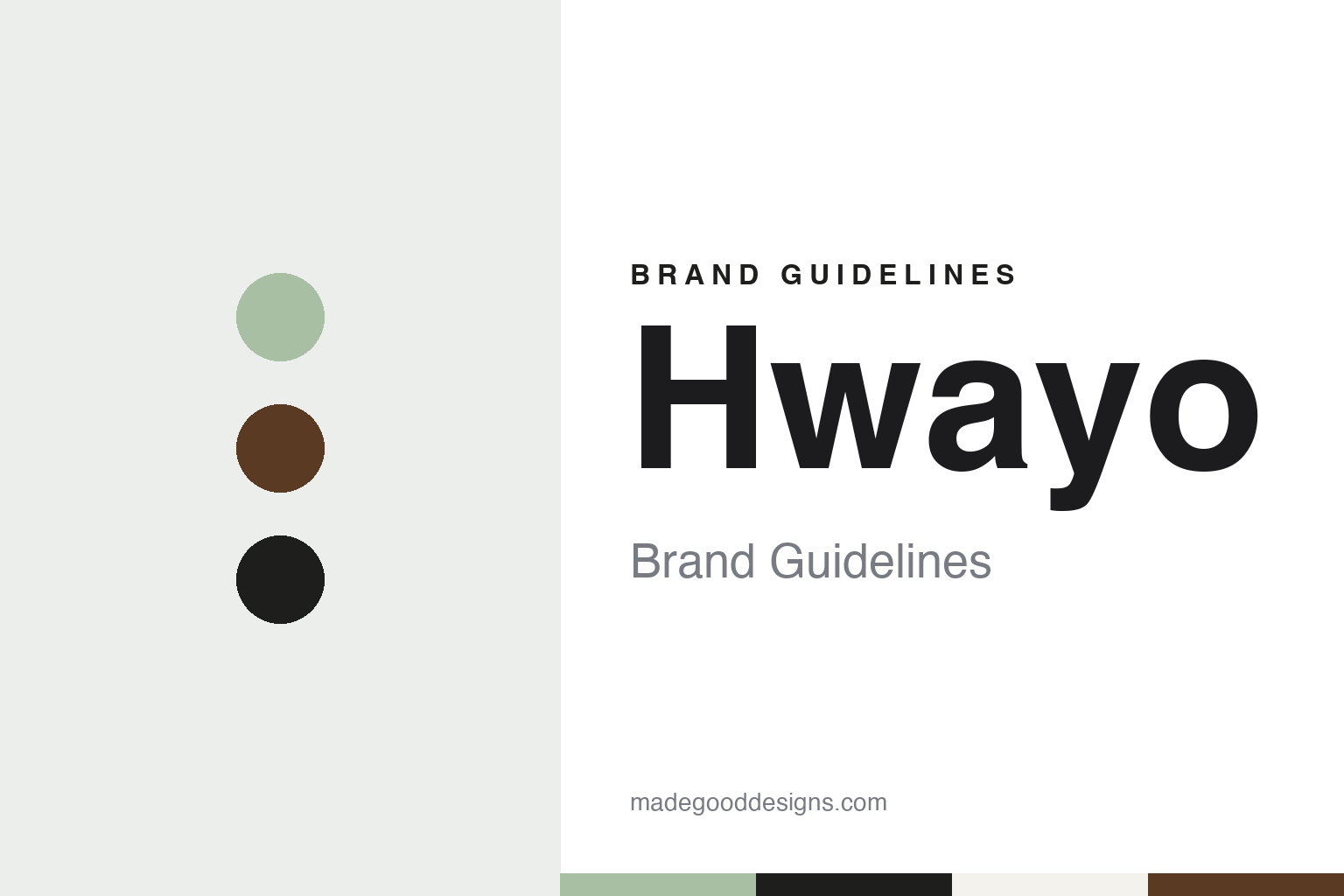
Hwayo Brand Guidelines
A rice soju from Yeoju, born in a porcelain house.
Aa
Two constants: a celadon green, iron brown and kiln black palette and a brush-cut Korean serif register. Abstract homage — not a Hwayo product or mark; no label, logo or bottle is reproduced.
A soju from a porcelain house
How a ceramics group came to distil its own rice spirit.
Hwayo is a distilled rice soju made in Yeoju, Gyeonggi Province, by the company of the same name, which belongs to the Hwayo Group. The Korea Times reported in December 2025 that the group’s chairman, Cho Tae-kwon, founded Hwayo in 2003. On the same day Money Today reported that the company had marked its 22nd anniversary on 1 December 2025, and that it had started out at Yeoju with two tanks and four or five employees.
The first bottles followed in 2005. The company’s own history lists Hwayo 25 and Hwayo 41 — the numbers are the alcohol strengths — as its 2005 launches, alongside its first exports to China, the United States and Japan, and Money Today reported that full-scale production of distilled soju began in January 2005.
The brand’s roots are in ceramics rather than drink. Hwayo says it grew out of the Kwangjuyo group’s effort to present Korean food on its own porcelain with a Korean liquor to match, and that the group developed the spirit with two veteran liquor advisers, Park Chan-young and Kim Ho-young. The Korea Times described the present group as three companies — Hwayo, the porcelain maker Kwangjuyo and the dining business Gaon Society — each led by one of the chairman’s daughters, and reported that Kwangjuyo supplies containers for Hwayo. Hwayo’s president, Cho Hee-kyung, reorganised the ceramics-rooted Kwangjuyo Group into the Hwayo Group, her alma mater, the School of the Art Institute of Chicago, reported in 2026; Esquire Korea reported in September 2026 that the three businesses were regrouped under the Hwayo name with a move to a new headquarters in Seocho, Seoul.
Hwayo is a distilled soju, made from fermented rice, and the company sets it against the diluted soju that dominated the Korean market when it launched — the category of brands such as Jinro and Chum Churum.
Colour
A split character, a celadon shoulder and a cellar of onggi.
The name is itself a piece of calligraphy. Hwayo explains that it was made by splitting the character 燒 — the “so” of soju, meaning to burn — into its two halves: 火 (hwa), fire, and 堯 (yo), which the company glosses as something high and noble. Esquire Korea wrote in 2026 that the name comes from an old kiln and carries the sense of mastering fire to make something precious, and that it reflects all three of the group’s businesses, since ceramics and cooking both depend on fire.
The bottle points back to the same craft. The company says its design reinterprets Goryeo-dynasty celadon in a modern form, naming a twelfth-century celadon bottle with a willow design in underglaze iron — which it identifies as National Treasure No. 113 — and a celadon kundika with a willow pattern as references. Hwayo describes the natural curve of Korean ceramics on the bottle’s surface and a confident shoulder line that it ties to the spirit of Kwangjuyo.
The range has been added to in steps. The company’s history records a new bottle introduced in 2010 together with the lighter Hwayo 17; Hwayo X.Premium, Hwayo 41 spirit aged in oak casks, in 2013; and in 2015 Hwayo 53 in a dragon-pattern bottle, plus a Black edition. Hwayo describes the dragon edition as a white porcelain bottle with a dragon carved across its front. A 200 ml size across the whole range followed in 2016.
Production is part of the brand story. Hwayo says it uses 100 per cent Korean rice and water drawn from bedrock 150 metres underground, distils under reduced pressure so that the wash boils at a lower temperature, uses no additives, and matures the spirit in onggi, the breathing Korean earthenware jar; its English-language site gives the maturation as 180 days. Visiting the Yeoju plant in December 2025, Money Today reported a minimum of three months in onggi and saw a jar inscribed with the date 24 January 2004, while The Korea Times counted 1,500 onggi and reported that an automated plant was built in 2023.
Typography
Design and documentation.
The seven brands in this group are all Korean drinks: Good Day, Kooksoondang, Hwayo, Andong Soju, Seoul Jangsoo, Saero and Jinro Is Back. They cover three kinds of drink. Good Day, Saero and Jinro Is Back are everyday soju, from Muhak, Lotte Chilsung Beverage and HiteJinro respectively. Hwayo and Andong Soju are distilled soju: Andong soju is a traditional distilled soju produced in Andong, in North Gyeongsang Province, and Hwayo is made in Yeoju, in Gyeonggi Province, by a company that Cho Tae-kwon founded in 2003; he had founded the porcelain maker Kwangjuyo in 1963, The Korea Times reported in 2025. Kooksoondang and Seoul Jangsoo are rice-wine names: Kooksoondang began as a maker of nuruk, the starter used to brew Korean wines, and is better known for Baekseju, a clear rice wine brewed with raw rice and herbs, while Seoul Jangsoo makgeolli is produced by an association formed by breweries in Seoul, The Korea Times reported in 2013.
For everyday soju, the bottle itself has long been shared. In 2009 Korea’s soju makers agreed with the Ministry of Environment to use green bottles of the same size and design, so that they could collect and reuse one another’s bottles, The Korea Times reported; the agreement was revised in August 2020 after makers began using bottles of other colours and shapes.
Each guide separates what independent sources record from what the company says about itself — its founding story, its owners over time, where its drinks are made and how its labels and bottles have changed — and marks plainly what rests only on the company’s own word.
火堯
A brush-cut serif for a name built from a split character. (Specimen set in Nanum Myeongjo, a Korean serif STAND-IN; NOT the Hwayo logo.)
Hwayo
Six strengths, onggi cellars and an export map.
Today the company lists six expressions: Hwayo 17, 19, 25, 41 and 53 and X.Premium. The newest, Hwayo 19, is described by the company as a blend of onggi-matured and oak-matured rice spirit, and Hwayo 17 as a lighter blend that includes some X.Premium. The Korea Times reported in December 2025 that Hwayo exports six labels to 30 countries.
The company began exporting in its launch year. Money Today reported in December 2025 that Hwayo first shipped to the United States, Japan and China in 2005 and is now sold in about 30 countries, among them France, Germany, Vietnam, Singapore, Taiwan and Australia. At home, Esquire Korea reported in 2026 that the brand’s growth gathered pace around 2012, as Korean-style bars around Garosu-gil in Seoul took it up.
Two notes on the name. In Korean the syllables hwa-yo also begin hwayoil, Tuesday, which is written with different characters, so a search for the word alone brings up calendars as well as the spirit. And the porcelain house behind it, Kwangjuyo, is a separate company and brand within the same group.
For a design guide, Hwayo shows how a ceramics group carried its own vocabulary — a split character, a celadon silhouette and the onggi jar — into a spirit, and kept the strength of each bottle in its name. Compare Andong Soju, the pot-distilled spirit of North Gyeongsang, and Jinro, the soju name that dates to 1924. For this guide we use celadon green, iron brown and kiln black with a Korean serif, an unofficial interpretation; no product or logo is reproduced.
Explore & save
Keep Hwayo’s identity on hand — save it to a board in the Made Good inspiration library.
Hwayo identity set
Pin the Hwayo celadon green, iron brown and kiln black palette and the brush-cut Korean serif register to your own board.