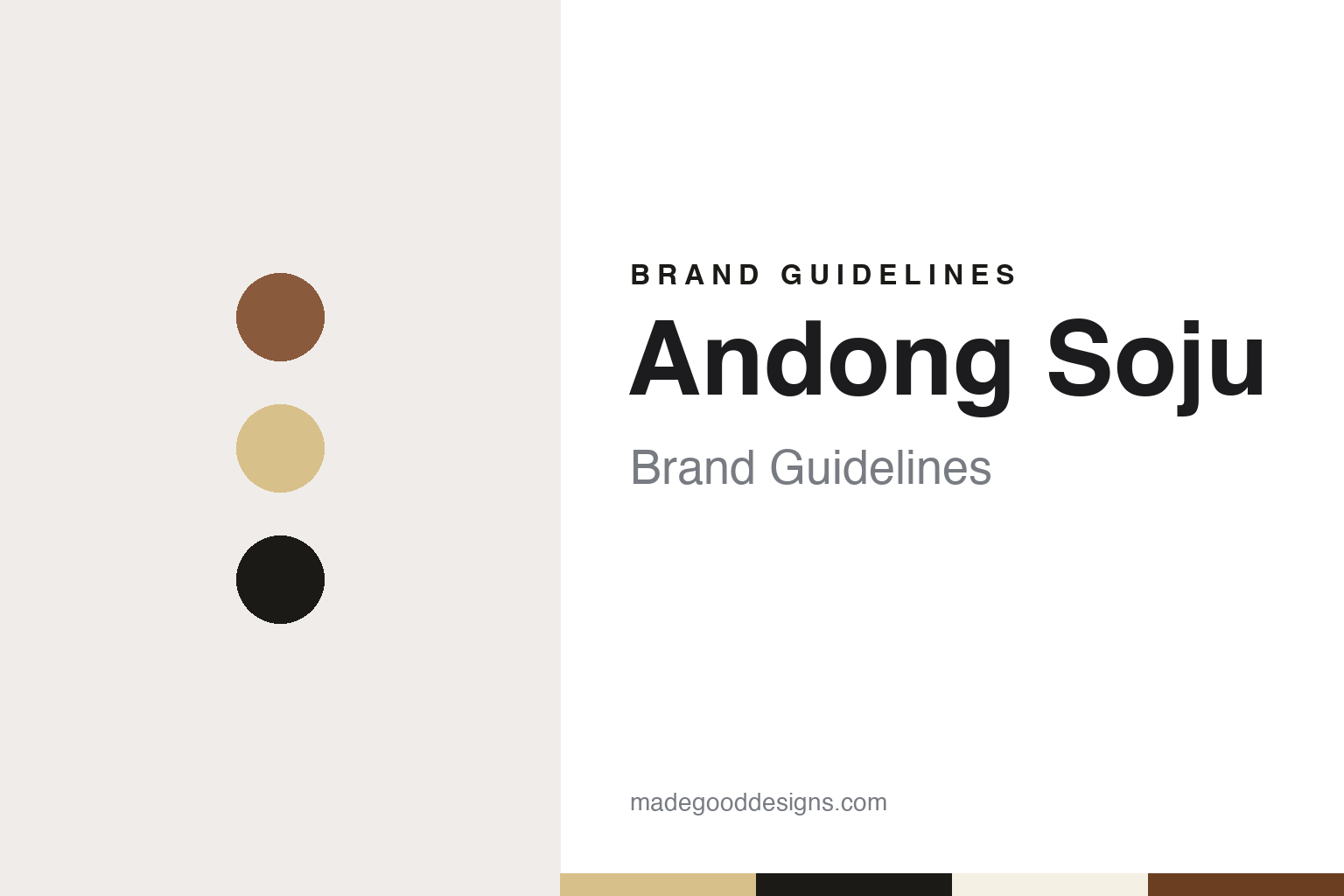
Andong Soju Brand Guidelines
Cho Ok-hwa’s pot-distilled rice spirit from Andong.
Aa
Two constants: a mask timber, nuruk wheat and ink black palette and an old-style Korean serif register. Abstract homage — not an Andong Soju product or mark; no label, logo or bottle is reproduced.
A city’s spirit, and one family’s still
Andong soju is a category; this guide follows one documented maker.
Andong soju is a distilled spirit of rice and nuruk from Andong, in North Gyeongsang Province, and more than one company makes it. This guide covers Minsokju Andong Soju (민속주 안동소주), the producer built on the method of Cho Ok-hwa and now led by her son, Kim Yeon-bak. It is a different business from Myeongin Andong Soju, the line of the food master Park Jae-seo, whom the agriculture ministry named a food master in 1995, the Segye Ilbo reported in 2020.
The name has a commercial past. Writing in the Segye Ilbo in July 2020, the liquor columnist Myeong Uk recorded that in 1920 the Andong businessman Kwon Tae-yeon built a soju factory in the city, the Andong Brewing Company, whose product was Jebiwon-brand Andong soju; the company later moved to diluted soju, and in 1974 it was merged into Geumbokju. The Seoul Shinmun reported in 2004 that a 1962 revision of the liquor tax law banned the production of pure-grain liquor, which all but ended the old method.
The revival is tied to Cho Ok-hwa. Andong soju was designated North Gyeongsang Intangible Cultural Property No. 12 on 13 May 1987, with Cho recognised as the holder of the skill, the Segye Ilbo and Korean Wikipedia record. According to the Seoul Shinmun’s 2004 profile, Cho began in 1986 by selling dongdongju at a local night market to raise money for the Saemaul Movement, when a retiring city employee suggested that soju would be better; she received her production licence in September 1990 and began distilling at her home in Andong on the family’s own still, kept as an heirloom.
Colour
Wheat nuruk, a soju-gori and a stop at 45 per cent.
The method is the product’s main story. The company describes making its own nuruk from washed and crushed wheat pressed in a round mould and left to ferment for about 20 days, steaming rice, mixing the two with water and leaving the mash to ferment for about 15 days or more. The fermented liquor is heated in a cauldron under a soju-gori, the traditional still, with a cooling vessel on top and the joints sealed with dough; the spirit runs strong at first, and the company says distillation stops when it falls to 45 per cent, where it finds the taste and aroma best. The Seoul Shinmun gave a similar account in 2004, reporting that the spirit starts at around 70 per cent and is collected at about 45.
Korean Wikipedia distinguishes Cho’s method, distilled at ordinary pressure in a pot, from Park Jae-seo’s, which uses a three-stage ferment and reduced-pressure distillation. In 2019 the food writer Hwang Gwang-hae wrote in the Kyongbuk Maeil that Cho’s house sold a single 45 per cent soju and made its own nuruk, which gives it a faint nuruk aroma; the company’s shop now also lists a 25 per cent bottle.
The packaging draws on the masks of Hahoe, the folk village in Andong. The company presents Hahoe-mask bottles — the Yangban mask and the Bune mask — describing them as Andong’s folk liquor put into mask bottles “in an Andong way,” alongside a plain clear glass bottle that it calls clean and uncluttered. Its gift range adds one-litre Seowon and Blossom editions packed in a wooden box with a wrapping cloth, the bojagi. The company’s name, minsokju, means folk liquor.
Typography
Design and documentation.
The seven brands in this group are all Korean drinks: Good Day, Kooksoondang, Hwayo, Andong Soju, Seoul Jangsoo, Saero and Jinro Is Back. They cover three kinds of drink. Good Day, Saero and Jinro Is Back are everyday soju, from Muhak, Lotte Chilsung Beverage and HiteJinro respectively. Hwayo and Andong Soju are distilled soju: Andong soju is a traditional distilled soju produced in Andong, in North Gyeongsang Province, and Hwayo is made in Yeoju, in Gyeonggi Province, by a company that Cho Tae-kwon founded in 2003; he had founded the porcelain maker Kwangjuyo in 1963, The Korea Times reported in 2025. Kooksoondang and Seoul Jangsoo are rice-wine names: Kooksoondang began as a maker of nuruk, the starter used to brew Korean wines, and is better known for Baekseju, a clear rice wine brewed with raw rice and herbs, while Seoul Jangsoo makgeolli is produced by an association formed by breweries in Seoul, The Korea Times reported in 2013.
For everyday soju, the bottle itself has long been shared. In 2009 Korea’s soju makers agreed with the Ministry of Environment to use green bottles of the same size and design, so that they could collect and reuse one another’s bottles, The Korea Times reported; the agreement was revised in August 2020 after makers began using bottles of other colours and shapes.
Each guide separates what independent sources record from what the company says about itself — its founding story, its owners over time, where its drinks are made and how its labels and bottles have changed — and marks plainly what rests only on the company’s own word.
燒酒
An old-style serif for a spirit named after its city. (Specimen set in Gowun Batang, a Korean serif STAND-IN; NOT the Andong Soju logo.)
Andong Soju
A second generation, a museum and a royal birthday.
The skill has passed down the family. The Seoul Shinmun wrote in 2004 that Cho’s daughter-in-law, Bae Kyeong-hwa, had volunteered to learn the demanding work and become her leading disciple, and the Kyongbuk Maeil reported in 2019 that Bae and Cho’s son Kim Yeon-bak were carrying on the method and running the distillery and its museum. The company says Kim became its representative director in October 2020 and director of the museum in November 2020, and was named a Korean food master in December 2020; it describes Bae as the designated transmitter of the intangible cultural property, with master’s and doctoral theses from Andong National University on the history of Andong soju and on its fermentation and home-made nuruk.
The Andong Soju & Traditional Food Museum, run alongside the distillery, shows the history and making of the spirit and offers tastings and soju-making sessions. Its tourism listing, updated in December 2025, says the displays include the birthday table prepared for Queen Elizabeth II’s visit to Andong on 21 April 1999; The Korea Times recalled in 2022 that the Queen spent her birthday that day at Hahoe Folk Village, where villagers prepared a feast of 47 dishes.
The name needs care online. Andong soju is a category as much as a brand, and the two best-known family houses sell from different sites: Minsokju Andong Soju at andongsoju.co.kr, and Park Jae-seo’s Myeongin Andong Soju at its own shop, andongsojumall.com.
For a design guide, Andong Soju shows how a spirit can lean on its city — a mask from the nearby folk village, a strength set by the still and a maker’s name that means “folk liquor” — rather than on an invented brand. Compare Hwayo, the onggi-matured rice soju of Yeoju, and Kooksoondang, the Korean brewer of traditional liquors. For this guide we use mask timber, nuruk wheat and ink black with a Korean serif, an unofficial interpretation; no product or logo is reproduced.
Explore & save
Keep Andong Soju’s identity on hand — save it to a board in the Made Good inspiration library.
Andong Soju identity set
Pin the Andong Soju mask timber, nuruk wheat and ink black palette and the old-style Korean serif register to your own board.


