Salton Brand Guidelines
The Bento Gonçalves winery formalised by an immigrant’s sons in 1910.
Aa
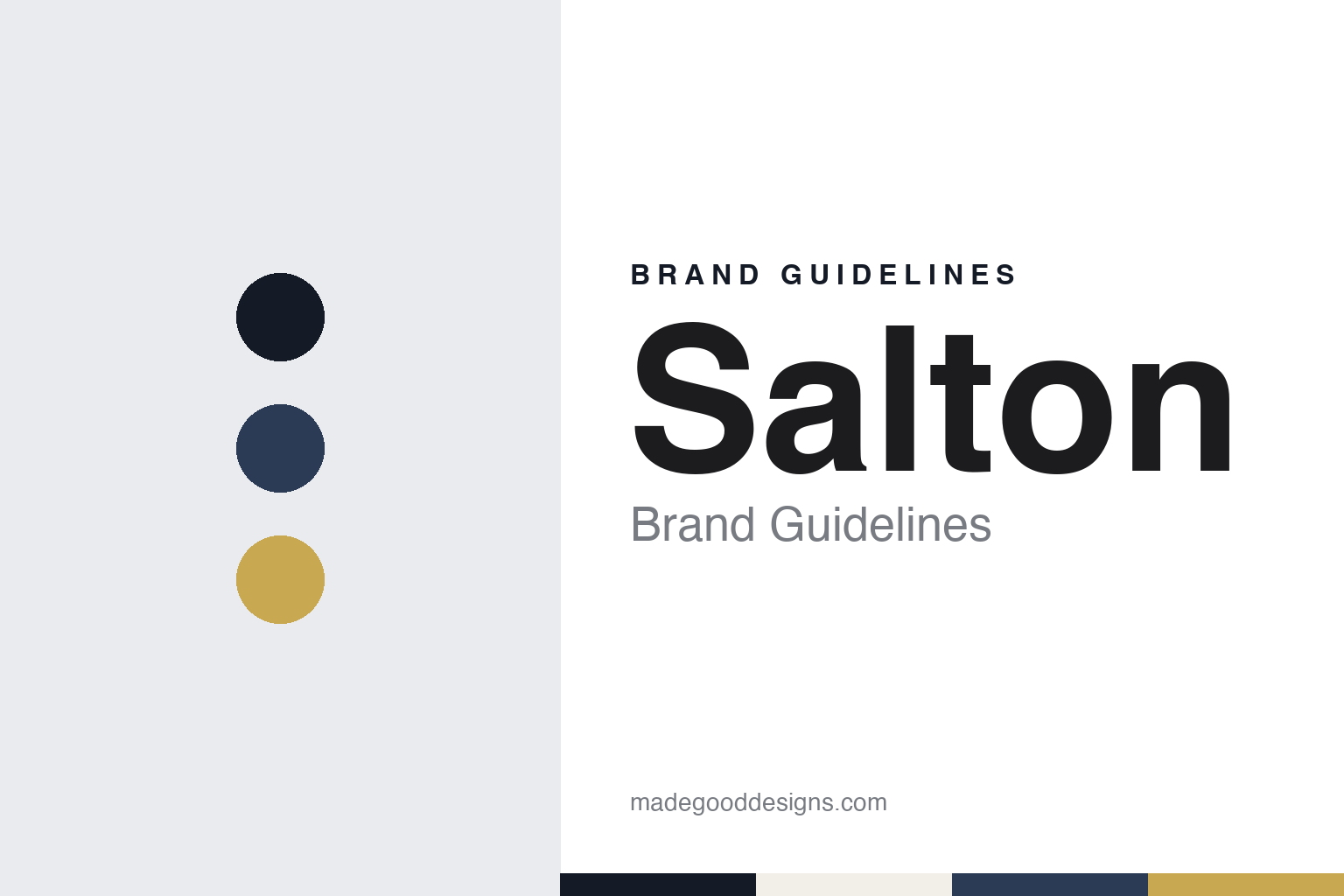
Two constants: a Serra slate, cellar ink and sparkling gold palette and a traditional book serif register. Abstract homage — not a Salton product or mark; no bottle, label or logo is reproduced.
Casa di pasto
An immigrant’s tavern that became a family company.
Salton traces its roots to Antonio Domenico Salton, who left Cison di Valmarino, in the Veneto region of Italy, and arrived in Brazil in 1878, the company says. He settled in the Italian colony of Dona Isabel, today the city of Bento Gonçalves in Rio Grande do Sul, where he married Lucia Canei; the couple had ten children, according to the company. In 1884, according to the company’s history, the couple opened a casa di pasto, an eating house, opposite the town’s main church.
The business took its formal shape in 1910. Portuguese Wikipedia gives the founding date as 25 August 1910 and names Antônio Domênico Salton as founder; the company’s own timeline says that in that year the brothers Paulo, Angelo, João, José, Cesar, Luis and Antonio took the family business over and formalised it. By 1922 it was trading as Paulo Salton e Irmãos, after the eldest brother. The company says it began making sparkling wine in 1933 and that in 1940 Antonio “Nini” Salton created Vinho Canônico, an altar wine made to the Vatican’s rules, which it still produces.
The family moved into the national market from São Paulo. José and Cesar opened a São Paulo branch in 1948, and in the 1950s the company launched Presidente brandy, which it still makes in São Paulo state. In 1967 the company became Vinhos Salton S/A – Indústria e Comércio, later renamed Vinícola Salton S.A., the name it carries today.
Colour
Brandy, a president’s wine and a return to fine wine.
For several decades Salton was as much a brandy house as a winery. The company says that in the 1960s it supplied the office of the President of the Republic with its Presidente wine, and that in 1961 President Jânio Quadros named it his preferred wine. In the 1970s, its timeline records, wine production in Bento Gonçalves declined and the company concentrated on Presidente brandy.
The shift back to fine wine began at the end of the century. Salton dates its Salton Classic line of fine wines to 1999, and in 2004 it opened a new production site in the Tuiuty district of Bento Gonçalves. It moved south in 2012, when it began operations at Azienda Domenico, at Santana do Livramento in the Campanha Gaúcha on the border with Uruguay; the same year it launched its Terroir Salton programme, which the company says began with 40 partner grape growers. In 2015 it opened the Complexo Presidente at Jarinu, in São Paulo state.
The family still runs the company. Salton says members of the family’s fourth generation lead the winery: Maurício Salton became chief executive in 2018, and Gregório Bircke Salton became winemaker and technical director in 2020, the year Salton marked 110 years. The company published its first sustainability report in 2022, and in 2023 it opened the Casa di Pasto Salton on the Caminhos de Pedra heritage route in Bento Gonçalves, reviving the name of the 1884 eating house. The same year, the company says, it published a wine-tourism accessibility guide and a glossary of wine terms in Libras, Brazilian Sign Language.
Typography
Design and documentation.
The seven brands in this group are wine names from two neighbours on South America’s Atlantic side: Bodega Garzón, Familia Deicas, Bouza and Pisano from Uruguay, and Miolo, Salton and Casa Valduga from Brazil. In Uruguay, Garzón stands in Maldonado, near the Atlantic coast, where Alejandro and Bettina Bulgheroni founded it in 2007, the International Wine Challenge reported in 2026; Familia Deicas took over the Juanicó estate in Canelones in 1979, the estate says; the Pisano family, from Liguria, planted its first vines at Progreso, also in Canelones, in 1919, La Capital reported in 2019; and the Bouza family began making wine in the late 1990s, with its winery at Melilla, on the rural edge of Montevideo.
The three Brazilian houses all belong to the Serra Gaúcha in Rio Grande do Sul, and to families of Italian descent. Salton was founded in Bento Gonçalves in 1910, Portuguese Wikipedia says; Miolo traces its land in the Vale dos Vinhedos to Giuseppe Miolo’s arrival in 1897 and set up its winery in 1989, the family says; and Casa Valduga, in the same valley, dates the family’s arrival to 1875, while its winery was begun in 1973. Portuguese Wikipedia says the Vale dos Vinhedos has carried an Indication of Provenance since 2002 and a Denomination of Origin since 2012.
A wine brand’s identity is usually carried less by a single bottle than by a label, a family name and the place it promises. Each guide separates what independent sources record from what the company says about itself — its founding story, its owners over time, where its wine is made and how its labels have changed — and marks plainly what rests only on the company’s own word.
Aa
A traditional book serif for a 1910 family house. (Specimen set in Libre Baskerville, a serif STAND-IN; NOT the Salton logo.)
Salton
A family surname, an advertising concept and a supply-chain reckoning.
In July 2013 the trade site Acontecendo Aqui reported that Vinícola Salton had introduced a new visual identity built on the concept “Um Mundo a Explorar” (“A World to Explore”), created by the Porto Alegre agency GADred’, with photographs by Jeferson Caldart and image treatment by M1 Engenharia, for a campaign in national media and trade magazines.
In February 2023, Super Varejo reported on 3 March, more than 200 workers recruited in Bahia and supplied by an outsourced firm to three Serra Gaúcha wineries, Salton among them, were found in conditions that authorities described as analogous to slavery; the outsourced firm denied this. Salton said it repudiated any violation of human rights, had suspended the contract and would commission independent labour audits of its suppliers, the same report said.
For a design guide, Salton shows how a 19th-century origin story — a tavern opposite a church, seven brothers formalising the business, a brandy named for the presidency — can carry a modern sparkling-wine brand, and how a family name also carries a company’s responsibilities. Compare its Vale dos Vinhedos neighbour Miolo and the Serra Gaúcha family winery Casa Valduga. For this guide we use Serra slate, cellar ink and sparkling gold with a serif, an unofficial interpretation; no product or logo is reproduced.
Explore & save
Keep Salton’s identity on hand — save it to a board in the Made Good inspiration library.
Salton identity set
Pin the Salton Serra slate, cellar ink and sparkling gold palette and the traditional book serif register to your own board.