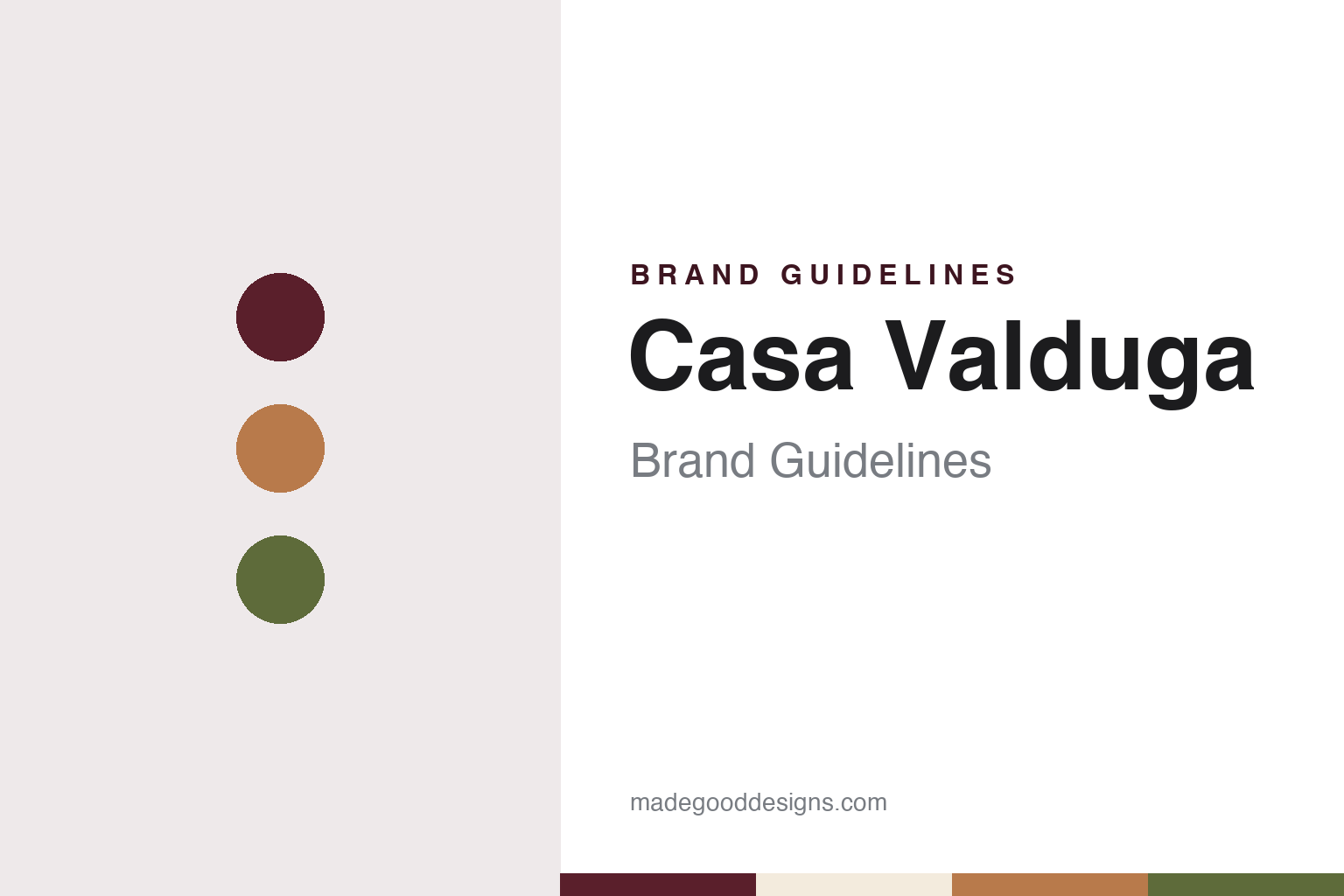
Casa Valduga Brand Guidelines
The Vale dos Vinhedos family winery behind the 130.
Aa
Two constants: a merlot, copper and vine green palette and an old-style roman serif register. Abstract homage — not a Casa Valduga product or mark; no label, logo or bottle is reproduced.
A family from northern Italy and a valley of vines
Rovereto, the Vale dos Vinhedos and a winery begun in 1973.
Casa Valduga is a family winery in the Vale dos Vinhedos, the valley of vineyards in the municipality of Bento Gonçalves in Brazil’s Serra Gaúcha, in the state of Rio Grande do Sul. Portuguese Wikipedia describes it as a Brazilian family winery whose founders descend from Italian immigrants, like those of many neighbouring houses, and lists it among the members of Aprovale, the association of wine producers in the valley.
The family story begins in Italy. The company says the first Valduga immigrant came from Rovereto, in northern Italy, at the end of the nineteenth century and planted the first vines in what is now the heart of the Vale dos Vinhedos. Its website dates that arrival to 1875, and the line “Desde 1875” — “since 1875” — sits beneath the name on its product sheets. The wine educator Liz Thach MW, writing after a visit in 2018, gives the same year for the family’s emigration from northern Italy to southern Brazil.
The winery as a business came much later. In her 2018 account, Thach writes that it was not until 1973 that Luiz Valduga set out to build a winery of his own. At first he planted mainly American labrusca grapes such as Concord, which suited the cool, wet climate. His sons wanted to make fine wine from European vinifera varieties, and, in a story the family still tells, they sent their father on a long holiday and used the time to pull out most of the old vines and replant with Chardonnay, Pinot Noir and Merlot. When he came back, Thach writes, he agreed to invest in new equipment — while carrying on making Concord wine for himself.
The company calls Luiz Valduga the patriarch who dreamed of building the best winery in Brazil, and it quotes a piece of his advice that it treats as a house motto: before making two bottles of wine, make one, but make it well.
Colour
Traditional-method sparkling wine, a number as a name and an appellation seal.
Sparkling wine is the centre of the house. Thach describes Casa Valduga as focused on sparkling wine made by the traditional method, the bottle-fermented process used in Champagne, alongside still wines with an emphasis on cool-climate Merlot and Chardonnay. In November 2025 Jornal do Comércio of Porto Alegre reported that the winery planned to put still more of its effort into sparkling wine, quoting the enologist Eduardo Valduga, who credited the terroir of the Serra Gaúcha.
The best-known label carries a number rather than a word. The company’s product sheet for the 130 says that in 2005 Casa Valduga made a sparkling wine to mark 130 years since the Valduga family arrived in Brazil, and named it Brut 130. The current 130 Extra Brut D.O.V.V. is made from Chardonnay and Pinot Noir grown in the company’s own vineyards and spends 36 months on its lees, the sheet says. Jornal do Comércio described it as the brand’s first sparkling wine certified under the Vale dos Vinhedos Denomination of Origin.
That seal has its own history. Portuguese Wikipedia, citing Gazeta do Povo, says wines from the valley have carried an Indication of Provenance since 2002 and a Denomination of Origin since 2012, with Aprovale’s regulatory council checking that grapes are grown and wine is made inside the delimited area. Among still wines, the company names Storia, a Merlot, and Villa Lobos, a Cabernet Sauvignon, as reds aged in French oak and then in its underground cellars. Recent launches reported by Jornal do Comércio include Maria Valduga Nature, Praeteritum, made with the Italian appassimento technique of drying grapes, and Mundvs.
Visitors are part of the identity too. Thach wrote in 2018 about the winery’s early focus on tourism, and the company presents Luiz Valduga as a pioneer of wine tourism in the Vale dos Vinhedos; restaurants and guesthouses stand beside the cellar among the vines.
Typography
Design and documentation.
The seven brands in this group are wine names from two neighbours on South America’s Atlantic side: Bodega Garzón, Familia Deicas, Bouza and Pisano from Uruguay, and Miolo, Salton and Casa Valduga from Brazil. In Uruguay, Garzón stands in Maldonado, near the Atlantic coast, where Alejandro and Bettina Bulgheroni founded it in 2007, the International Wine Challenge reported in 2026; Familia Deicas took over the Juanicó estate in Canelones in 1979, the estate says; the Pisano family, from Liguria, planted its first vines at Progreso, also in Canelones, in 1919, La Capital reported in 2019; and the Bouza family began making wine in the late 1990s, with its winery at Melilla, on the rural edge of Montevideo.
The three Brazilian houses all belong to the Serra Gaúcha in Rio Grande do Sul, and to families of Italian descent. Salton was founded in Bento Gonçalves in 1910, Portuguese Wikipedia says; Miolo traces its land in the Vale dos Vinhedos to Giuseppe Miolo’s arrival in 1897 and set up its winery in 1989, the family says; and Casa Valduga, in the same valley, dates the family’s arrival to 1875, while its winery was begun in 1973. Portuguese Wikipedia says the Vale dos Vinhedos has carried an Indication of Provenance since 2002 and a Denomination of Origin since 2012.
A wine brand’s identity is usually carried less by a single bottle than by a label, a family name and the place it promises. Each guide separates what independent sources record from what the company says about itself — its founding story, its owners over time, where its wine is made and how its labels have changed — and marks plainly what rests only on the company’s own word.
Aa
An old-style roman serif for a house that signs its labels “Desde 1875”. (Specimen set in Cormorant Garamond, a serif STAND-IN; NOT the Casa Valduga logo.)
Casa Valduga
A family business that grew into a group of companies.
Casa Valduga is still a family business. The company says it is led by the brothers Erielso, Juarez and João Valduga, working together with their children, and Thach described it in 2018 as still family operated. Over time the family has built a wider group around the winery. Jornal do Comércio reported in November 2025 that Casa Valduga belongs to the Grupo Famiglia Valduga alongside five other companies, naming among its brands the Charmat-method sparkling label Ponto Nero, the importer Domno, the grape-juice and food brand Casa Madeira, Brio Dona Leopoldina and the cosmetics brand Vinotage. The paper said the group grows grapes in three regions of southern Brazil and also works in Chile through a partnership with a winery there.
On the label, the house keeps things restrained. The company’s current product sheets set CASA VALDUGA in serif capitals beneath a simple line drawing of a building, with the small line “Desde 1875” underneath, and that date also appears on a round seal on its website, which speaks of 150 years of family tradition.
One practical note for searchers: the group trades as Famiglia Valduga, while the winery and its labels carry the name Casa Valduga, so the two names belong to the same family but not to the same business.
For a design guide, Casa Valduga shows how a winery founded in 1973 can borrow its authority from a family arrival in 1875, and how a number — the 130 — can carry a whole family story on a single bottle. Compare Miolo, another Vale dos Vinhedos family of Italian descent, and Salton, the Bento Gonçalves house founded in 1910. For this guide we use merlot, copper and vine green with an old-style serif, an unofficial interpretation; no product or logo is reproduced.
Explore & save
Keep Casa Valduga’s identity on hand — save it to a board in the Made Good inspiration library.
Casa Valduga identity set
Pin the Casa Valduga merlot, copper and vine green palette and the old-style roman serif register to your own board.


