Xifeng Brand Guidelines
The phoenix baijiu of Fengxiang, Shaanxi.
Aa
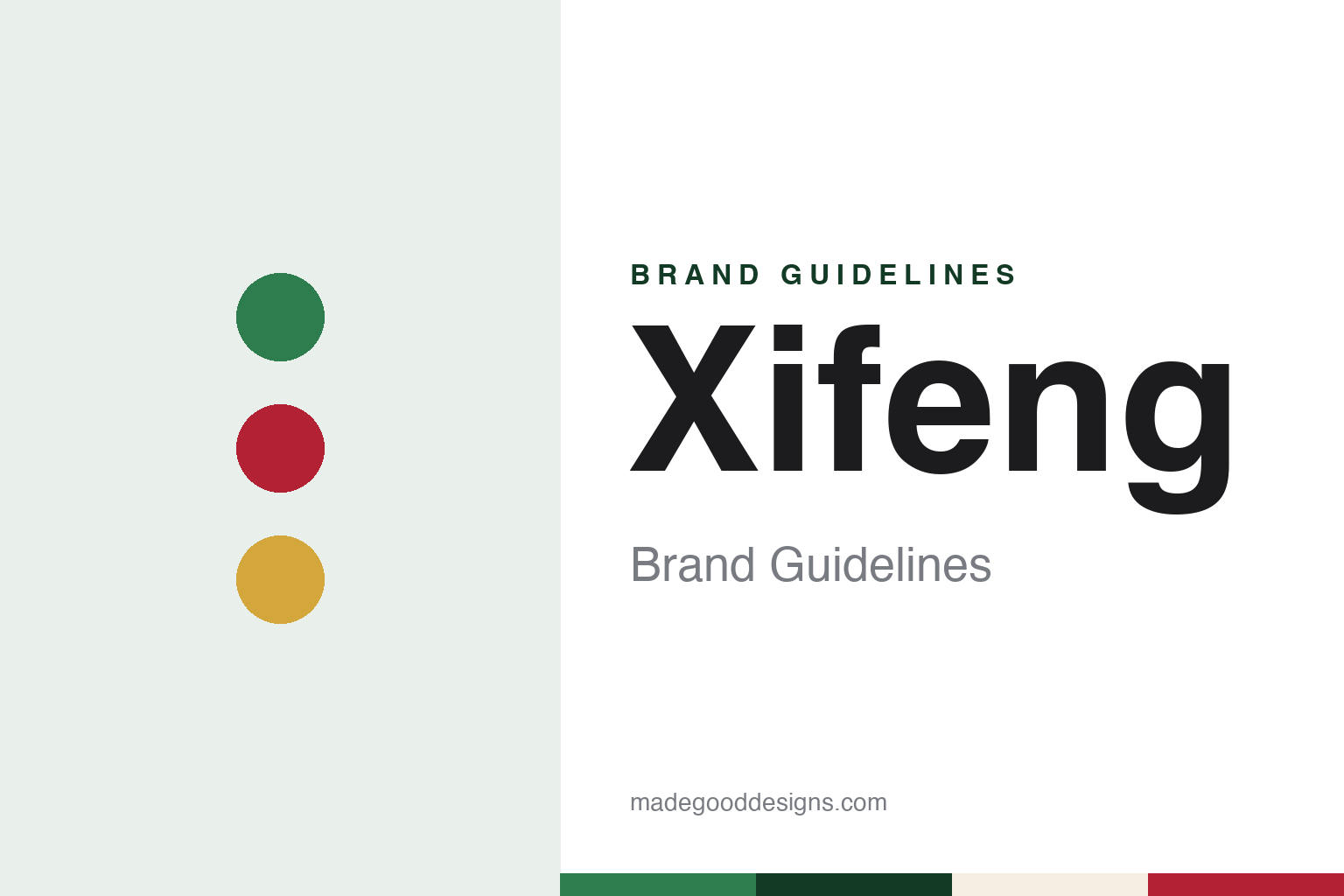
Two constants: a bottle green, phoenix red and gold palette and a bookish serif register. Abstract homage — not a Xifeng product or mark; no bottle, label or logo is reproduced.
Fengxiang
A town named for a phoenix, and a state distillery.
Xifeng — “West Phoenix” — is a baijiu made in Liulin, a town in the Fengxiang district of Baoji, in China’s Shaanxi province, Chinese Wikipedia says. Fengxiang, anciently called Yong, lies in the west of the Guanzhong plain, which is why the area was known as “Xifu Fengxiang,” the western prefecture. English Wikipedia, citing Derek Sandhaus’s Baijiu: The Essential Guide to Chinese Spirits (2014), says the place took the name Fengxiang, “phoenix flight,” in 757 under the Tang, after legends of phoenixes; the liquor’s name carries the same bird. Both encyclopedias relay a long local brewing history, and English Wikipedia notes that the Song poet Su Shi wrote about the drink while serving as an official in Fengxiang.
The company is younger. Its own history says its predecessor, the state-run Shaanxi Provincial Xifeng Distillery, was founded in 1956; the business site Jiemian reported in 2023 that construction of the state distillery began that year, and English Wikipedia says the region’s distilleries were then nationalised and combined. In 1999 the factory became a joint-stock company, Shaanxi Xifeng Jiu Co., Ltd., which took in new capital in 2009 and 2010, the company says. Above it sits Shaanxi Xifeng Distillery Group, which says it was restructured in 2010 as an investment-holding group with the liquor company as its core subsidiary.
Xifeng’s standing rests on China’s national liquor tastings. At the first, held in Beijing in 1952, it was named one of the country’s four famous liquors, Chinese Wikipedia and Jiemian say, alongside Moutai, Fenjiu and Luzhou Laojiao. At the second, in 1963, it was among the eight named, Jiemian says, and it was named again in 1984 and 1989.
Colour
A style of its own, and a green bottle.
Xifeng gave its name to an aroma style. At the third national tasting in 1979, the first to judge liquors by aroma type, Xifeng missed out because its aroma sat between the strong and light styles, Jiemian reported; the company then had experts study its character, which was named feng aroma (fengxiang xing). Chinese Wikipedia describes the style as a compound aroma led by ethyl acetate and ethyl caproate, and the company calls itself the founder and typical representative of the style.
The method is distinctive too. Chinese Wikipedia lists sorghum and spring water as the main materials, a daqu starter made from barley and peas, fermentation in earthen pits and storage in large vessels called jiu hai, “seas of liquor,” which English Wikipedia, citing Sandhaus, describes as rattan baskets lined with hemp paper and cotton cloth. Xifeng’s brewing technique was added to the national list of intangible cultural heritage by the State Council in 2021, on a nomination from Fengxiang, and Xifeng is a national geographical-indication product whose protected area is the Fengxiang region, Chinese Wikipedia says.
The phoenix is the brand’s emblem by name and by trademark. The group says it was “Phoenix brand” Xifeng that was named a national famous liquor at the 1963 tasting. Its classic everyday product is named for its bottle: the old green bottle, which Jiemian described in March 2026 as a national classic and the base of the company’s “family” series. The same report counted many versions of it — high-necked and boxed bottles, a zodiac box and a red-capped edition — and new 211 ml and 618 ml sizes, while the premium line is Red Xifeng. No designer or agency is credited for the bottle, the label or the phoenix mark in the sources available.
Typography
Design and documentation.
The seven brands in this group are all Chinese baijiu names: Jiannanchun, Xifeng, Langjiu, Gujing Gongjiu, Shui Jing Fang, Jiugui and Hongxing Erguotou. Four come from western China — Jiannanchun from Mianzhu and Shui Jing Fang from Chengdu, both in Sichuan; Langjiu from Erlang in Gulin County, also in Sichuan; and Xifeng from Fengxiang, near Baoji in Shaanxi. Gujing Gongjiu is made at Gujing, near Bozhou in Anhui; Jiugui comes from Jishou in western Hunan; and Hongxing Erguotou is a Beijing brand.
Baijiu is sorted into aroma styles, and the group spans several of them. Chinese Wikipedia classes Jiannanchun and Gujing Gongjiu as strong-aroma baijiu, Langjiu as sauce-aroma, Xifeng as the phoenix-aroma style, and Jiugui as a mixed-aroma spirit of its own fuyu type; Beijing Red Star describes its erguotou as light-aroma. Ownership varies just as widely. Shui Jing Fang’s Shanghai-listed company is controlled by Diageo; Jiugui’s Shenzhen-listed company sits within the state food group COFCO; Gujing’s company has been listed in Shenzhen since 1996; and Hongxing Erguotou’s maker is owned by Beijing state investors.
A baijiu brand’s identity is usually carried by a name, a place and a bottle rather than by a single logo, and the company behind the name may have been merged, listed or sold many times since the brand began. Each guide separates what independent sources record from what the company says about itself — its founding story, its owners over time, where its baijiu is distilled and bottled, and how its labels have changed — and marks plainly what rests only on the company’s own word.
Aa
A bookish serif for a liquor named after a phoenix. (Specimen set in Libre Baskerville, a serif STAND-IN; NOT the Xifeng logo.)
Xifeng
A state-owned distiller in Baoji.
Xifeng remains in state hands. Times Weekly, in a report republished by Jiemian in June 2024, described the company as sitting under Baoji’s state-owned assets supervision commission, and the investment site Pedaily described Xifeng Group in January 2024 as a municipal state-owned enterprise, naming Zhang Zheng as its party secretary and chairman. The group’s own development plan cites a 2020 document from Baoji’s state-assets regulator on deepening the group’s reform. Private investors came in through the capital increases: Jiemian reported in 2023 that a 2010 round included CPE Yuanfeng and New Horizon Capital.
A stock-market listing has not followed. Jiemian reported that an attempt begun in 2012 ended after reports of falsified financial results, that a second prospectus followed in 2016, and that in 2018 the application was withdrawn the day before it was due to be reviewed; Times Weekly counted four failed attempts between 2012 and 2018. In 2023 Baoji’s state-assets regulator said it would prepare the group to try again once policy allowed, Times Weekly reported, though the company’s office told the paper there were no listing plans.
Closer to home, Baoji passed a regulation on protecting the history, culture and environment of its feng-aroma liquor region, which took effect on 1 May 2023, Pedaily reported. In November 2025 National Business Daily described Xifeng as the “chain leader” expected to consolidate Shaanxi’s liquor industry, and reported that a Xifeng culture museum had opened that September. The company’s websites are sxxfj.com and xifenggroup.com.
For a design guide, Xifeng shows how a place name, a mythical bird and a plain green bottle can carry a liquor for decades. Compare Fenjiu, the light-aroma baijiu of Xinghuacun, and Moutai, its fellow famous liquor of 1952. For this guide we use bottle green, phoenix red and gold with a serif, an unofficial interpretation; no product or logo is reproduced.
Explore & save
Keep Xifeng’s identity on hand — save it to a board in the Made Good inspiration library.
Xifeng identity set
Pin the Xifeng bottle green, phoenix red and gold palette and the bookish serif register to your own board.