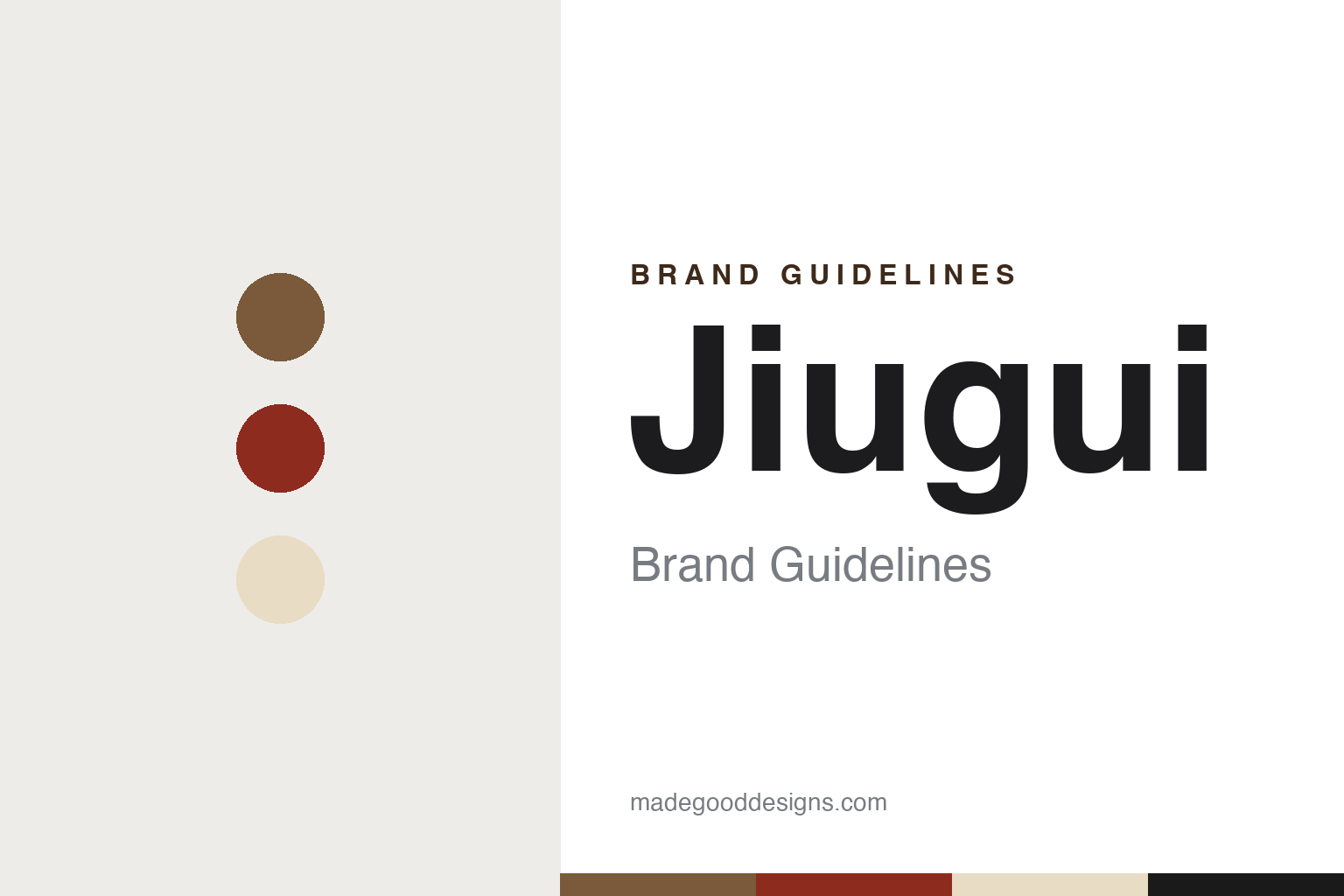
Jiugui Brand Guidelines
The Hunan baijiu in Huang Yongyu’s hemp-sack bottle.
Aa
Two constants: a hemp-sack brown, seal red and brush ink palette and an old-style serif register. Abstract homage — not a Jiugui product or mark; no bottle, calligraphy or logo is reproduced.
A distillery in Xiangxi
From a state works in Jishou to a named brand.
Jiugui comes from Jishou, a city in the Xiangxi Tujia and Miao Autonomous Prefecture of western Hunan. The Beijing News, in a December 2019 history of the company, traced it to the Jishou Distillery, a state-owned works founded in 1956 and later renamed the Xiangquan Liquor General Factory. Chinese Wikipedia dates the factory’s Xiangquan liquor to 1977; the name survives as the company’s entry-level brand.
The name Jiugui, written 酒鬼, means roughly “wine ghost,” the everyday Chinese word for a drunkard: an unusual thing to call a premium spirit, and a deliberate one. The Beijing News reported that in the 1980s the painter Huang Yongyu both named the brand and designed its packaging, and that the support of cultural figures helped it win a following in Beijing. The company, Jiugui Liquor Co., Ltd., listed on the Shenzhen Stock Exchange in July 1997, the same report said, and it remains based in Jishou.
The spirit itself has its own category. Chinese Wikipedia, citing a 2020 Sohu business article, describes Jiugui as a mixed-aroma baijiu that can be placed in the narrower Fuyu aroma type, 馥郁香型, a name that suggests a rich, layered fragrance. Jiugui calls itself the creator of Fuyu-aroma baijiu, and its general manager’s work report for 2020, filed with the Shenzhen exchange in April 2021, said that Fuyu aroma now ranked among the eleven aroma types with a Chinese national standard. Chinese Wikipedia lists three tiers: Xiangquan at the entry level, Jiugui in the middle and the Neican series at the top.
Culture is the company’s chosen theme. The same 2020 report described its mission as leading China’s “cultural liquor,” and named three core values for the brand: a “cultural Jiugui,” an “ecological Jiugui” and a “Fuyu Jiugui,” the last pointing back to the aroma style it claims to have created.
Colour
A hemp sack in clay, and two lines of brushwork.
Jiugui’s identity rests on one object. The Paper reported in January 2018 that Huang Yongyu designed the first version of the packaging in 1987: a ceramic bottle shaped like a hemp sack, tied at the neck. He also wrote the two characters of the name, 酒鬼, in his own hand, and the four characters 无上妙品, which can be read as “a supreme and marvellous thing,” on the back of the bottle. The sack shape and the brushed name have stayed at the centre of the brand ever since.
Huang returned to the design two decades later. According to The Paper, he redrew the packaging in 2007 and added a new line of calligraphy, 不可不醉,不可太醉, roughly “one must get drunk, but not too drunk.” On 21 June 2007 he transferred the intellectual property in the new design to a Jishou culture company, which a week later granted Jiugui permanent exclusive use of it; a supplementary agreement signed in January 2010 restated Jiugui’s exclusive right and gave the culture company a priority right in supplying the packaging. That company later sued over the terms; the Xiangxi Intermediate People’s Court dismissed its claims in September 2017, and when the Hunan High People’s Court heard the appeal in January 2018 both sides said they were open to mediation, The Paper reported.
The bottles are still made close to home. In its 2020 work report the company said it had chosen ceramic factories in Luxi and Baojing counties of Xiangxi, together with local printing firms, as suppliers of its bottles and packaging, buying its materials locally.
Typography
Design and documentation.
The seven brands in this group are all Chinese baijiu names: Jiannanchun, Xifeng, Langjiu, Gujing Gongjiu, Shui Jing Fang, Jiugui and Hongxing Erguotou. Four come from western China — Jiannanchun from Mianzhu and Shui Jing Fang from Chengdu, both in Sichuan; Langjiu from Erlang in Gulin County, also in Sichuan; and Xifeng from Fengxiang, near Baoji in Shaanxi. Gujing Gongjiu is made at Gujing, near Bozhou in Anhui; Jiugui comes from Jishou in western Hunan; and Hongxing Erguotou is a Beijing brand.
Baijiu is sorted into aroma styles, and the group spans several of them. Chinese Wikipedia classes Jiannanchun and Gujing Gongjiu as strong-aroma baijiu, Langjiu as sauce-aroma, Xifeng as the phoenix-aroma style, and Jiugui as a mixed-aroma spirit of its own fuyu type; Beijing Red Star describes its erguotou as light-aroma. Ownership varies just as widely. Shui Jing Fang’s Shanghai-listed company is controlled by Diageo; Jiugui’s Shenzhen-listed company sits within the state food group COFCO; Gujing’s company has been listed in Shenzhen since 1996; and Hongxing Erguotou’s maker is owned by Beijing state investors.
A baijiu brand’s identity is usually carried by a name, a place and a bottle rather than by a single logo, and the company behind the name may have been merged, listed or sold many times since the brand began. Each guide separates what independent sources record from what the company says about itself — its founding story, its owners over time, where its baijiu is distilled and bottled, and how its labels have changed — and marks plainly what rests only on the company’s own word.
Aa
An old-style serif for a brand written by a painter’s brush. (Specimen set in Crimson Pro, a serif STAND-IN; NOT the Jiugui logo or Huang Yongyu’s calligraphy.)
Jiugui
A crisis, a state owner and a recovery.
Jiugui has had a turbulent decade and a half. On 19 November 2012 the National Business Daily reported that bottles of Jiugui bought at random and sent by an industry insider to a third-party laboratory had shown the plasticiser DBP above a limit set by the health ministry in 2011. The company suspended trading in its shares that day; executives said plasticisers were not added in brewing, questioned the laboratory’s methods and pointed to bottle caps as a possible source. The Beijing News later reported that Jiugui halted its packaging lines for corrective work and resumed on 3 December 2012, and that the company posted losses in 2013 and 2014 before returning to profit in 2015.
Ownership settled in the same period. In a board announcement dated 1 October 2015, Jiugui named COFCO, the state-owned food group, as its actual controller, through its controlling shareholder Zhonghuang Co., Ltd.; the Beijing News dates COFCO’s indirect control to 2014 and reported that in May 2018 the stake was brought under COFCO Wine & Spirits. Chinese Wikipedia describes Jiugui as a member of the COFCO group since 2016.
For a design guide, Jiugui shows how a single artist’s object, a sack made of clay and a name in his brushwork, can become the whole identity of a brand. Compare Moutai, whose white bottle is just as recognisable, and Fenjiu, a baijiu defined by its own aroma style. For this guide we use hemp-sack brown, seal red and brush ink with a serif, an unofficial interpretation; no product or logo is reproduced.
Explore & save
Keep Jiugui’s identity on hand — save it to a board in the Made Good inspiration library.
Jiugui identity set
Pin the Jiugui hemp-sack brown, seal red and brush ink palette and the old-style serif register to your own board.


