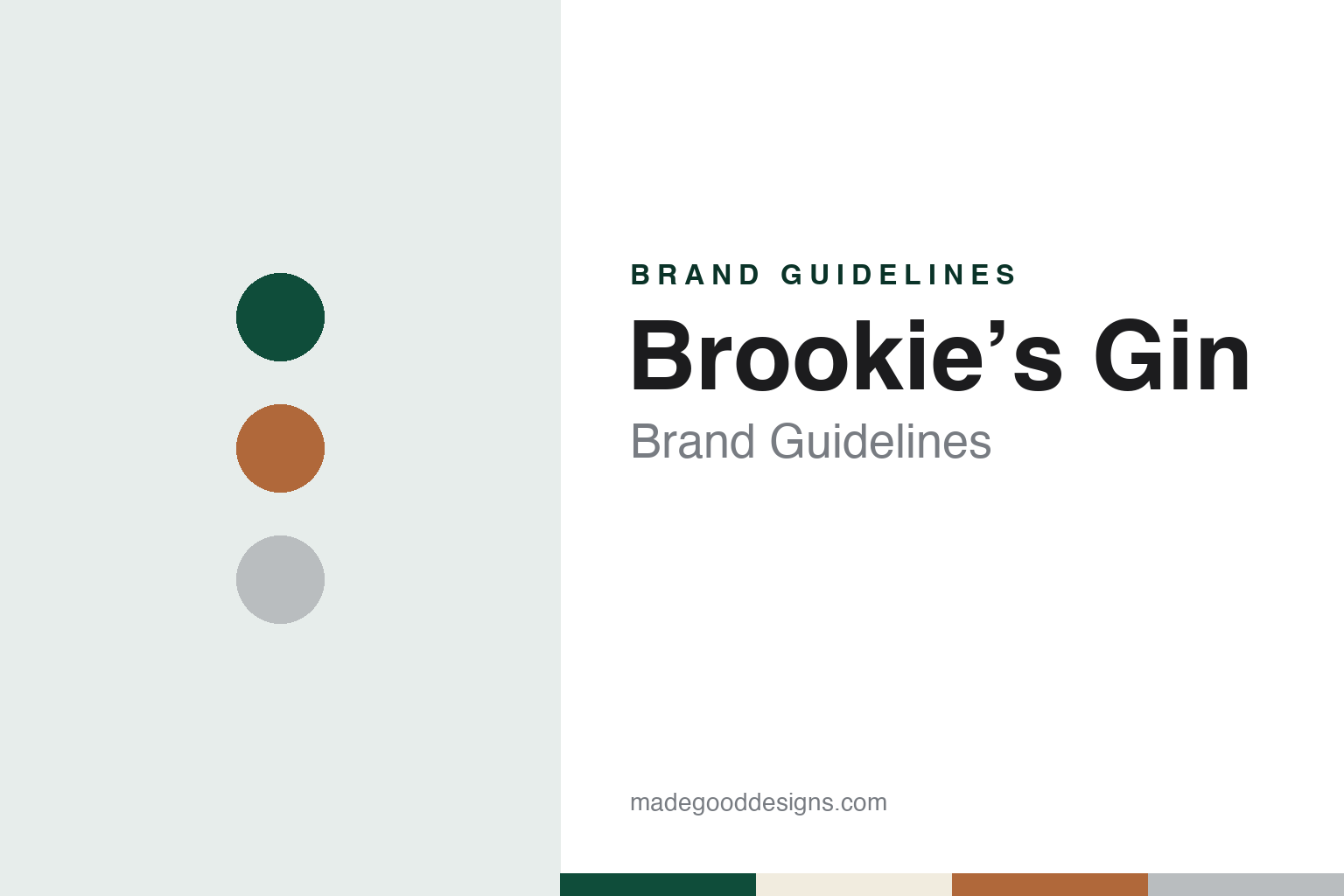
Brookie’s Gin Brand Guidelines
Cape Byron Distillery’s rainforest gin from a Byron Bay farm.
Aa
Two constants: an emerald green, still copper and tin silver palette and a hand-lettered serif register. Abstract homage — not a Brookie’s or Cape Byron Distillery product or mark; no label, logo or bottle is reproduced.
A dairy farm turned rainforest
A macadamia farm, a family business and a Scottish master distiller.
Brookie’s Gin comes from Cape Byron Distillery, which sits on the Brook family’s farm in the hinterland behind Byron Bay, in the Northern Rivers region of New South Wales. Its story starts with the land. Whisky Magazine reported in April 2022 that Pam and Martin Brook bought the property in 1988, when it was a cleared, run-down dairy farm, and that the family went on to plant about 4,500 macadamia trees and some 40,000 native rainforest plants on its 95 acres. The family is also behind Brookfarm, the macadamia and muesli business; Food & Drink Business reported in March 2021 that Eddie Brook is Pam and Martin’s son and that his brother Will runs Brookfarm as chief executive. The company says Martin Brook, known as “Brookie”, is vice president of the Big Scrub Rainforest Conservancy.
The distillery came out of a friendship. Australian Bartender reported in March 2018 that the family had first talked about starting a distillery years earlier, but that the idea only took shape after Eddie Brook, then working for the drinks company SouthTrade, organised an Australian whisky tour with the Scottish distiller Jim McEwan. McEwan worked on Islay at Bowmore, Bruichladdich and Ardnahoe, The Spirits Business has reported, and Australian Bartender credits him with creating The Botanist gin; BeverageDaily noted in December 2016 that he had retired as Bruichladdich’s production director in 2015. Australian Bartender wrote that the family took McEwan into the farm’s rainforest to taste native botanicals such as lilly pilly, riberry and myrtles.
Whisky Magazine dates the distillery’s founding to 2016. BeverageDaily reported that December that Brookfarm had funded the build without outside investors, that the gin was made in a custom 2,000-litre copper pot still, and that the first release, Brookie’s Byron Dry Gin, was being offered to supporters through the Australian crowdfunding site Pozible. In 2018 Australian Bartender described the business as owned by the Brook family and McEwan; The Spirits Business described it in May 2019 as owned by the Brook family, with Eddie Brook as co-founder.
Colour
Native botanicals, a plum gin, a macadamia liqueur and, later, whisky.
The flagship gin is built around the farm’s rainforest. Australian Bartender reported in 2018 that Brookie’s Dry Gin used 26 botanicals, 15 of them native to the Northern Rivers and most picked on the property; The Spirits Business gave the count in 2019 as 26 botanicals, 18 of them native to the Byron Bay region, naming finger lime, aniseed myrtle, cinnamon myrtle, macadamia, river mint and native raspberry among them. The company’s own site now says 17 of the 25 botanicals in Byron Dry Gin come from the local area, so the recipe count has been described differently over time. The design write-up described below says the family wanted it seen as a classic gin in the London Dry style.
A second gin followed quickly. Brookie’s Slow Gin borrows the English sloe-gin idea but uses the Davidson plum, a sour rainforest fruit; Australian Bartender reported in 2018 that the plums were steeped in the dry gin for about seven months, and The Spirits Business said in 2019 that the result was blended with spring water from Mount Warning. When the two gins reached the United Kingdom in May 2019, the same magazine listed Harrods, Hedonism, Master of Malt and The Whisky Exchange among the stockists. The range has since added Mac, a macadamia and wattleseed liqueur, and, according to the company, a cumquat gin called Shirl the Pearl.
Whisky was the longer project. Food & Drink Business reported in March 2021 that the first spirit had gone into ex-bourbon American oak casks in February 2019, with McEwan mentoring Eddie Brook on the single malt. The Spirits Business reported on 27 July 2022 that the distillery had released its first whisky, Cape Byron Single Malt “The Original”, alongside a limited Chardonnay-cask bottling, with McEwan and Brook hosting trade masterclasses as co-founders.
Sustainability is part of the pitch. Whisky Magazine reported on 7 April 2022 that Cape Byron Distillery had been certified as a B Corp, the B Lab standard for social and environmental performance, citing a composting system that uses black soldier flies and the reuse of whisky-making waste as mulch for the farm’s Davidson plum orchard.
Typography
Where Brookie’s sits among Australia’s craft gin and whisky makers.
The seven brands in this group are all Australian gin and craft-spirits names: Archie Rose, Never Never, Brookie’s, Manly Spirits, Ink Gin, Poor Toms and Applewood. They sit at different points in the trade, from small distilleries that still carry a founder’s name or a home town to brands that have taken outside investment or now belong to larger drinks companies, and a single gin can be sold at a cellar door, in a bottle shop and over a cocktail bar.
A gin’s identity is usually carried less by the liquid than by a bottle, a label, a name and the place it promises, and in Australian gin that place is often spelled out through native botanicals and a named region or suburb. The company behind the name may have changed hands, moved its distilling or grown far beyond the shed or warehouse where it started, which makes the plain questions worth asking: who started it, who owns it now, and where its spirit is actually distilled and bottled.
Each guide separates what independent sources record from what the company says about itself — its founding story, its owners over time, where its spirits are made and how its bottles and labels have changed — and marks plainly what rests only on the company’s own word.
Aa
A hand-lettered serif for a signature-style wordmark. (Specimen set in Fraunces, a serif STAND-IN; NOT the Brookie’s logo.)
It’s in our nature
A hand-lettered name, two leaves and a copper still.
The Brookie’s packaging was designed by the Sydney studio Co Partnership. Packaging of the World, which published the project in September 2018, credits Zoe Green as creative director and Max Harkness as art director, and says the team visited the farm and foraged native botanicals by hand before starting. That visit produced the brand line “It’s in our nature”, which the studio says guided the design and the tone of voice. The family, the write-up adds, wanted Brookie’s seen as a classic Australian gin in the London Dry style rather than a niche product.
The details all point back to the farm. The signature logo is hand lettered and deliberately keeps the imperfections of its first version. The “B” of the monogram is made from two leaves, embossed in copper foil as a reference to the still, and set against a deep emerald green meant to place the brand in the rainforest. The silver tin capsules echo the tags hung on the macadamia trees, and the label paper is made from recycled sugar cane.
The same studio dressed the macadamia liqueur in a looser register. Packaging News reported in May 2019 that the Mac label draws on 1960s and 1970s surf culture and the poster for the surf film The Endless Summer, with a shaka hand gesture on the front, gold foil to stand out in dim bars and a leafy capsule that nods to the Northern Rivers rainforest. Harkness told the magazine the shaka was meant as a friendly, easygoing welcome.
The names need a little care. Brookfarm, the family’s muesli and macadamia brand, is a separate business from the distillery, which trades online at capebyrondistillery.com.
For a design guide, Brookie’s shows how a hand-lettered name, a monogram drawn from two leaves and a single deep green can turn a farm’s rainforest regeneration into a gin brand. Compare The Botanist, the Islay gin Jim McEwan created at Bruichladdich, and Four Pillars, the Yarra Valley gin maker. For this guide we use emerald green, still copper and tin silver with a serif, an unofficial interpretation; no product or logo is reproduced.
Explore & save
Keep Brookie’s Gin’s identity on hand — save it to a board in the Made Good inspiration library.
Brookie’s Gin identity set
Pin the Brookie’s emerald green, still copper and tin silver palette and the hand-lettered serif register to your own board.


