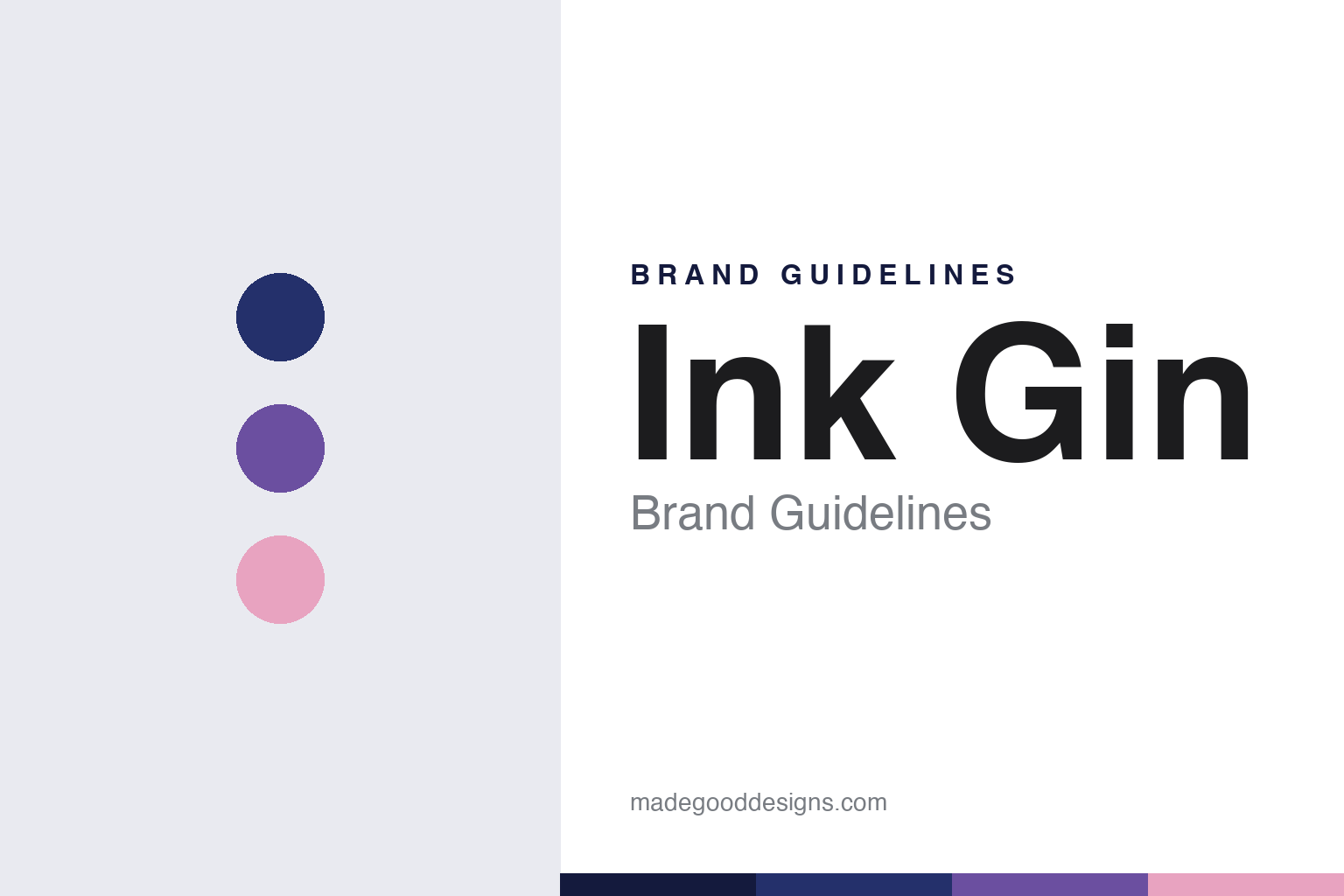
Ink Gin Brand Guidelines
The colour-changing gin from a Tweed Valley cane farm.
Aa
Two constants: an indigo, violet and pink palette and an inkwell serif register. Abstract homage — not an Ink Gin product or mark; no bottle, label or logo is reproduced.
A cane farm on the Tweed
A rum distillery first, a gin second.
Ink Gin comes from a rum distillery. Husk Distillers sits on the Messenger family’s sugar-cane farm outside Tumbulgum, on the Tweed River in the far north of New South Wales, close to the Queensland border. Production of the family’s first paddock-to-bottle agricole-style rum, made from cane grown on the farm, began in 2012, Scout Magazine reported in 2019. The company’s own account of its history agrees: in December 2025 it described itself as “thirteen years in.”
In March 2016 the agricultural paper The Land described the business as a family affair on a 60-hectare cane farm. It named the founder as Paul Messenger, whom it called a retired geologist, working with his wife Mandy Perkins, their daughter Harriet and a cousin, Don Mackay, a chemist by training. The rum, the paper reported, is made from crushed cane juice rather than molasses, from cane varieties chosen with the help of a Tweed cane farmer for the drinking quality of their juice rather than for sugar yield. The first barrel of three-year-old rum had been released online just before Christmas 2015.
The gin came while the rum was ageing. “Last year the family brought a second product to market — Ink Gin,” The Land wrote in 2016, which places the launch in 2015. It described a gin distilled with 14 botanicals from around the world, including locally grown lemon myrtle, and finished with an infusion of dried butterfly pea flowers from Asia, added at the end of the process.
Colour
A flower that reacts to tonic.
The colour is the brand. Butterfly pea flowers give the gin a deep blue to violet tint, and the pigment is sensitive to acidity: when the gin meets tonic water, which is usually acidic, it shifts towards pink, The Land explained. Scout Magazine described the same effect in 2019 as a change from blue to purple. Messenger told The Land that balancing the ingredients for both flavour and visual effect took four years of tinkering.
That shift explains the name. The company calls the colour a “floral ink,” and its website now sells the gin as “the original colour-changing gin” — the company’s own description. The range has grown to four gins, the company says: Ink Gin, Ink Bitter Orange Gin, Ink Sloe & Berry Gin and Ink Art Gin.
The family has shaped the brand directly. In 2019 Scout Magazine listed Mandy as the company’s chief financial officer and “chief designer,” Harriet in marketing, Edwina in logistics and Claudia in graphic design. In July that year the magazine reported that Husk Farm Distillery, with a cellar door, cocktail bar and café, had just opened to the public on the farm, and that the business had outgrown its original shed.
The labels were redrawn in a refresh reported in January 2024 by Food & Drink Business. The new labels were designed by the studio Zendoke and produced with the label printer MCC. The design treats the bottle as a heritage inkwell, with a torn paper edge and textured paper. A round front label carries the main branding, with embossing and hot foil colour-matched to each variety; a strip label wraps around three sides of the bottle with the details of the variety; a custom die-cut shape and variable batch numbering complete it, with a small back label. The magazine linked the refresh to growth: the distillery had replaced a manual labelling process with high-speed applicators.
Typography
Australian gin and its distillers.
The seven brands in this group are all Australian gin and craft-spirits names: Archie Rose, Never Never, Brookie’s, Manly Spirits, Ink Gin, Poor Toms and Applewood. They sit at different points in the trade, from small distilleries that still carry a founder’s name or a home town to brands that have taken outside investment or now belong to larger drinks companies, and a single gin can be sold at a cellar door, in a bottle shop and over a cocktail bar.
A gin’s identity is usually carried less by the liquid than by a bottle, a label, a name and the place it promises, and in Australian gin that place is often spelled out through native botanicals and a named region or suburb. The company behind the name may have changed hands, moved its distilling or grown far beyond the shed or warehouse where it started, which makes the plain questions worth asking: who started it, who owns it now, and where its spirit is actually distilled and bottled.
Each guide separates what independent sources record from what the company says about itself — its founding story, its owners over time, where its spirits are made and how its bottles and labels have changed — and marks plainly what rests only on the company’s own word.
Aa
An inkwell serif — the heritage note in the 2024 labels. (Specimen set in Cormorant Garamond, a serif STAND-IN; NOT the Ink Gin logo.)
Ink Gin
A label that doubles as a gallery.
The most distinctive design idea in the range is Ink Art Gin. Through its Ink Art Prize, the company says, one Australian artist’s work is chosen for a limited release of the gin, “turning each bottle into a piece of liquid art.” Its website names the artist Brian Connolly for 2022, Natalie Yates for 2023 and Karina Jambrak for 2024, whose winning work is titled “Black Cockatoos in Sydney Harbour”. The company says the prize is now held every two years. On the 2024 labels, Food & Drink Business reported, Ink Art Gin has a double-sided back label, so that a second design shows through the bottle and gives a three-dimensional effect with the front labels.
Husk changed its leadership in 2025. In December it announced that Quentin Brival, born in Martinique and with the business since 2017 as head distiller and head of production, had become chief executive, while Paul Messenger moved to executive director, focusing on strategy, product development and industry advocacy. The announcement described Husk as an “independent, family-owned distillery,”; the Ink website says the gin was “born on our family farm in the Northern Rivers.” The Messenger family has owned Husk since it began distilling in 2012.
For a design guide, Ink Gin shows how a single visual trick — a colour that changes in the glass — can become a name, a palette and a label concept at once. Compare Four Pillars, the Yarra Valley gin distillery, and Brookie’s Gin, another New South Wales gin. For this guide we use inkwell indigo, pea-flower violet and tonic pink with a serif, an unofficial interpretation; no product or logo is reproduced.
Explore & save
Keep Ink Gin’s identity on hand — save it to a board in the Made Good inspiration library.
Ink Gin identity set
Pin the Ink Gin indigo, violet and pink palette and the inkwell serif register to your own board.


