Maraska Brand Guidelines
Zadar’s Maraschino maker, formed from Drioli, Luxardo and Vlahov.
Aa
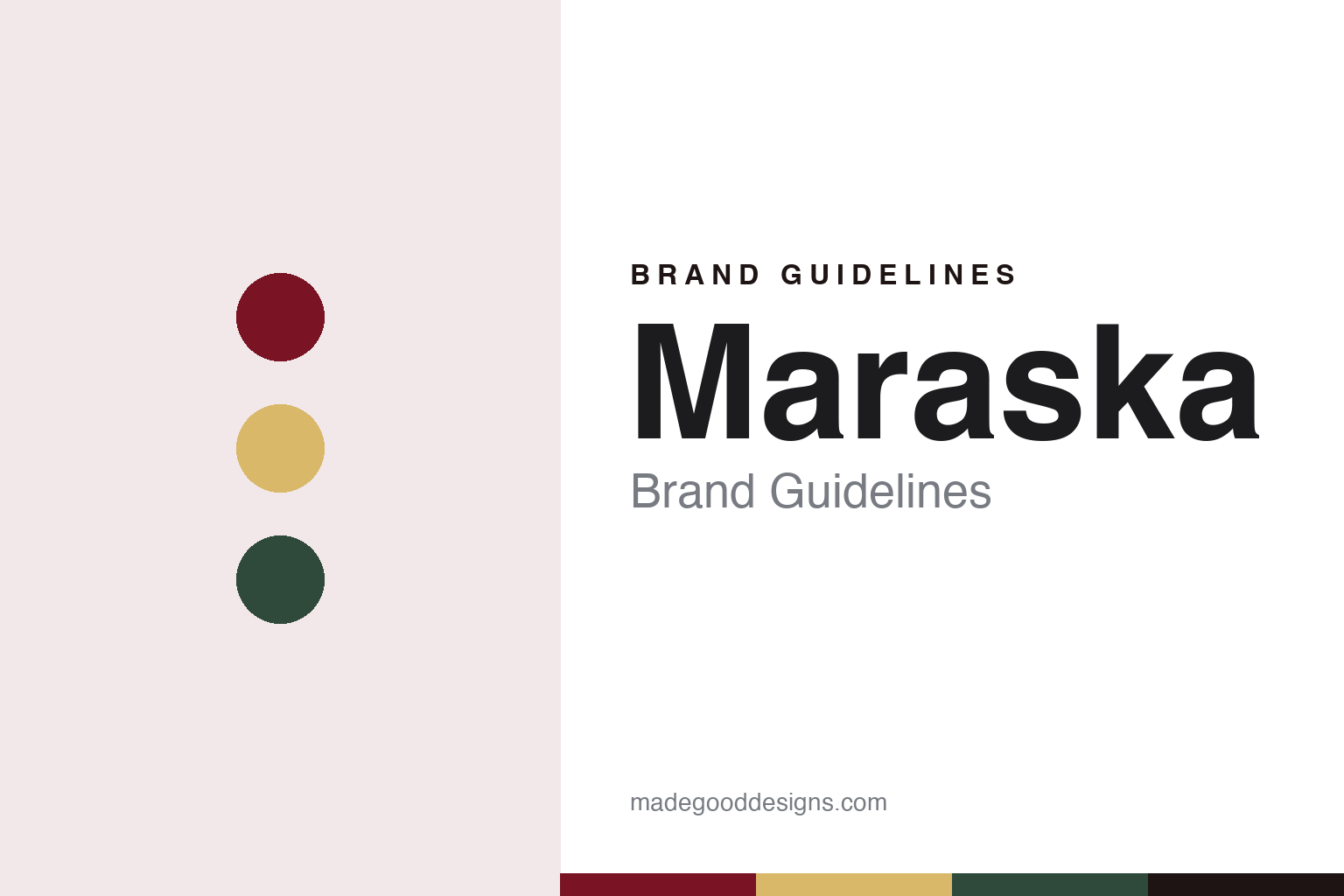
Two constants: a marasca red, braided straw and bottle green palette and a high-contrast serif register. Abstract homage — not a Maraska product or mark; no label, logo or bottle is reproduced.
Three factories, one name
How Zadar’s rival liqueur houses became Maraska.
Maraska is the Zadar company built around the marasca, the sour Dalmatian cherry that gives Maraschino its name. The company’s own history begins long before the firm: it cites a notarial record of 1399, held by the State Archives in Zadar, that mentions a large marasca tree near the city walls.
Its industrial story starts with Francesco Drioli, a merchant who, the company says, came to Zadar from Istria in 1768 and founded a liqueur factory that took marasca distillation to industrial scale; English Wikipedia dates the start of Drioli’s production to 1759. From 1808, the company says, his nephew Giuseppe Salghetti took the name Salghetti-Drioli and kept the firm going. By then the house already traded far beyond Dalmatia: the company cites a notice in the London Morning Post of 17 June 1779 announcing a shipment of Zadar maraschino, and says that in 1803 Drioli received an imperial privilege from Vienna to trade his liqueur freely across the Habsburg lands and to display the imperial eagle on his factory. Competition grew too: in 1813, it says, a former Drioli employee, Josip Sabalić, set up his own liqueur works. Girolamo Luxardo opened a rival factory in Zadar in 1821, and Romano Vlahov, whose house liqueur was called Vlahovac, moved his works to the Brodarica district of the city in 1886, according to the company. In 1911, it adds, the Luxardo family built a house-factory named “Maraska” at the start of the Obala kneza Trpimira waterfront.
The Second World War ended that era. The company says Allied bombing of Zadar in 1943 and 1944 badly damaged several factories, and English Wikipedia says the historic plants were nationalised after the war and merged into one enterprise. In the company’s dating, the three best-known houses — Excelsior Girolamo Luxardo, Romano Vlahov and Francesco Drioli S.A. — were consolidated at the end of December 1946 into “Maraska,” a factory of liqueurs, chocolate and sweets. It was entered in the state register in November 1948 as the Maraskino distillery and renamed Maraska on 7 February 1949; English Wikipedia gives 1945 as the founding year. The Luxardo family, meanwhile, rebuilt its business in Italy, at Torreglia near Padua, English Wikipedia says; its story is told in our Luxardo guide.
Colour
The braided bottle and an archive of labels.
The most distinctive thing in Maraska’s visual story is a piece of packaging. The company says Drioli introduced a technique of hand-braiding the bottle in 1806, giving the liqueur a covering as particular as its taste, and that Maraska has kept both the flavour and the hand-woven wrap to this day. It says the Luxardo factory, too, paid close attention to the look of its Maraschino, with bottles woven by hand by young women from Arbanasi, the Zadar neighbourhood.
That emphasis on presentation was shared across the town’s liqueur makers. The company says the Drioli, Luxardo and Vlahov families were among the best-known producers who perfected Maraschino, and that alongside it they made a cherry brandy, later adding other liqueurs, rum and, during the First World War, punch.
The company also presents its past through labels. Its history page carries an archive of old labels from the house range, and the names show how wide that range was: Vlahovac, Orahovac, Kruškovac, Pelinkovac, Cherry Brandy and Šljivovica appear alongside syrups, rum, gin and a chocolate liqueur with egg.
Maraschino is still the centre. On its website the company presents Maraschino as its featured product with five centuries of Zadar tradition behind it, and lists alcoholic drinks, non-alcoholic drinks and gift products alongside it. It also describes Maraschino candied cherries as a growing export line, and says its products made from marasca cherries rely on a variety grown in the Zadar hinterland. The company tells several stories of Maraschino’s reach, including that a large consignment was in the stores of the Titanic in 1912; they are the company’s accounts, not independent records.
Typography
Design and documentation.
The seven brands in this group are all names from the fruit-spirit and liqueur trade of the Balkans and Central Europe: Maraska, Badel 1862, Jelínek, Žuta Osa, Stara Sokolova, Agárdi and Rubin. Between them they come from Croatia, the Czech Republic, Serbia and Hungary, and they sit at very different points in the trade, from long-established houses, some of them privatised after years of state ownership, to producers built around a single distillery.
In this part of Europe a spirit’s identity is often carried as much by a word as by a logo — rakija, šljivovica, slivovice, pálinka, maraschino or vinjak — and the same style can be made by many producers. That makes the questions behind each name worth asking plainly: who started it, who owns it now, where the fruit is grown and where the spirit is actually distilled, aged and bottled.
Each guide separates what independent sources record from what the company says about itself — its founding story, its owners over time, where its spirits are made and how its labels and bottles have changed — and marks plainly what rests only on the company’s own word.
Aa
A high-contrast serif for a label tradition rooted in nineteenth-century Zadar. (Specimen set in Playfair Display, a serif STAND-IN; NOT the Maraska logo.)
Maraska
A new plant, and a new owner.
In 2006, the company says, Maraska moved its production into a newly built plant in Zadar. It describes itself as a joint-stock company of about 150 staff, organised into sales, production, marketing, development, finance and human-resources departments, and its shares trade on the Zagreb Stock Exchange.
The company also sets out what it wants the name to stand for: its stated mission is high-quality alcoholic and non-alcoholic drinks “signed” Maraska Zadar, with quality that stays consistent from bottle to bottle, and it lists export markets across the former Yugoslavia, much of Europe, North America and Australia.
Ownership changed in 2021 and 2022. A notice Maraska filed with the Zagreb Stock Exchange on 16 September 2021 said that its two main shareholders, Saponia and Koestlin, had agreed to sell their combined stake of just over 98 percent to Stanić Beverages of Zagreb, with the transfer due once agreed conditions were met. English Wikipedia dates the acquisition to 2022, and the company now says it is part of the Stanić group, which has owned it since 2022.
For a design guide, Maraska shows how a regional cherry, a woven bottle and a factory name can carry a brand through war, nationalisation and new owners. Compare Luxardo, the Zadar house that rebuilt in Italy, and Cedevita, another Croatian drinks brand. For this guide we use marasca red, braided straw and bottle green with a high-contrast serif, an unofficial interpretation; no product or logo is reproduced.
Explore & save
Keep Maraska’s identity on hand — save it to a board in the Made Good inspiration library.
Maraska identity set
Pin the Maraska marasca red, braided straw and bottle green palette and the high-contrast serif register to your own board.