Sarah Goodridge made portraits small enough to hold in one hand. Working in Boston from 1820 until her eyesight failed around 1850, she painted sitters on thin slips of ivory, in a format meant to be carried, cased and kept close. For designers who work at small sizes, from app icons and avatars to stamps, badges and profile images, Sarah Goodridge is a useful teacher: every one of her pictures has to make a face legible in a few square inches.
The Metropolitan Museum of Art publishes several of her miniatures as public-domain images, and this guide uses four. For more public-domain portraits to study, browse the MGD museum inspiration collection.
Who was Sarah Goodridge?
Goodridge was born on 5 February 1788 in Templeton, Massachusetts, according to Women in World History (via Encyclopedia.com) and a 1947 article by Agnes M. Dods in The Magazine Antiques; the Smithsonian American Art Museum (SAAM) also gives Templeton and 1788. Women in World History and Chris Packard, writing in the history journal Commonplace, both describe her as the sixth of nine children in a farming family. SAAM and Women in World History both record that, with paper scarce, she drew her first pictures on the sanded kitchen floor, and both describe her as largely self-taught.
According to Dods, her first works were life-size crayon portraits made in Templeton in 1812. Both Dods and Women in World History say she learned to paint on ivory partly from a printed booklet.
In 1820 she opened a studio in Boston, as SAAM, Women in World History and Dods all record. The same year she met the portrait painter Gilbert Stuart. SAAM calls the meeting a turning point; Women in World History says Stuart took her on as a student, while Dods describes him advising her to attend a drawing school and giving her critiques. For three decades she painted in Boston; SAAM says she often produced about three portraits a week, and Packard says two or three. SAAM and Packard both record five exhibitions of her work at the Boston Athenaeum between 1827 and 1835.
She never married; SAAM and Women in World History both note that she supported her ailing mother for eleven years and raised an orphaned niece.
Her sight began to fail around 1850, and SAAM says she gave up painting the following year. Women in World History and Packard both say she retired to a house in Reading, Massachusetts. She died in 1853; SAAM gives Boston as the place of death, and Women in World History gives Reading.
Key works by Sarah Goodridge
Gilbert Stuart, 1825
Stuart sat for her in 1825, as SAAM, Dods and Women in World History all record. SAAM quotes his verdict that it was “the most lifelike of anything ever painted of him in this country”. Dods places the original in the Museum of Fine Arts, Boston, and Women in World History says Goodridge also painted replicas, now in the Metropolitan Museum and in Boston. The Met’s version, catalogued as watercolour on ivory, about 9.3 by 7 centimetres and dated around 1825, is shown below.
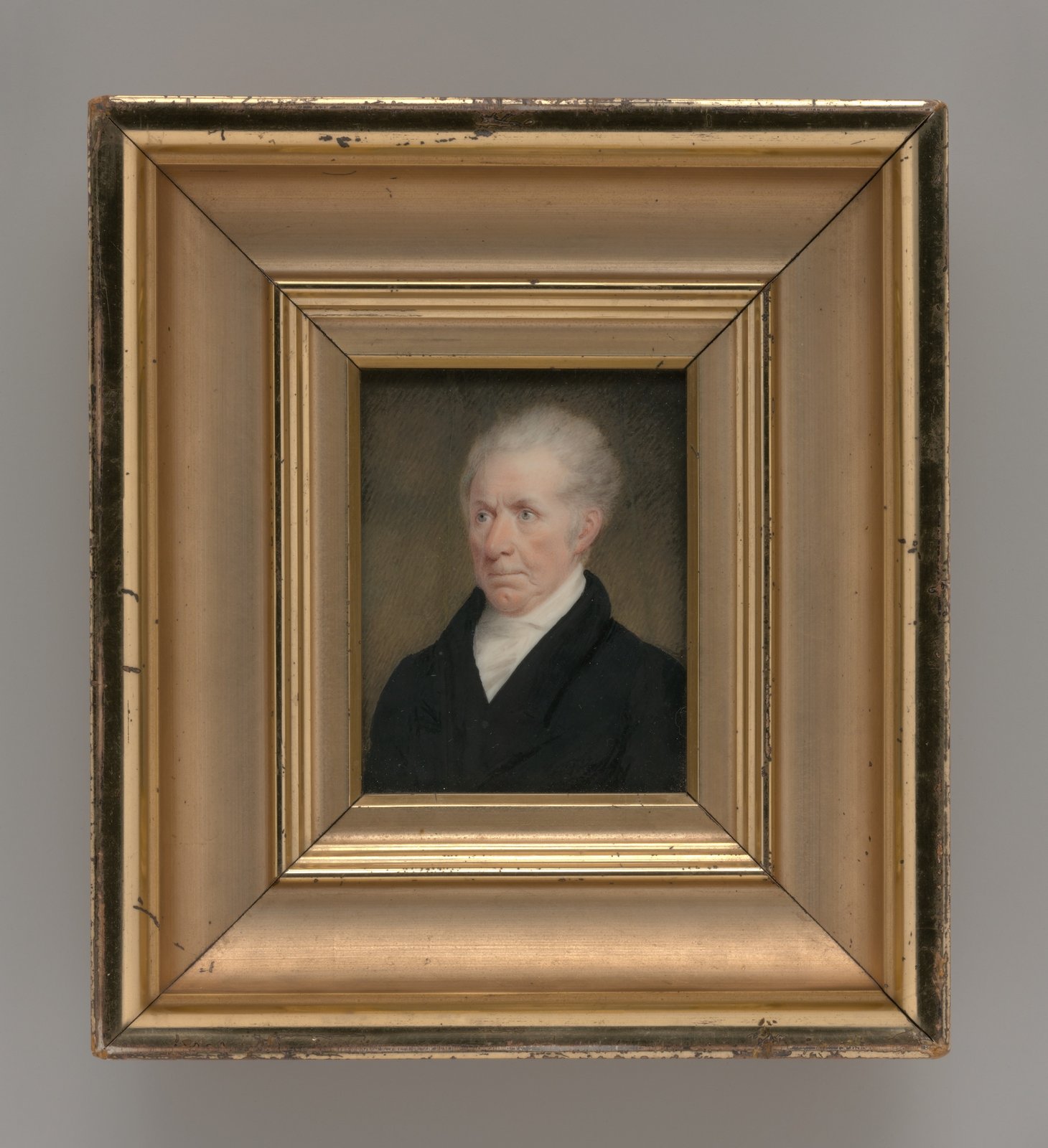
What to look at: the head sits high in the oval of light, the dark coat fills the lower half almost as a solid shape, and the white neckcloth forms the brightest point and pulls the eye straight up to the face.
Portraits of Daniel Webster
SAAM and Women in World History both name the senator Daniel Webster and General Henry Lee among her sitters. Dods records a Webster likeness of 1827 owned by the Massachusetts Historical Society.
Beauty Revealed, 1828
The Met holds this watercolour on ivory, dated 1828 and measuring about 6.7 by 8 centimetres, which it received as a gift of Gloria Manney in 2006. It is an unusual self-portrait: instead of her face, it shows a close-up of the artist’s bare chest framed by gauzy drapery. Packard and the Public Domain Review both say she gave it to Webster in 1828. It is not reproduced here; its lesson for designers is that the miniature could carry private meanings as well as public likenesses.
Self-portraits
Packard describes a self-portrait dated 1830 in the Museum of Fine Arts, Boston, and one of around 1845 in the R. W. Norton Art Gallery, Shreveport, showing her at her easel. He argues that her self-portraits doubled as advertisements of her skill.
Technique: watercolour on ivory
The Met catalogues every Goodridge miniature cited here as watercolour on ivory, and Dods and SAAM describe the same medium. Ivory is smooth, hard and slightly translucent, so paint sits on top of it in thin, transparent layers. Packard notes that she let the bare ivory glow through for luminosity and used stippled, dotted backgrounds; Dods writes that her early work was crude but that she later achieved almost photographic detail.
In the scans, faces are built from tiny touches rather than broad washes, and backgrounds are graded, paler behind the head, so the head sits in a halo of light. Clothing is handled more broadly than the face, which keeps attention on the likeness.
Palette and composition
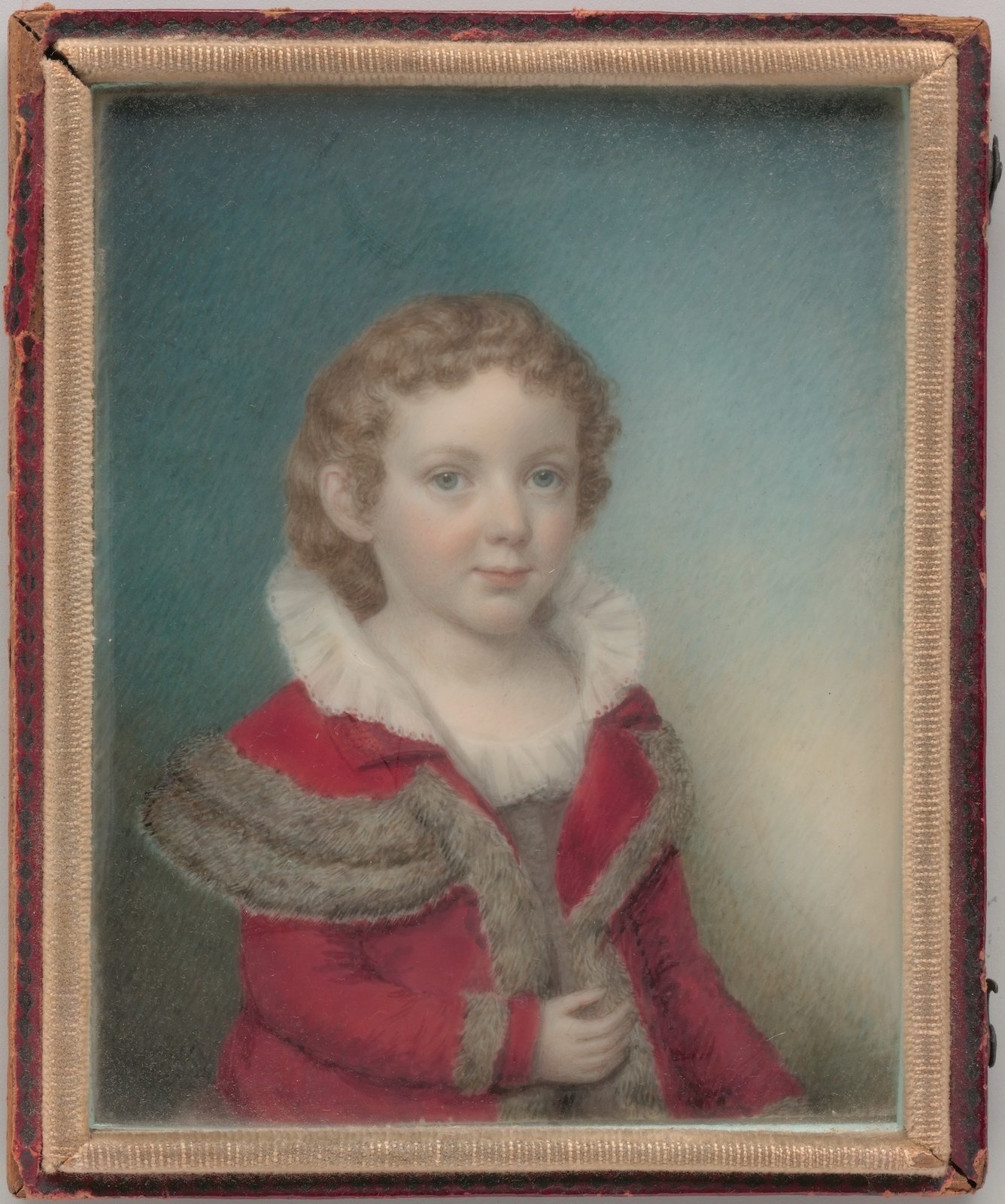
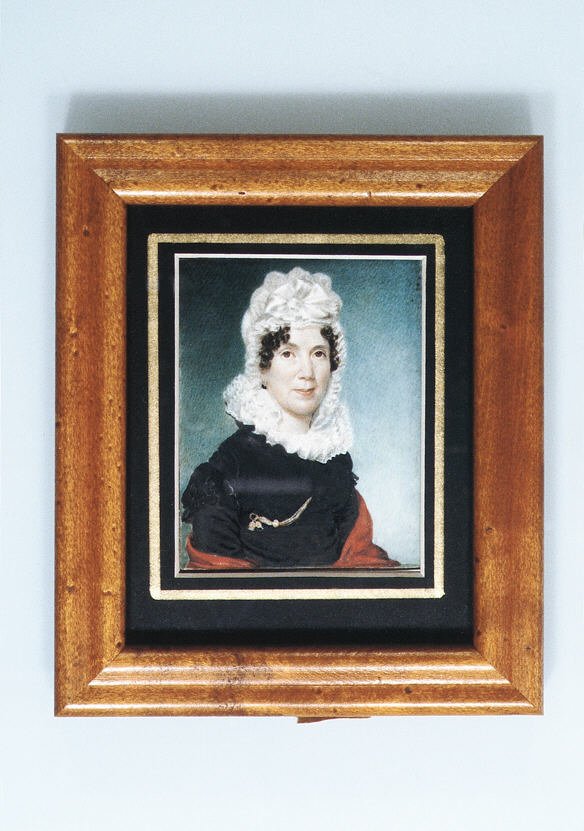
Dods describes her palette as somewhat drab, with unexpected touches of colour in shawls, drapery and upholstery. The Met’s scans bear that out. In Mrs. George Ingersoll, a black dress and white cap frame the face and a sliver of red shawl at the lower edge is the only warm accent. In Edward Blake Parkman, the red coat is the accent, set against a cool sky.
For muted schemes like this, our guide to vintage colour palettes is a good companion. Measured from the museum’s scan of Edward Blake Parkman (Met 13494), the main colours are a blue-green sky at about #4E6562, a muted brick red coat at about #714445, a warm parchment light at about #B7A795 and a grey-green middle tone at about #959B90. From the scan of Mrs. George Ingersoll (Met 13384) come a near-black dress at about #292F33, a pale cap at about #CBD4D5 and a grey-green ground at about #889591. You can sample them yourself with the image colour picker and build variations in the colour palette generator.
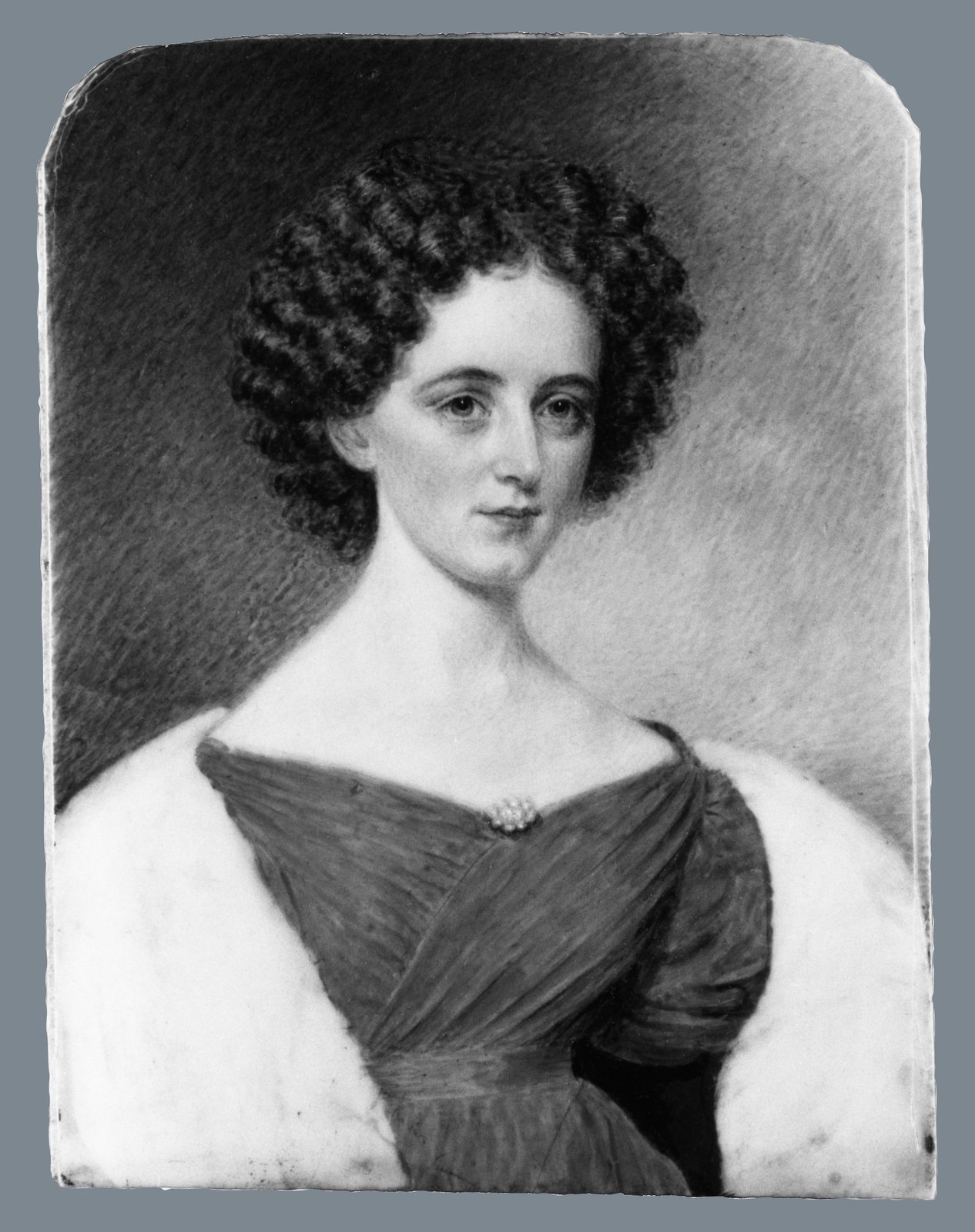
Most of her miniatures follow one pattern: head and shoulders, face turned slightly, eyes above the centre line. The 1830 Portrait of a Lady in the Met shows how far she could push tone alone: the sitter’s dark curls and dress against a pale, hatched ground give a strong, almost graphic contrast.
The miniature as an object
A portrait miniature was never just an image; it was a thing to hold, carry, give and keep. The Met’s photographs show Goodridge’s portraits in deep gilt frames and fitted cases, and Women in World History says Stuart kept his portrait set in a bracelet. The Public Domain Review notes that Beauty Revealed travelled in a leather case with two clasps. Presentation was part of the design, as packaging is today.
The miniature sits close to other small-format portrait traditions; see our guide to silhouette art for the cut-paper profiles that were popular in the same decades, and our guide to Gilbert Stuart for the painter whose portrait she made.
How designers can borrow from Sarah Goodridge
- Design for the thumbnail first. Her portraits had to work at three inches. Test avatars, icons and profile crops at their smallest size and simplify until the face still reads.
- Light behind the head. A graded background that is palest behind the face is a simple way to lift a subject off a busy layout, in photography and illustration alike.
- Keep the palette quiet and add one accent. A dark garment, a pale ground and one warm note, such as a red shawl or coat, give each miniature its focus. The same structure works for brand portraits and team pages.
- Use texture, not outlines. Stippled grounds give her surfaces life; fine grain or halftone can do the same digitally.
- Treat the frame as part of the design. A case, mount or border changes how a small image feels. Consider the container, from card stock to app frame, as carefully as the picture.
Where to see Sarah Goodridge’s work
The Metropolitan Museum of Art holds a group of her miniatures, including those shown here, Beauty Revealed and a Portrait of a Gentleman of around 1825. The Magazine Antiques and Packard both place work by her in the Museum of Fine Arts, Boston. Miniatures are light-sensitive and often off view, so the museums’ online records are the easiest way to study them.
Frequently asked questions
What is Sarah Goodridge known for?
Portrait miniatures in watercolour on ivory, painted in Boston between 1820 and about 1850, above all her 1825 portrait of Gilbert Stuart.
Was Sarah Goodridge a student of Gilbert Stuart?
She met Stuart in 1820. Women in World History calls her his student; SAAM and The Magazine Antiques describe a mentor who critiqued her work. He sat for her in 1825.
What is Beauty Revealed?
It is an 1828 self-portrait miniature in the Met that shows the artist’s bare chest and drapery rather than her face. Two sources say she gave it to Daniel Webster. It is not reproduced in this guide.
Are Sarah Goodridge’s miniatures in the public domain?
Yes. She died in 1853, and the Met marks its Goodridge miniatures as public domain.