Thomas Crawford spent his short career designing sculpture that had to be read from far away: a bronze figure 19 feet 6 inches tall on top of a dome, a row of marble figures along an 80-foot pediment, a horseman ringed by statesmen in a public square. Each one is built from symbols a passer-by can decode quickly. For designers of icons and emblems, Thomas Crawford shows how to load an image with meaning and keep its outline clear.
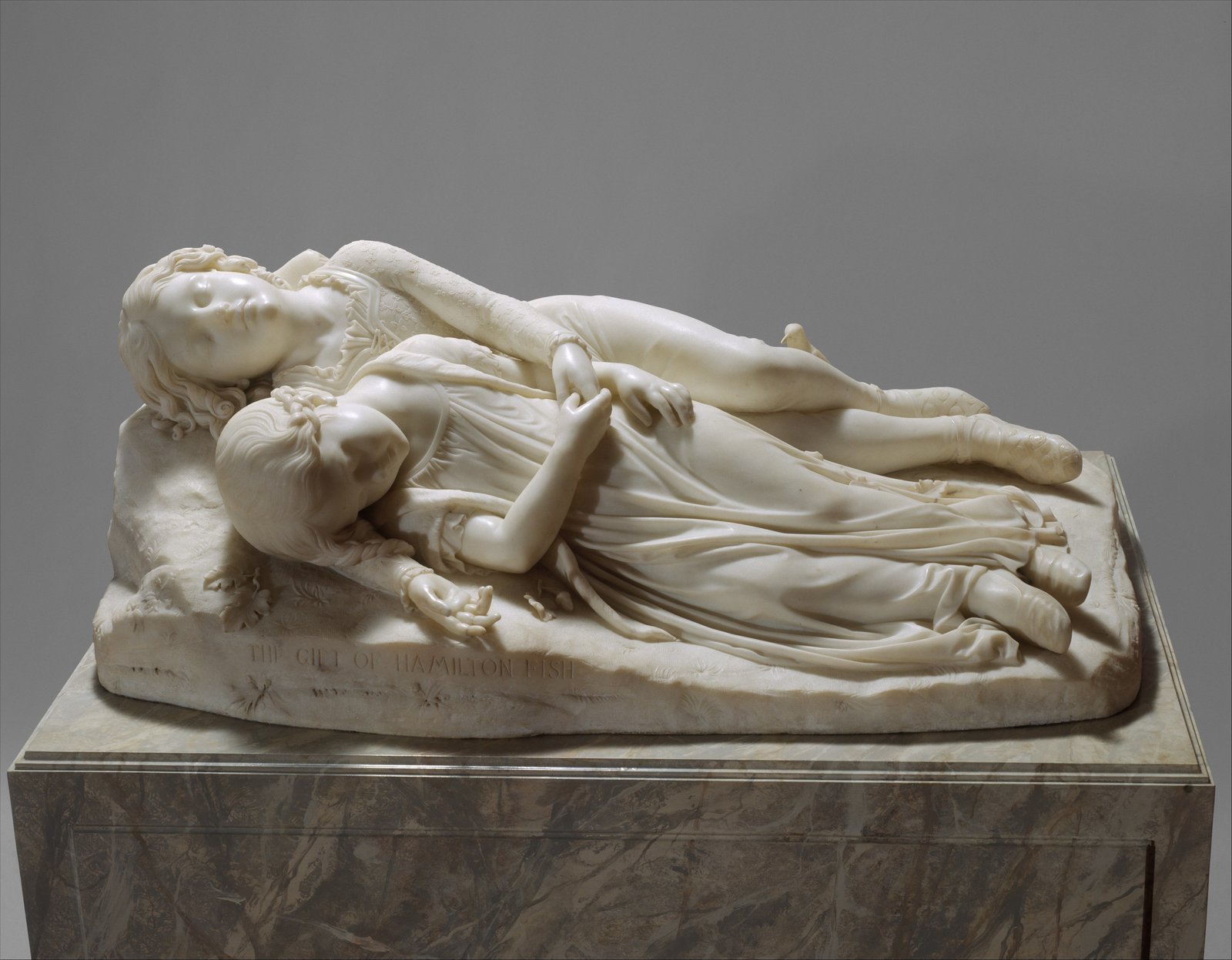
The Metropolitan Museum of Art releases his marble The Babes in the Wood as public domain, shown below. For more cleared images from museum collections, browse the MGD museum inspiration collection.
Who was Thomas Crawford?
Sources give two birth years. The Met records him as born in New York in “1813?” and the Smithsonian American Art Museum (SAAM) gives about 1813, while the Architect of the Capitol (AOC) and Britannica give 1814. All agree that he was born in New York City and died in London in 1857; the Library of Virginia and Britannica give the date of death as 10 October 1857.
SAAM says he trained first in woodwork and then learned to carve marble in New York. The AOC names the studio: the New York stonecutting workshop of John Frazee and Robert Launitz. In 1835, according to both the AOC and SAAM, he went to Rome to study with the Danish sculptor Bertel Thorvaldsen, and he set up his own studio there. For the Danish sculptor’s own work, see our guide to Bertel Thorvaldsen; for the style they shared, see our guide to neoclassical art.
Career outline and key works
Orpheus and Cerberus (marble finished 1843). SAAM says his reputation grew after Senator Charles Sumner arranged a commission for the Boston Athenaeum. The Athenaeum says Bostonians paid for the marble by subscription and that it was unveiled in a gallery built for it in 1844; the US Senate’s art office dates the work to 1843 and places it at the Museum of Fine Arts, Boston.
Ideal marbles of the 1840s. The Met holds three: Genius of Mirth (1842, carved 1843), Mexican Girl Dying (by 1846, carved 1848) and The Babes in the Wood (about 1850, carved 1851).
Washington monument, Richmond (commissioned 1849–50). The Library of Virginia records that Crawford won a design competition for an equestrian George Washington surrounded by standing Virginians, signed his agreement in June 1850 and in 1854 sent a 21-foot plaster of the horse and rider to Munich for casting. After his death, the sculptor Randolph Rogers was chosen to finish it. The monument was unveiled, still incomplete, on 22 February 1858 and finished in 1869, with six bronze Virginians, among them Patrick Henry and Thomas Jefferson, around the base. SAAM and the Senate both list the Richmond Washington among his main works.
Capitol commissions (from 1853). The AOC says that in July 1853 Captain Montgomery Meigs, in charge of the Capitol extension, took Crawford’s name on the recommendation of Senator Edward Everett. The AOC and the Senate credit him with four designs for the building: the Progress of Civilization pediment, the Justice and History group above the Senate doors of the east portico, bronze doors for both the Senate and House wings, and the Statue of Freedom.
The Statue of Freedom: designing a symbol
The AOC dates Meigs’s commission to May 1855. According to both the AOC and the Senate’s historical office, Crawford’s first design was titled Freedom Triumphant in War and Peace; a second showed the figure in a liberty cap ringed with stars. Secretary of War Jefferson Davis objected to the liberty cap, arguing, in the Senate’s account, that it was inappropriate for a people “born free”, and suggested a helmet. Crawford replaced the cap with a crested helmet whose crest, in the AOC’s description, is an eagle’s head and a bold arrangement of feathers. The AOC says this design was approved in April 1856.
The AOC lists the final attributes: nine stars around the helmet, a sheathed sword wrapped in a scarf in the right hand, a laurel wreath and a shield with 13 stripes in the left, and a globe on the pedestal inscribed “E Pluribus Unum”. Crawford died in 1857, soon after finishing the full-size plaster in Rome. The AOC and the Senate both record that it reached Washington in sections by March 1859 and was cast in bronze at Clark Mills’s foundry from 1860. Both credit Philip Reid, an enslaved man who worked at the foundry, with working out how to separate the plaster model for casting. The last section was raised on 2 December 1863.
Progress of Civilization: a long frieze of types
The AOC dates the Senate pediment as designed in Rome in 1854, carved at the Capitol in 1855–59 in marble from Lee, Massachusetts, and set in place in 1863. The pediment is 80 feet long; the sculpture spans about 60. The Senate notes that the Italian carver Tommaso Gagliardi spent about three years carving Crawford’s statuary for the Senate wing.
The composition reads from the centre outward. America stands in the middle with an eagle at her side and the sun at her back. To one side, a woodsman, a hunter and a Native American family and grave stand for the continent’s early days; to the other, a soldier, a merchant, two youths, a schoolmaster with a child and a mechanic stand for human work, with sheaves of wheat and an anchor at the end. The Library of Congress, which reproduces his preliminary sketch of about 1853, notes that the pediment celebrates Euro-American dominance of the continent.
What to look at in Thomas Crawford’s sculpture
Symbols with clear outlines. On Freedom every attribute, from the feathered crest to the shield and wreath, is large and separate. At 288 feet above the plaza, the height the AOC gives for the crest, small detail disappears and outline is all that is left.
A centre and two wings. The pediment and the Richmond monument both put one figure at the centre and arrange subordinate figures around it.
Line in the drapery. In The Babes in the Wood, which the Met says takes its subject from an old English ballad about two abandoned children, the thin dresses fall in long parallel folds across the base. They lead the eye along the group’s length.
A narrow palette. Measured from the Met’s scan of The Babes in the Wood, the brightest marble sits near #ccc9c7, the lit surfaces around #b3afa4 and the shaded folds near #99927f, against a grey backdrop of about #7a7977. These are values from the museum’s scan, not the stone itself.
Technique: models in Rome, work elsewhere
The records show Crawford working as a designer whose models were realised by others: the Richmond horse and rider went to Munich as plaster, the pediment was carved at the Capitol, and Freedom was cast by Clark Mills from a plaster finished in Rome. The Senate also reports that his studio once had 12 rooms and 50 assistants and that he made more than 60 statues. For a sculptor in Florence who ran a similar model-to-marble studio in the same years, see our guide to Hiram Powers; the AOC records that Meigs first suggested Powers and Crawford share the Capitol pediments, and that Powers declined.
How designers can borrow Thomas Crawford’s ideas
Design for the smallest size first. Freedom is seen from far below. Shrink logos and icons until detail goes, and check that the outline still works.
Give each symbol one job. Crawford’s sheathed sword, victory wreath and 13-striped shield each sit apart, and none overlaps another. An emblem with three well-separated elements reads faster than one with ten.
Use a central figure for long formats. On banners or exhibition walls, a dominant centre with smaller elements to each side keeps a wide layout from reading like a list.
Work in one hue. For single-colour print or embossing, use the value range of white marble: one warm off-white and two warm greys. Sample your own from a museum scan with the image colour picker.
Know what a symbol carries. The liberty cap, the helmet and the pediment’s figures all carried political meaning in 1850s Washington. Check what period imagery meant then and means now.
Frequently asked questions
What is Thomas Crawford known for?
For the Statue of Freedom on the US Capitol dome, the Progress of Civilization pediment and the Washington monument in Richmond, Virginia.
Who taught Thomas Crawford?
He trained in a New York stonecutting studio and, from 1835, in Rome with the Danish sculptor Bertel Thorvaldsen, according to the Architect of the Capitol and SAAM.
Did Thomas Crawford see the Statue of Freedom installed?
No. He died in October 1857; the bronze was cast from 1860 and completed on the dome on 2 December 1863.
Can I use images of Thomas Crawford’s sculpture?
The Met flags The Babes in the Wood as public domain, which is why it appears on this page. Photographs of his other works belong to the museums and agencies that hold them, so check each holder’s terms before reusing an image.