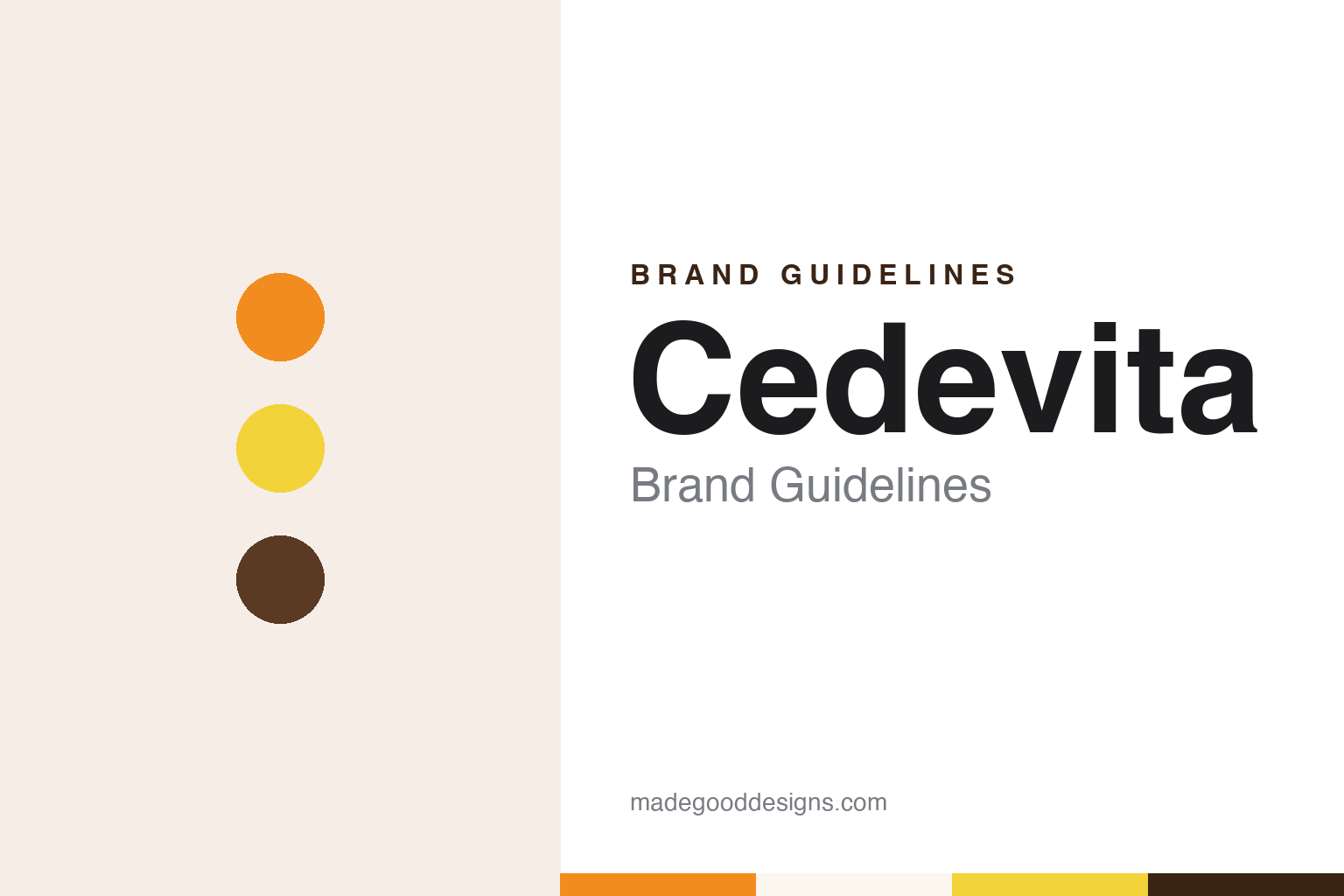
Cedevita Brand Guidelines
The 1969 Pliva instant drink that left the pharmacy.
Aa
Two constants: a Cedevita orange, lemon and brown palette and a rounded sans register. Abstract homage — not a Cedevita product or mark; no pack, logo or label is reproduced.
From the pharmacy
A drink developed inside a drug company.
Cedevita is an instant drink made from granules stirred into water, and it began inside a pharmaceutical company. The company says the drink was created in 1969 “under the wing” of the Zagreb drug maker Pliva, as the result of scientific work, and that production began in 1970. Croatian Wikipedia, citing the brand’s own history page, says the first flavour was orange, and it credits the invention to Martin Stanković, a master of pharmacy, citing the Zagreb daily 24sata.
The first packs showed that origin. Cedevita came in small glass bottles with a measuring scoop, packed in cardboard boxes, and was at first sold only in pharmacies, Croatian Wikipedia says; the company describes the original format as glass vials sold through pharmacies. Croatian Wikipedia adds that at first sight the product looked more like a medicine than a drink, and that it was well received and soon became available outside pharmacies as an everyday consumer product.
New flavours came slowly. Lemon arrived in 1985 and grapefruit in 1990, according to both English and Croatian Wikipedia, and English Wikipedia dates a sugar-free version to 1985 and wild berry and apple flavours to 1999. For three decades Cedevita was developed within Pliva’s own business, Croatian Wikipedia says. The company that makes it today is named on the brand’s website as Atlantic Cedevita d.o.o., part of Atlantic Grupa, and is based in Zagreb.
Colour
Brown tubs, café glasses and a basketball club.
Much of Cedevita’s design history is told through its packaging. In the company’s own fifty-year timeline, the first change after the pharmacy years came in 1980, when Cedevita introduced brown plastic packaging, which the company says became a familiar sight at social gatherings. Larger family sizes followed: the timeline dates a 1 kg pack to 1990, while the company’s “about us” page gives 1993 for the first 1 kg family pack and 1999 for a 500 g pack.
The drink then moved out of the home. The company says Cedevita began appearing in cafés around 2000, and Croatian Wikipedia says that entering the hotel and catering trade meant it could be ordered in most cafés in Croatia and the surrounding region. In 2010, Croatian Wikipedia says, a special cap that keeps the powder apart until the drink is opened took Cedevita into the on-the-go market; the company’s timeline dates its Cedevita Fresh variant to 2009.
The current brand platform is called “Generation CE”, which the company describes as a generation of creative, open people “of all ages, but young in spirit.” Its campaign pages use lines such as “Years are nothing but a number” and “Differences bring us together.” The company marked the brand’s fifty years in 2019 under the line “50 years of fresh memories.”
The name also reached sport. A Zagreb basketball club founded in 1991 as KK Botinec was renamed KK Cedevita after Atlantic Grupa became its main sponsor in 2005, English Wikipedia says. In 2019 it merged with Ljubljana’s Olimpija to form KK Cedevita Olimpija, which the same source calls the first merger of two clubs from different countries; the Ljubljana club still carries the Cedevita name.
Typography
Croatian food and drink brands.
The seven brands in this group all make food or drink, and all of them come from Croatia: Dukat, Vindija, Zvečevo, Franck, Cedevita, Jamnica and Ledo. Croatian food and drink brands in general sit at many different points in the trade, from firms that still carry the name of the town or region where they started to names that now belong to much larger food groups, and a single brand can be sold everywhere from a corner kiosk to a supermarket shelf.
A food or drink brand’s identity is usually carried less by a single product than by a pack, a name and the everyday moment it promises, because the company behind the name may have changed hands, moved its production or grown far beyond the town where it started. That makes the questions behind each name worth asking plainly: who started it, who owns it now, and where its products are actually made and packed.
Each guide separates what independent sources record from what the company says about itself — its founding story, its owners over time, where its products are made and how its packaging has changed — and marks plainly what rests only on the company’s own word.
Aa
A rounded, friendly sans for a drink that left the pharmacy. (Specimen set in Nunito, a sans STAND-IN; NOT the Cedevita logo.)
Cedevita
Sold by Pliva, built up by Atlantic.
Pliva sold the business at the start of the 2000s. On 2 July 2001 Pliva announced the sale of Cedevita d.o.o. and another subsidiary, Vivera, in two separate transactions, saying this completed the divestment of its foodstuffs business so that it could concentrate on pharmaceuticals. The buyer of Cedevita was Atlantic Grupa, the Zagreb company that grew out of Atlantic Trade, a consumer-goods distributor founded by Emil Tedeschi in 1991, English Wikipedia says; buying Cedevita turned the distributor into a producer as well. Croatian Wikipedia dates the change of ownership to July 2001, and the company gives 2001 as the year Atlantic acquired the brand.
Under Atlantic the brand has spread further. The company says Cedevita is now sold in more than 30 countries, with its strongest presence in Croatia, Bosnia and Herzegovina, Serbia, Slovenia and North Macedonia, and it puts annual production at around 9,000 tonnes. In a 2009 investor presentation cited by English Wikipedia, Atlantic described Cedevita as its best-selling brand, sitting in a division that accounted for about a quarter of group sales. The brand’s earlier website, cited by Croatian Wikipedia, claimed more than half of the instant vitamin drink market in Croatia and in several neighbouring countries, from Slovenia and Serbia to North Macedonia and Albania. Cedevita’s range has also grown beyond the original granules, English Wikipedia says, to include teas and sweets sold under the same name.
For a design guide, Cedevita shows how a product that began in a pharmacy box became an everyday drink through its packs, its place in cafés and its name on a basketball club. Compare Ovaltine, another powdered drink with a long history, and Jamnica, the Croatian mineral water. For this guide we use orange, lemon yellow and a deep brown with a rounded sans, an unofficial interpretation; no product or logo is reproduced.
Explore & save
Keep Cedevita’s identity on hand — save it to a board in the Made Good inspiration library.
Cedevita identity set
Pin the Cedevita orange, lemon and brown palette and the rounded sans register to your own board.