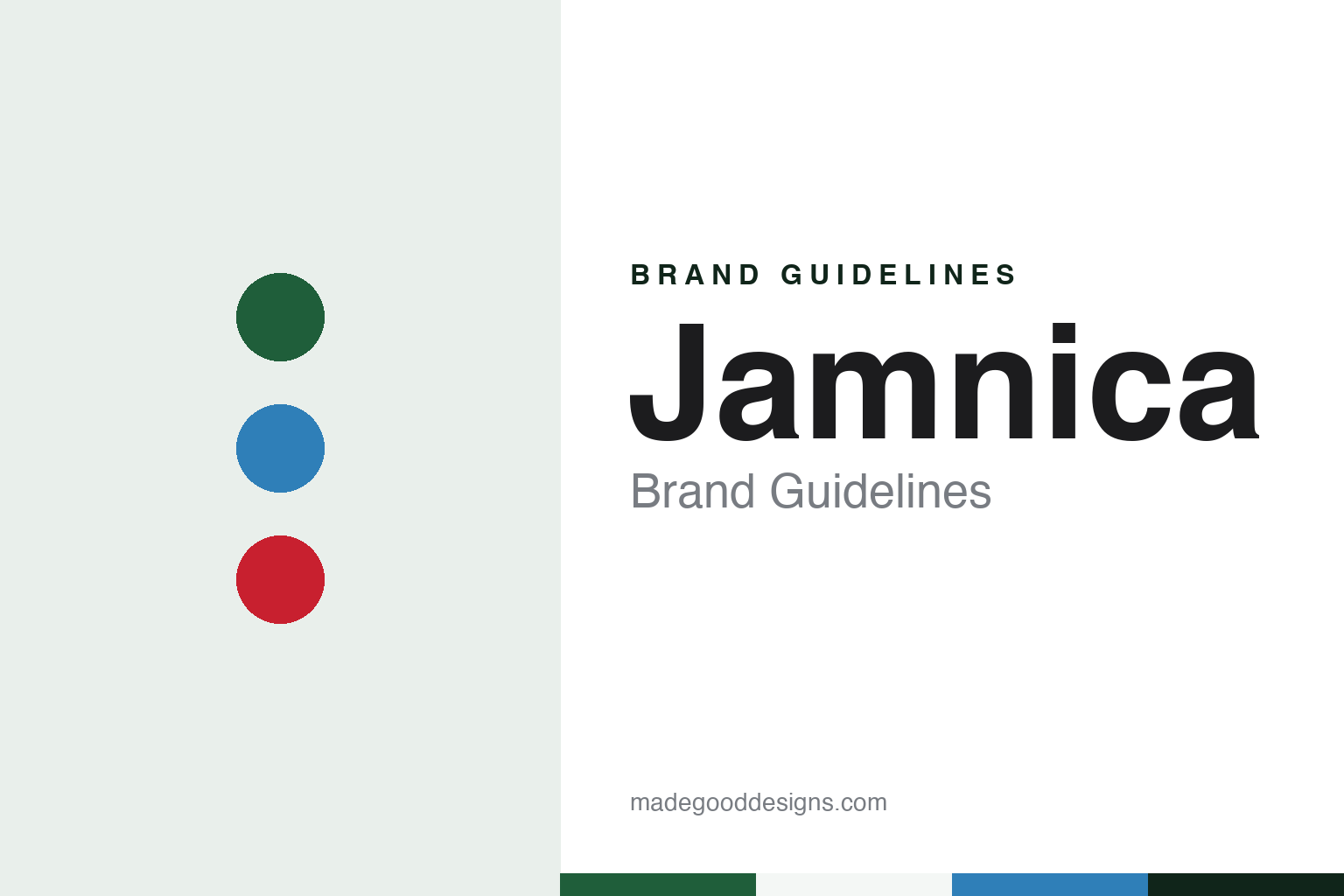
Jamnica Brand Guidelines
The Croatian mineral water first bottled in 1828.
Aa
Two constants: a Jamnica green, blue and red palette and a spa-town serif register. Abstract homage — not a Jamnica product or mark; no bottle, logo or label is reproduced.
A spring and a spa
Analysed for an empress, bottled from 1828.
Jamnica is a mineral water from Jamnička Kiselica, in the municipality of Pisarovina in Zagreb County, and its documented history begins before the brand. In 1772, the company and both English and Croatian Wikipedia say, Empress Maria Theresa had samples of the water sent for chemical analysis, and it was entered that year in a register of mineral waters. In 1823 the pharmacist Josip Mikšić made the first quantitative scientific analysis of the water, Croatian Wikipedia says.
The brand dates itself to 18 October 1828, when, the company says, the first bottles intended for the market were filled; the date is still marked as Jamnica Day. A month later, on 18 November 1828, the pharmacist Đuro Augustin carried out a second analysis, and the company says 5,000 bottles were produced in 1829.
A spa grew up around the spring. A bathhouse opened in 1830 and ran until 1870, and in 1852 a new spa building went up, the work of the Zagreb builder Janko Jambrišak, Croatian Wikipedia says. Bishop Josip Juraj Strossmayer stayed there in 1863 and 1864, and the politician Ante Starčević and the writer August Harambašić also visited; Harambašić, Croatian Wikipedia says, wrote the rhyming couplet that became Jamnica’s best-known slogan.
Colour
From a family business to Badel.
Ownership changed several times before the Second World War. At the end of the nineteenth century the spring was sold to Vilim Lovrenčić, who modernised the bottling plant in 1899; the company says this raised output to what it calls a then revolutionary 500,000 bottles a year, and that by 1903 the business was run from the Lovrenčić family house in Zagreb. In 1926 the spring was bought by Mira Vrbanić and Margita Rottenbucher, and in 1932 a new, modern spring capture was built, Croatian Wikipedia says. The company’s history also records a book about Jamnička kiselica published in 1905. Production lapsed during the Second World War.
It resumed under Yugoslav-era companies. In 1961 the springs passed to Agrokombinat of Zagreb, and a new well, Jamnica 62, was drilled the following year. Two automatic bottling lines were installed in 1964, and on 1 August 1967 the drinks company Marijan Badel bought the plant from Agrokombinat; the company says Jamnica then became part of Badel. Until the 1960s, the company says, bottles were still delivered by horse-drawn carts. A new well, Janino vrelo, followed in 1973, and in 1978 a new bottling plant opened; on 30 December that year its 50-millionth bottle was filled.
The range widened from the 1980s. In May 1982 Jamnica launched Jana, a pair of drinks based on its mineral water in lemon and orange flavours, Croatian Wikipedia says, and in 1986 a mineral-water drink called Sprint tonic. In 1990 Jamnica became an independent company.
Typography
Croatian food and drink brands.
The seven brands in this group all make food or drink, and all of them come from Croatia: Dukat, Vindija, Zvečevo, Franck, Cedevita, Jamnica and Ledo. Croatian food and drink brands in general sit at many different points in the trade, from firms that still carry the name of the town or region where they started to names that now belong to much larger food groups, and a single brand can be sold everywhere from a corner kiosk to a supermarket shelf.
A food or drink brand’s identity is usually carried less by a single product than by a pack, a name and the everyday moment it promises, because the company behind the name may have changed hands, moved its production or grown far beyond the town where it started. That makes the questions behind each name worth asking plainly: who started it, who owns it now, and where its products are actually made and packed.
Each guide separates what independent sources record from what the company says about itself — its founding story, its owners over time, where its products are made and how its packaging has changed — and marks plainly what rests only on the company’s own word.
Aa
A soft, old-style serif for a spa-town water. (Specimen set in Fraunces, a serif STAND-IN; NOT the Jamnica logo.)
Jamnica
Rebuilt by Agrokor, now part of Fortenova.
The 1990s rebuilt the brand. On 7 October 1991 the plant was shelled, and damage to buildings, bottling lines, packaging and stock continued until July 1992, Croatian Wikipedia says; the plant was hit a second time on 10 September 1993. On 28 December 1992 the company became a joint-stock company with Agrokor, the Zagreb group founded by Ivica Todorić in 1976, as majority owner, and Agrokor began rebuilding the plant. Three new lines and distribution centres in Zagreb, Split, Rijeka and Osijek followed in 1993, and the company says annual output had reached 200 million litres by 2001.
The packaging changed with them. In July 1994 Jamnica began filling its own 1.5-litre PET bottle; still Jamnica followed in August 1995, and in December 1995 the labels were redesigned and the company logo changed, Croatian Wikipedia says, and the company’s own history also lists a logo redesign in 1995. A 0.5-litre PET bottle came in July 1996, and in 2007 a 1-litre glass bottle with a folding carrier, which Croatian Wikipedia calls new to the Croatian market. In 2023 Jamnica moved to caps that stay attached to the bottle, in line with an EU directive. The company’s website now uses the line “Izvorno naša.”
Jamnica also became a group. It took majority control of Sarajevski kiseljak in Bosnia and Herzegovina in 2000, of the Fonyodi bottler in Hungary in 2004 and of Mg Mivela in Serbia in 2009, and since 2002 it has bottled Jana water at Gorica Svetojanska, near Jastrebarsko, while Jamnica itself is still filled at Pisarovina. In April 2017 Agrokor was placed under extraordinary administration under a new Croatian law, English Wikipedia says, and on 1 April 2019 Jamnica became part of the newly founded Fortenova Group, the company says. Since 2020 Jamnica plus d.o.o. has been part of Fortenova’s Beverages Group, with sister bottlers in Bosnia and Herzegovina, Serbia, Slovenia and Hungary.
For a design guide, Jamnica shows how a spring with nearly two centuries of bottling behind it keeps its founding year at the centre of the brand. Compare Ledo, the Zagreb ice-cream maker that also joined Agrokor in the 1990s, and Cedevita, the Zagreb instant drink. For this guide we use a spring green, a mineral blue and a red with a serif, an unofficial interpretation; no product or logo is reproduced.
Explore & save
Keep Jamnica’s identity on hand — save it to a board in the Made Good inspiration library.
Jamnica identity set
Pin the Jamnica green, blue and red palette and the spa-town serif register to your own board.