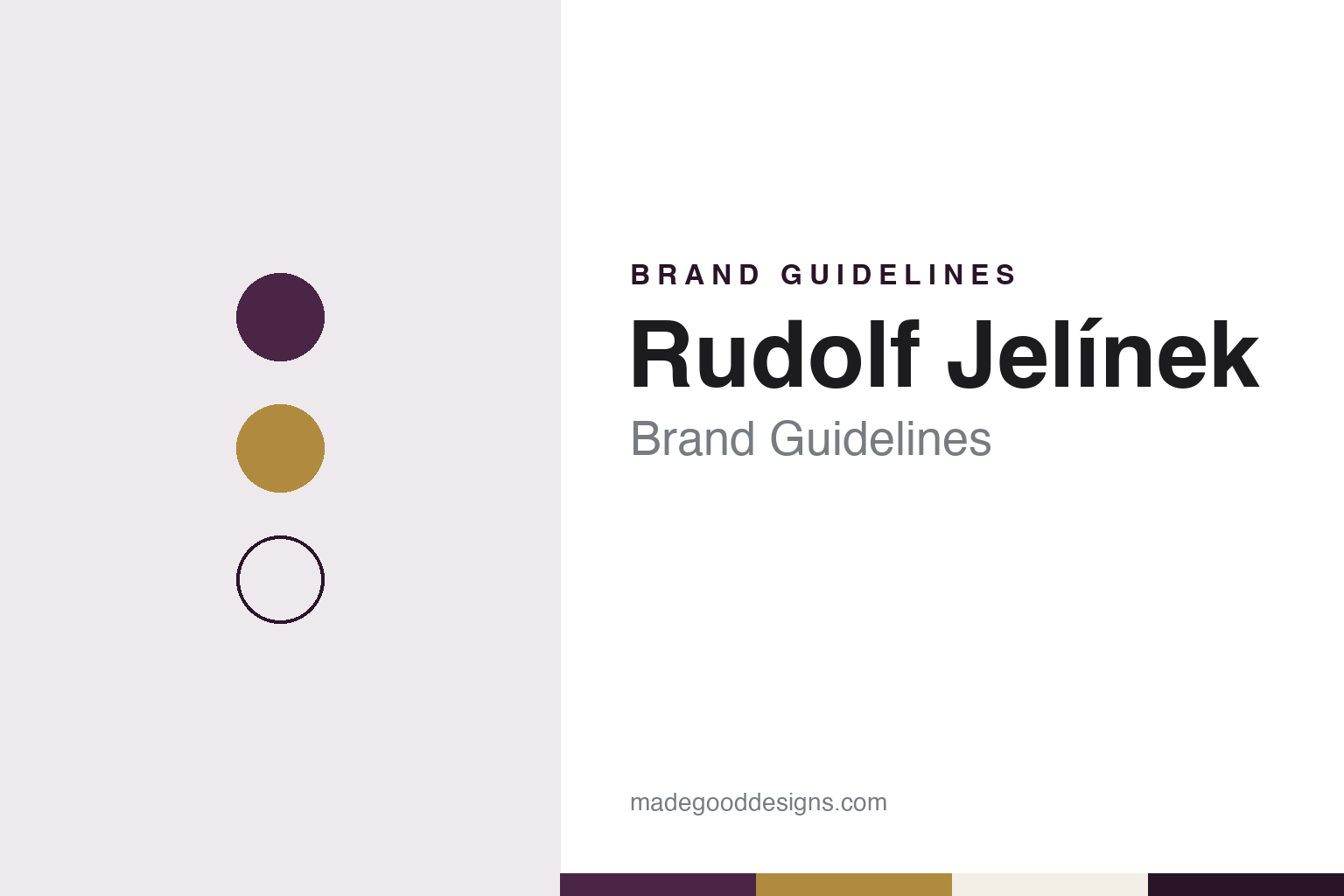
Rudolf Jelínek Brand Guidelines
The Vizovice slivovitz distillery behind the “budík” bottle.
Aa
Two constants: a plum, gold and cellar-paper palette and an old-style serif register. Abstract homage — not a Rudolf Jelínek product or mark; no bottle, label or logo is reproduced.
Zikmund’s sons
A leased distillery, a farmers’ plant and a family name.
The distillery that carries the name Rudolf Jelínek stands at Razov on the edge of Vizovice, a small town in Moravian Wallachia in the east of the Czech Republic. The company’s own history traces distilling in the area to an urbarium of the Vizovice estate dated 1585, which contains the first written record of a distillery there, and says plum brandy, slivovice, began to be made around the middle of the eighteenth century because plum trees thrive on the local hills.
The family story begins in 1882, when, the company says, the owner of the manorial distillery, Aron Eichen, leased it to Jakub Jelínek, who handed the running of it to his son Zikmund. In 1891 Zikmund founded a distillery of his own. Radio Prague International, in a 2022 feature, adds that the Jelíneks were not from Vizovice originally but from the Uherský Brod area. In 1894 local farmers set up a joint-stock fruit-processing company with its own distillery, the Rolnický akciový závod ovocnářský Vizovice, known as RAZOV; that is the year the brand now prints as its founding date.
When Zikmund retired in 1919, his sons Rudolf and Vladimír took over under the name “Zikmunda Jelínka synové.” In 1921 the brothers bought RAZOV. They parted ways in 1926: according to the company, Rudolf stayed at Razov and gave that firm his own name, while Vladimír carried on at the original site under the old name.
Colour
Kosher spirits, war and nationalisation.
Rudolf Jelínek, the company says, began making kosher spirits in the 1930s, partly because of his own Jewish origin, and after the end of Prohibition shipped the first kosher products to the United States in 1934. That trade lasted until the Second World War. The firm was “aryanised” and placed under forced administration until 1945; the company says almost all members of the Jelínek family were murdered in concentration camps. Radio Prague reported in 2022 that Rudolf and his wife were sent to Auschwitz in the autumn of 1944, where both died.
Only Rudolf’s sons, Zdeněk and Jiří, survived. They returned to the business in 1945; the economics site e15 reported in 2022 that Jiří transferred the trademarks to the state. On 28 April 1948, the company says, the Jelínek plant was nationalised. Jiří and his family went into exile — to Israel in 1949, according to Radio Prague — and production was folded into the national enterprise Moravské lihovary a octárny Brno, later part of Slovácké konzervárny. The company says the Rudolf Jelínek name was kept throughout because it was well known abroad, and Radio Prague reported that in 1953 the range was cut to slivovitz, borovička, kirsch and apricot brandy. e15 reported that a rabbi began visiting Vizovice in the 1950s so that kosher spirits could still be exported to the US.
In 1989 the state enterprise became an independent state company named RUDOLF JELÍNEK, and in 1994 the joint-stock company RUDOLF JELÍNEK a.s. was formed as privatisation began. The company calls the period that followed hectic, with unsettled ownership leading to decline; e15 reported that the former management took a 40 per cent stake and that the firm made losses from 1994.
Typography
Plum brandy as a national craft.
The seven brands in this group are all names from the fruit-spirit and liqueur trade of the Balkans and Central Europe: Maraska, Badel 1862, Jelínek, Žuta Osa, Stara Sokolova, Agárdi and Rubin. Between them they come from Croatia, the Czech Republic, Serbia and Hungary, and they sit at very different points in the trade, from long-established houses, some of them privatised after years of state ownership, to producers built around a single distillery.
In this part of Europe a spirit’s identity is often carried as much by a word as by a logo — rakija, šljivovica, slivovice, pálinka, maraschino or vinjak — and the same style can be made by many producers. That makes the questions behind each name worth asking plainly: who started it, who owns it now, where the fruit is grown and where the spirit is actually distilled, aged and bottled.
Each guide separates what independent sources record from what the company says about itself — its founding story, its owners over time, where its spirits are made and how its labels and bottles have changed — and marks plainly what rests only on the company’s own word.
Aa
An old-style serif — for a distillery that keeps its labels close to Rudolf’s originals. (Specimen set in Cormorant Garamond, a serif STAND-IN; NOT the Rudolf Jelínek logo.)
R. JELÍNEK
Orchards, a group and the “budík.”
At the end of 1998 a new group of shareholders led by Pavel Dvořáček entered the company; the company says the new owners rescued it and returned it to profit the following year, and e15 reported in 2022 that Dvořáček, an economist, and his colleagues first bought shares and then took a majority. In 2010 the company set up R. JELINEK GROUP to hold its investments abroad; its sister companies include Vinprom-Troyan in Bulgaria and a subsidiary in Chile, where, the company says, Williams pears are distilled and the spirit shipped in tanks to Vizovice for maturing and bottling.
The company returned to growing its own fruit in 2003, planting plum orchards at Těchlov near Vizovice; since 2008, it says, nine plum varieties have been harvested and distilled separately for a varietal Vizovická slivovice. It bought apricot orchards at Starovice and Velké Němčice in South Moravia in 2013 and launched Starovická meruňkovice from them in 2019. The flagship remains slivovitz, which the company describes as triple-distilled and aged for three years, sold clear, as a gold version aged in oak, as single-variety vintages and as kosher bottlings; the wider range includes pear, apricot, cherry and apple brandies.
The company’s most visible design asset is its bottle. It says its original products can be recognised by a typical bottle it calls the “budík” — the Czech word for an alarm clock. Radio Prague reported in 2022 that the labels have changed little over the decades: the materials and graphics have been adjusted slightly, but the aim is to keep the spirit of Rudolf’s design. The company publishes an “R. JELÍNEK – Original Czech Distillery” logo, a trademark in black-and-white and colour versions, and a line drawing of the distillery building for partners. It also runs a visitor route at Vizovice, opened as Distillery Land in 2004, and a slivovitz museum in a Prague building it bought in 2011; the company says the museum opened to the public in 2019, while Radio Prague dates the opening to 2020.
For a design guide, Rudolf Jelínek shows how a family name, a distinctive bottle and labels kept close to their prewar look can carry a Moravian plum brandy through aryanisation, nationalisation and privatisation. Compare Becherovka, the herbal liqueur from Karlovy Vary, and Žuta Osa, the Serbian plum rakija. For this guide we use plum, damson ink and aged gold with an old-style serif, an unofficial interpretation; no product or logo is reproduced.
Explore & save
Keep Rudolf Jelínek’s identity on hand — save it to a board in the Made Good inspiration library.
Rudolf Jelínek identity set
Pin the Rudolf Jelínek plum, gold and cellar-paper palette and the old-style serif register to your own board.