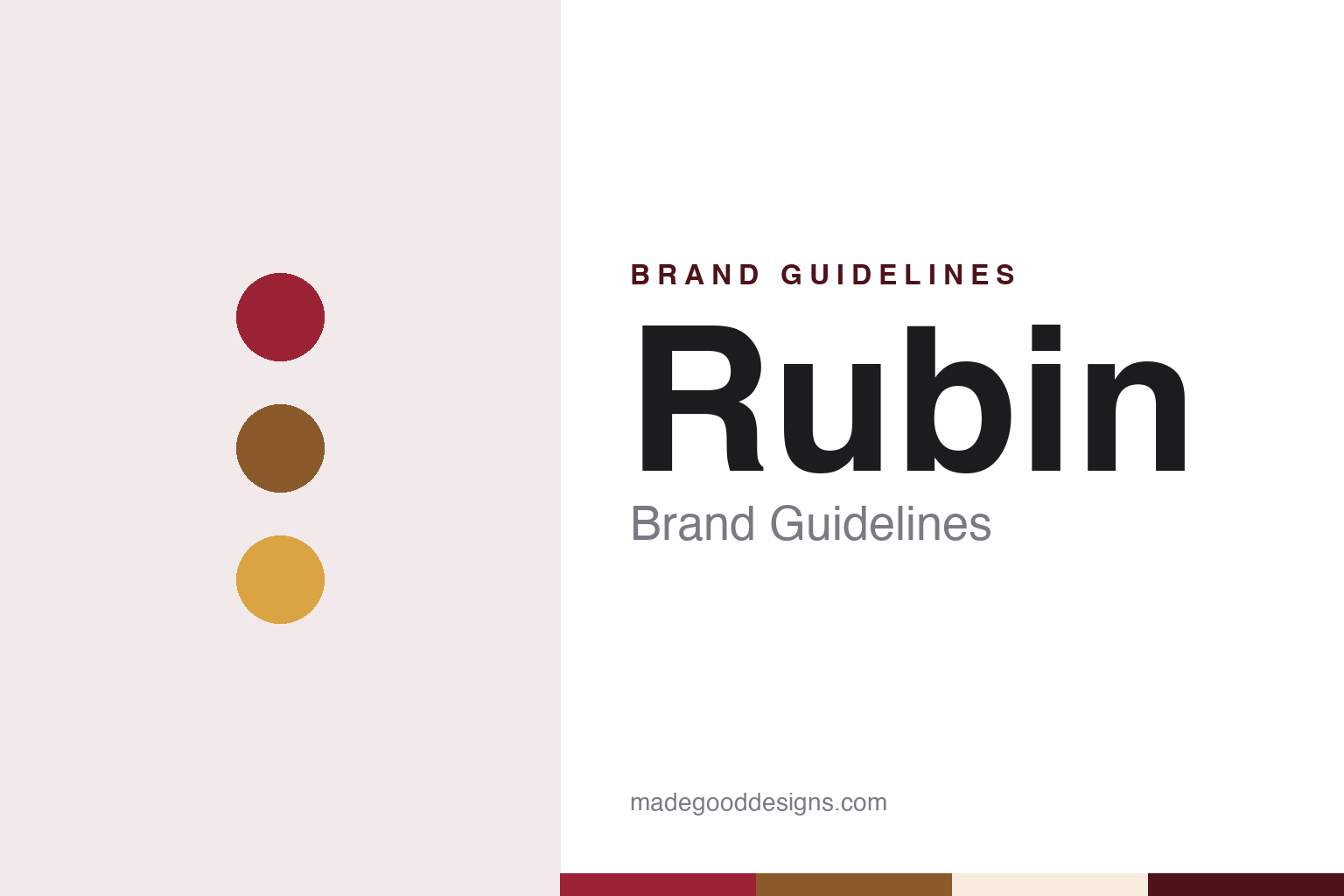
Rubin Brand Guidelines
The Kruševac cellar behind Rubinov Vinjak, founded 1955.
Aa
Two constants: a ruby red, oak brown and vinjak amber palette and a high-contrast serif register. Abstract homage — not a Rubin product or mark; no label, logo or bottle is reproduced.
A wine house in the West Morava valley
From a grape and wine trader to a bottler of brandy and rakija.
Rubin is a Serbian wine and spirits company based in Kruševac, a town in the West Morava wine region of central Serbia. English and Serbian Wikipedia both give its founding date as 14 July 1955. The company says it was set up in Kruševac that year to trade in grapes, wine and other drinks, with the aim of developing grape growing and the production of wine and spirits in the surrounding district. The word rubin is Serbian for ruby.
Its best-known product is Rubinov Vinjak, a brandy distilled from wine. English Wikipedia says Rubin has made the drink since 1957; the company dates its first oak barrels of wine distillate, laid down in Kruševac to age, to 1958. Either way, the spirit belongs to the late 1950s, and the company describes it as its flagship.
According to the company’s own history, Rubin began bottling its own products in the 1960s and built up a distribution network, while ties with local cooperatives brought more vineyards under well-known grape varieties. It says it rebuilt its distillation equipment and built a new cellar for vinjak in the early 1970s, added modern bottling lines for wine and spirits in the 1980s, and kept planting vineyards through the difficult 1990s.
The state-owned company was privatised in 2005. The Serbian government reported on 18 January 2005 that the tender commission of the Privatisation Agency, selling a 70 percent stake, had received three bids — from Invej of Zemun, from a consortium of Vinarija Čoka of Subotica and Rodić MB of Kula, and from the Slovenian company Istrabenz — and had ranked Invej’s offer first. English Wikipedia lists Invej as Rubin’s owner. The privatisation was later scrutinised: the Centre for Investigative Journalism of Serbia (CINS) reported in 2014, citing the Privatisation Agency’s own control reports, that the agency had recorded breaches of the sale contract, and that it had extended deadlines rather than impose a proposed penalty. English Wikipedia lists Rubin as a joint-stock company with shares on the Belgrade Stock Exchange.
Colour
Oak barrels, a renamed brandy and a ruby name.
Rubin’s most consistent image is not a typeface but a barrel. The company says the oak barrels first filled in 1958 became the brand’s recognisable visual symbol, and it still presents its cellars in those terms: it says its spirits cellar holds about 12,000 oak barrels of 500 litres each, and that it makes its own barrels in a cooperage workshop at Pinter. English Wikipedia’s article on the drink describes the same process — wine distilled and then aged in 500-litre oak casks for anything from several months to several years before it is cut with water to bottling strength of 40 percent.
The drink’s name has its own history. English Wikipedia says the brandy was previously sold as konjak, the Serbian rendering of “cognac,” and was renamed vinjak when stricter rules on use of the Cognac name took effect. The new word points to wine (vino), and the company says the name reflects that the spirit is made from wine. English Wikipedia adds that, as in Cognac, the brandy is graded by age as V.S., V.S.O.P. or XO.
Vinjak is not Rubin’s alone. English Wikipedia notes that the Croatian company Badel 1862 claims the first Croatian brandy later called vinjak, and that it introduced another, Cezar, in 1970 — so the name vinjak is used by more than one producer, while “Rubinov” means Rubin’s.
Around the brandy, the company lists a wider portfolio. It names Atlantic Vodka, a Rubin pelinkovac, cocktail liqueurs and rakija, including Prepečenica, which it describes as a traditional plum rakija made by double distillation and Loza. It also sells canned drinks — spritzers, a Vinjak Cola and a ready-to-drink line called Barman — and still and sparkling wines.
Typography
Design and documentation.
The seven brands in this group are all names from the fruit-spirit and liqueur trade of the Balkans and Central Europe: Maraska, Badel 1862, Jelínek, Žuta Osa, Stara Sokolova, Agárdi and Rubin. Between them they come from Croatia, the Czech Republic, Serbia and Hungary, and they sit at very different points in the trade, from long-established houses, some of them privatised after years of state ownership, to producers built around a single distillery.
In this part of Europe a spirit’s identity is often carried as much by a word as by a logo — rakija, šljivovica, slivovice, pálinka, maraschino or vinjak — and the same style can be made by many producers. That makes the questions behind each name worth asking plainly: who started it, who owns it now, where the fruit is grown and where the spirit is actually distilled, aged and bottled.
Each guide separates what independent sources record from what the company says about itself — its founding story, its owners over time, where its spirits are made and how its labels and bottles have changed — and marks plainly what rests only on the company’s own word.
Aa
A high-contrast serif for a cellar-and-barrel register. (Specimen set in Playfair Display, a serif STAND-IN; NOT the Rubin logo.)
Rubin
One brandy, a barrel cellar and the vineyards around them.
Rubin today presents itself as much as a winery as a distillery. The company says it farms about 1,200 hectares of vineyards at around 19 locations in Serbia, and its wine list runs from everyday bottles to premium ranges, including an Artist Series and single-variety Pinot Noir, Chardonnay and Nebbiolo. It says one premium red, Amante, is aged in barrels from its own Pinter cooperage, which links the wine side of the business back to the same oak that defines its brandy.
The company is still run from Kruševac, where English Wikipedia places its headquarters and where the company says its winery and cellars stand. In 2009 the regional business service SeeNews, citing Serbian media, reported Rubin’s plans to invest in a new vineyard.
The name needs a little care online. “Rubin” is also a common surname and the name of many unrelated companies in other countries, and the word means ruby in several Slavic languages; the Kruševac company’s own site is rubin.rs. The company writes its brandy’s name as “Rubinov Vinjak.”
For a design guide, Rubin shows how a Serbian drinks house can build a lasting identity around one renamed brandy and the oak barrels it ages in, rather than around a single logo. Compare Badel 1862, the Zagreb house that also makes a vinjak, and Becherovka, the herbal liqueur of Karlovy Vary. For this guide we use ruby red, oak brown and vinjak amber with a serif, an unofficial interpretation; no product or logo is reproduced.
Explore & save
Keep Rubin’s identity on hand — save it to a board in the Made Good inspiration library.
Rubin identity set
Pin the Rubin ruby red, oak brown and vinjak amber palette and the high-contrast serif register to your own board.


