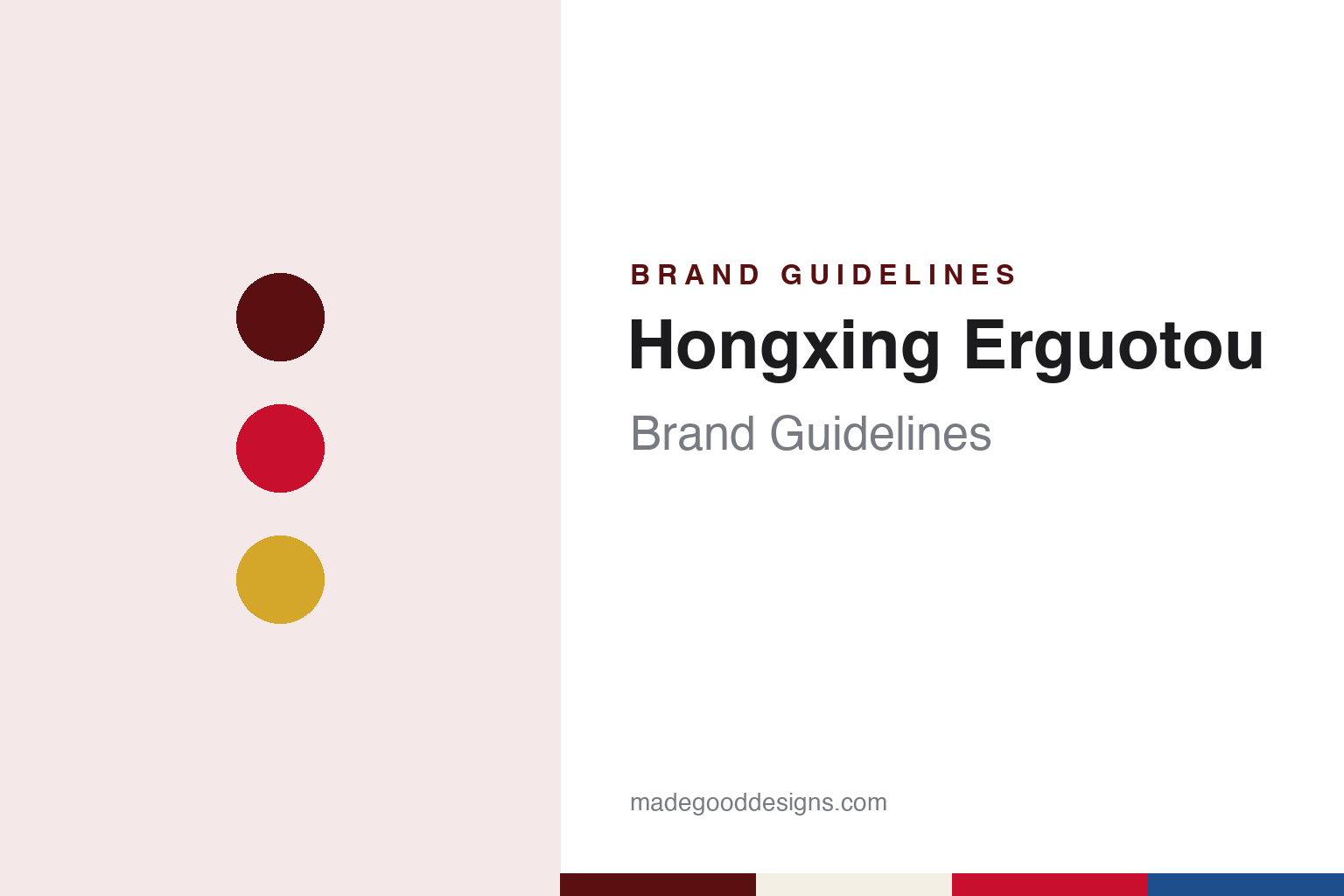
Hongxing Erguotou Brand Guidelines
Beijing’s Red Star baijiu of 1949.
Aa
Two constants: a star red, ribbon gold and sorghum white palette and a heavy Song-style serif register. Abstract homage — not a Hongxing Erguotou product or mark; no bottle, label or logo is reproduced.
Twelve distilleries
A Qianmen technique and a state plant of 1949.
Erguotou — literally “second pot head” — is the name of a Beijing method before it is the name of a drink, and Red Star tells its own story by starting with the method. The company says that in 1680 three brothers named Zhao Cunren, Zhao Cunyi and Zhao Cunli, distillers at the Yuanshenghao workshop near Qianmen, began collecting only the middle run of the spirit and discarding the first and last of it, and that this is how the erguotou technique was born. It is a tradition the company presents as its inheritance rather than a documented company history.
The company itself is a creation of 1949. Red Star says its predecessor, the North China Liquor Monopoly Company Experimental Plant, was set up in May 1949, after the new government placed liquor under a state monopoly, and that it took in twelve of Beijing’s old distilleries, Yuanshenghao, Longquan, Tongquanyong and Yonghecheng among them. Chinese Wikipedia dates the reorganisation to 6 May 1949 and says the plant built an industrial distillery on Jianguo Road.
That September, the company says, the plant produced its first batch of bottled erguotou as a tribute to the founding of the People’s Republic and named it Red Star Erguotou — 红星二锅头, Hongxing Erguotou. Red Star says it was the first Beijing producer to use the name of the process as the name of a product, and that it took part in the founding ceremony that October. Chinese Wikipedia says the plant became the state-run Beijing Distillery in September 1949.
The 1960s spread the method beyond the city. In 1965, Chinese Wikipedia says, the distillery was merged with Beijing’s wine and beer plants into the Beijing Distillery General Plant. Red Star says the general plant was asked by the government that year to take charge of 19 suburban county distilleries, including those at Niulanshan in Shunyi and at Changping, and to pass on its erguotou methods and staff to them, a step it credits with turning erguotou from one plant’s product into a category.
Colour
A red star, a shared name and a blue bottle.
The brand’s mark is the one in its name: a red five-pointed star with a ribbon. Chinese Wikipedia, citing the company, says the red-star mark was created in 1948 in the Jin-Cha-Ji border region, before the move to Beijing. Red Star says the trademark was among the first batch approved for registration in the new People’s Republic in 1951, and that in 1958 it registered “Red Star brand erguotou” in full.
The word erguotou itself did not stay the company’s. Chinese Wikipedia says that in 1981 the Beijing Distillery General Plant gave up registering “erguotou” as a trademark and kept only “Red Star,” leaving the process name for the other plants that had learned it.
Much of Red Star’s range is sold in unboxed bottles, which the company calls guangping products. It describes its erguotou in the light-aroma (qingxiang) style and lists everyday bottlings such as Daqu Niang, the Blue Bottle and Da Er, the “big erguotou,” alongside boxed lines and a mixed-aroma series. It says that in 1997 the State Bureau of Technical Supervision chose its 56-degree Da Er as the national physical reference sample for erguotou. Chinese Wikipedia dates the Qinghuaci blue-and-white porcelain series to 2003 and the blue-bottle erguotou to 2009.
Above these sits a second brand. Red Star now runs what it calls a dual-brand strategy: Red Star for the mass market and Hongxing Gaozhao — roughly “Red Star shining high” — as a vintage line, whose bottlings include Zongshi 1949, a name that points back to the founding year. The company also makes Liuqu Xiang, a light-aroma baijiu from Qixian in Shanxi; Chinese Wikipedia says Red Star took over its maker in December 2001 and made it a branch.
Typography
Design and documentation.
The seven brands in this group are all Chinese baijiu names: Jiannanchun, Xifeng, Langjiu, Gujing Gongjiu, Shui Jing Fang, Jiugui and Hongxing Erguotou. Four come from western China — Jiannanchun from Mianzhu and Shui Jing Fang from Chengdu, both in Sichuan; Langjiu from Erlang in Gulin County, also in Sichuan; and Xifeng from Fengxiang, near Baoji in Shaanxi. Gujing Gongjiu is made at Gujing, near Bozhou in Anhui; Jiugui comes from Jishou in western Hunan; and Hongxing Erguotou is a Beijing brand.
Baijiu is sorted into aroma styles, and the group spans several of them. Chinese Wikipedia classes Jiannanchun and Gujing Gongjiu as strong-aroma baijiu, Langjiu as sauce-aroma, Xifeng as the phoenix-aroma style, and Jiugui as a mixed-aroma spirit of its own fuyu type; Beijing Red Star describes its erguotou as light-aroma. Ownership varies just as widely. Shui Jing Fang’s Shanghai-listed company is controlled by Diageo; Jiugui’s Shenzhen-listed company sits within the state food group COFCO; Gujing’s company has been listed in Shenzhen since 1996; and Hongxing Erguotou’s maker is owned by Beijing state investors.
A baijiu brand’s identity is usually carried by a name, a place and a bottle rather than by a single logo, and the company behind the name may have been merged, listed or sold many times since the brand began. Each guide separates what independent sources record from what the company says about itself — its founding story, its owners over time, where its baijiu is distilled and bottled, and how its labels have changed — and marks plainly what rests only on the company’s own word.
红星
A heavy Song-style serif for a Beijing erguotou named after a red star. (Specimen set in Noto Serif SC, a serif STAND-IN; NOT the Hongxing Erguotou logo or its lettering.)
Beijing Red Star
A state company, a stalled listing and a brewing base in Shanxi.
The business behind the star has been reorganised many times. Chinese Wikipedia traces it from the general plant through the Beijing Red Star Distillery Group, formed in 1993, to Beijing Red Star Co., Ltd., set up in August 2000. It is state-owned: Jiemian reported in May 2022 that its controlling shareholder is Beijing Yiqing Holdings, the Beijing No. 1 Light Industry holding group, with a second state investor, Jingtai Investment, holding most of the rest.
Attempts to bring Red Star to the stock market have not succeeded. In February 2011 Yiqing set up Capital Liquor as a vehicle for a listing; the Beijing News reported in December 2014 that the plan had stalled. In November 2020 the Shanghai-listed Dahao Technology, also controlled by Yiqing, announced a plan to buy Red Star shares; TMTPost reported that the review was suspended in 2021 after a law firm on the deal came under investigation, and that Dahao announced the deal’s termination in March 2023.
Red Star’s head office and plant are in Huairou, in Beijing’s northern suburbs, where the company says an upgrade was completed in November 2019. Not all of its spirit is distilled in Beijing. The company describes a model of a Beijing brand and research centre, a base-spirit brewing site in Shanxi’s Fen River basin, and several bottling plants in Beijing, Tianjin and Shanxi. It dates the start of production at the Shanxi site’s first phase to November 2022; the Beijing News reported in June 2023 that the first phase had been completed.
The company leans on heritage. It says it was named a China Time-honoured Brand by the Ministry of Commerce in 2006, and that “Beijing erguotou brewing technique,” which it nominated, was added to the national intangible cultural heritage list in 2008. A Beijing Erguotou Liquor Museum at Huairou and a reconstruction of the Yuanshenghao workshop near Qianmen opened in September 2011, Chinese Wikipedia says.
For a design guide, Hongxing Erguotou shows how a single political emblem — a red star of 1949 — can do the work of a brand name once the name of the drink itself is shared by a whole city’s distillers. Compare Fenjiu, the light-aroma baijiu of Shanxi, and Yanjing, the Beijing beer. For this guide we use a star red, a ribbon gold and a sorghum white with a heavy Song-style serif, an unofficial interpretation; no product or logo is reproduced.
Explore & save
Keep Hongxing Erguotou’s identity on hand — save it to a board in the Made Good inspiration library.
Hongxing Erguotou identity set
Pin the Hongxing Erguotou star red, ribbon gold and sorghum white palette and the heavy Song-style serif register to your own board.


