Cutwater Brand Guidelines
The Ballast Point still that became a canned-cocktail brand.
Aa
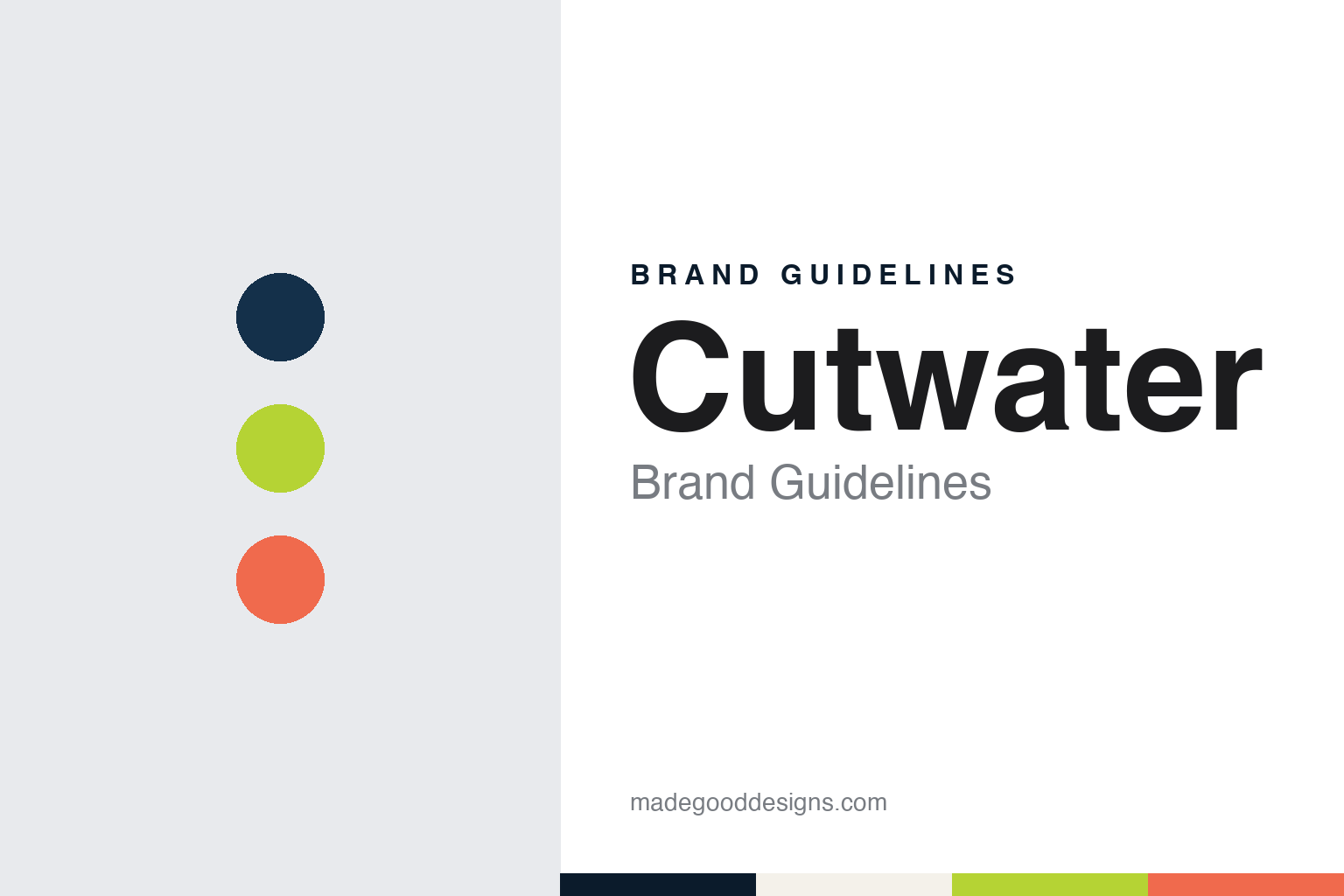
Two constants: a deep sea navy, margarita lime and coral palette and a condensed bold sans register. Abstract homage — not a Cutwater product or mark; no can, label or logo is reproduced.
Ballast Point Spirits
A brewery’s side project with a still built from a fermenter.
Cutwater Spirits is a San Diego distillery best known for its canned cocktails, and it began inside a brewery. San Diego Magazine, in a May 2018 profile, says the company started in 2007 as the distilling division of Ballast Point Brewing & Spirits and later became a brand of its own; The Whiskey Wash reported in 2019 that the division had been known as Ballast Point Spirits. The company says its founder and master distiller, Yuseff Cherney, started making spirits as a hobby in the back of his brewery, and that he custom-built his first pot still from an old beer fermenter to make rum, vodka, gin and whiskey. A 2021 feature on VinePair calls Cutwater the brainchild of Cherney, then Ballast Point’s head brewer, and of Ballast Point’s founder Jack White.
The split from the brewery followed a change of ownership. English Wikipedia, citing The Wall Street Journal and the trade site Brewbound, records that Constellation Brands announced in November 2015 that it would buy Ballast Point, a deal completed the following month. The distilled-spirits operation was not part of that sale, and by July 2016 four of Ballast Point’s founders, White among them, had left the brewery to pursue other interests, as the San Diego Business Journal reported in August 2016. The distillery business was then spun off into a new company, Cutwater Spirits, in 2017, according to Wikipedia’s summary of reporting in The San Diego Union-Tribune. VinePair says Cutwater completely broke away from Ballast Point when it moved into a facility of its own.
Cherney told San Diego Magazine that the separation had always been the plan: “We always planned to expand the distilling part of the business,” he said, adding that it was great to give the distillery “a life of its own.”
Colour
A Miramar distillery and a can full of cocktail.
The new company set itself up in the Miramar district of San Diego. San Diego Magazine reported in May 2018 that Cutwater had opened a large facility there the previous May, combining production with a restaurant kitchen run by chef Luke Johnson, formerly of La Valencia. The company still runs a tasting room and kitchen in San Diego, and says Cherney can still be found at its production facility there.
What made the name was the can. The same 2018 profile says Cutwater’s canned cocktails, such as Three Sheets Rum & Ginger and a Spicy Bloody Mary, had grown from four flavours to fourteen. The company says it distils its own whiskeys, vodka, gin, rums, tequilas and liqueurs and uses them in its canned line-up, and it describes Cherney as having pioneered the canned classic cocktail; VinePair repeats the company’s claim to have pioneered the category. Alongside the cans, Cutwater sells bottled spirits; its website lists, among others, Devil’s Share Whiskey and Opah Herbal Liqueur.
In February 2019 the brewer Anheuser-Busch agreed to buy the business. The Whiskey Wash reported the deal on 20 February 2019, quoting Marina Hahn of Anheuser-Busch: “We’re excited to welcome the Cutwater Spirits team to the Anheuser-Busch family.” Cherney said: “We’re thrilled to have found a partner that understands our vision for Cutwater Spirits.” Anheuser-Busch has owned Cutwater since 2019, and trade press in 2023 placed it in the company’s Beyond Beer portfolio of drinks that are not beer.
Typography
Design and documentation.
The seven brands in this group are all ready-to-drink names: Vizzy, Smirnoff Ice, Bacardi Breezer, Cutwater, Kirin Hyoketsu, Mike’s Hard Lemonade and Twisted Tea. Several of them come from companies better known for beer or wine. The Boston Beer Company, maker of Samuel Adams, first sold its hard iced tea in 2000 as BoDean’s Twisted Tea and renamed it Twisted Tea in 2001, the company says; Molson Coors launched Vizzy nationally in the United States in April 2020. Kirin Brewery launched Hyoketsu in Japan in 2001, according to a Kirin release of April 2016. Mike’s Hard Lemonade comes from the family-owned Mark Anthony group founded by Anthony von Mandl, which says it began in 1972 as a one-person wine importer.
Others sit inside spirits houses or were bought by one. Smirnoff Ice belongs to Diageo, and English Wikipedia notes that in the United States it is a malt beverage, while in many other markets it is made with Smirnoff vodka. Bacardi Breezer, which English Wikipedia describes as a premix of Bacardi rum, was launched in Britain in 1993, the same article says, citing the BBC. Cutwater was founded in San Diego in 2016 by former Ballast Point executives, FoodBev reported, and in February 2019 The Whiskey Wash reported its purchase by Anheuser-Busch.
A ready-to-drink brand’s identity is carried largely by a can, a name and a flavour list, and the same name can cover different recipes in different countries. Each guide separates what independent sources record from what the company says about itself — who launched it, who owns it now and how its packs have changed — and marks plainly what rests only on the company’s own word.
Aa
A condensed bold sans for a canned cocktail built to be read on a crowded shelf. (Specimen set in Oswald, a sans STAND-IN; NOT the Cutwater logo.)
Cutwater
Open the Bar: a bigger logo and the strength up front.
Cutwater’s most documented design change came in February 2023, when it launched a campaign called “Open the Bar” together with a visual refresh. Marketing Dive, citing a press release, dates the launch to 23 February 2023. The Metal Packager described the new cans on 24 February: bold colours and illustrations that show each flavour and its cocktail, a larger logo so the cans are easier to recognise on crowded shelves, and simpler typography for readability. The alcohol by volume moved to the front and centre of the can, and the number of shots in each can is clearly marked.
The advertising was made by the agency AKQA: three spots, titled “Après Ski,” “Beach” and “At-Home Entertaining,” directed by the Italian duo Mathery and run across social channels, connected TV, digital platforms and retail, according to Marketing Dive, which described a range of more than twenty offerings. Chad Lafeldt, Cutwater’s vice president of marketing, said the brand was “on a mission to make bar-quality cocktails more accessible,” and Monica Mody, group vice president of marketing for Anheuser-Busch’s Beyond Beer unit, said the company believed “in the power of the ever-evolving ready-to-drink category.” Today the canned range runs from margaritas to a Mai Tai, a White Russian and a Long Island Iced Tea, according to the company’s website.
For a design guide, Cutwater shows a craft distiller’s story told through a mass-market can: a still built from a brewery fermenter, then a big logo, a drawn cocktail and the strength printed up front. Compare the canned vodka seltzer High Noon and the Chicago brewpub brand Goose Island. For this guide we use deep sea navy, margarita lime and coral with a condensed sans, an unofficial interpretation; no product or logo is reproduced.
Explore & save
Keep Cutwater’s identity on hand — save it to a board in the Made Good inspiration library.
Cutwater identity set
Pin the Cutwater deep sea navy, margarita lime and coral palette and the condensed bold sans register to your own board.