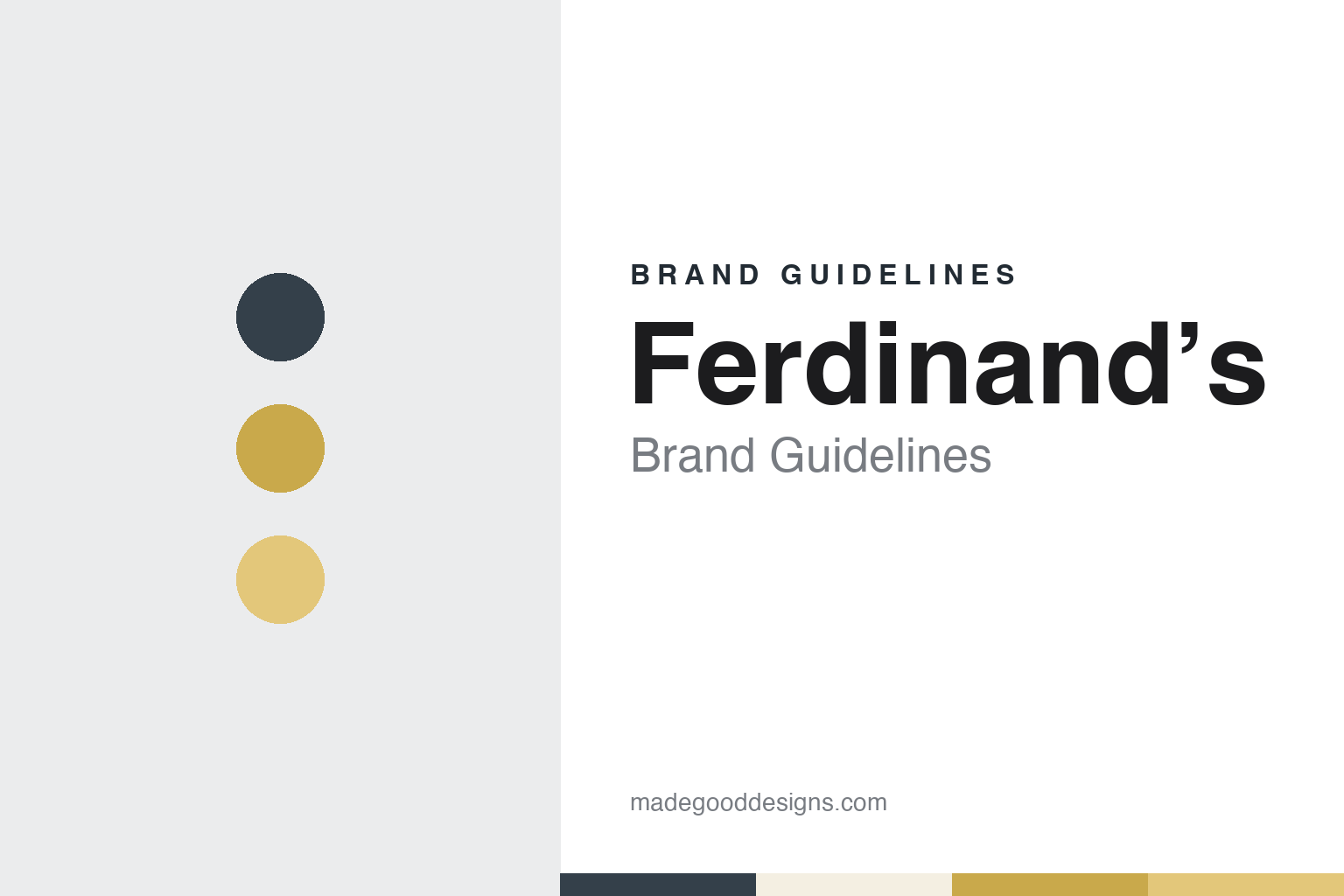
Ferdinand’s Brand Guidelines
The Riesling-infused Saar dry gin, begun in 2013.
Aa
Two constants: a Saar slate, Riesling gold and beeswax palette and a high-contrast display serif register. Abstract homage — not a Ferdinand’s product or mark; no label, logo or bottle is reproduced.
A distiller, a wine estate and two siblings
Three partners from the Saar and a gin named after a forester.
Ferdinand’s Saar Dry Gin comes from the Saar, the river valley in south-west Germany that joins the Mosel close to the borders with Luxembourg and France, and it was built from the start as a partnership. Harpers Wine & Spirit reported in January 2014 that the gin was the work of three partners: master distiller Andreas Vallendar of the Avadis Distillery in Wincheringen; Dorothee Zilliken of the VDP wine estate Forstmeister Geltz-Zilliken in Saarburg; and Capulet & Montague, a marketing company based in Saarbrücken. The brand dates the start of the gin’s story to 2013.
The brand’s own site gives each partner a role. It says the siblings Denis Reinhardt and Erik Wimmers, who run a sales agency specialising in spirits, had the original idea for a “Riesling inspired gin.” It describes Vallendar as a trained chemical laboratory technician from Saarburg who studied beverage technology and then founded Avadis, on a farm estate in Wincheringen-Bilzingen that his family established in 1824 and where it has distilled fruit brandies for several generations. The wine comes from the Zilliken family’s estate.
The name looks back to that estate’s history. Ferdinand’s is named after Ferdinand Geltz, a royal Prussian district forester and a co-founder of the growers’ association VDP Mosel-Saar-Ruwer, Harpers reported, and the estate that supplies the Riesling still carries his title and name: Forstmeister Geltz-Zilliken.
Colour
Riesling in the gin, and a wine bottle to hold it.
What sets the gin apart is wine. Harpers described in 2014 how a semi-sweet slate Riesling from the Saar is added after distillation, alongside 30 hand-picked organic botanicals chosen by Vallendar, with thyme, lavender and juniper as the key notes and sloe, rosehip, angelica, hop blossom, almond shell, coriander and ginger among the rest; it gave the strength as 44% abv, and quoted the makers describing floral and grassy lemon notes and saying that the Riesling’s elegance and fruitiness carry through into the finished spirit. The Canadian spirits reviewer The Rum Howler Blog wrote in February 2016 that the wine came from the Saarburger Rausch vineyard and placed the distillery in the border country where Germany meets Luxembourg and France; it singled out quince, lavender and lemon thyme among the botanicals. The brand says most of its botanicals come from its own cultivation, including vineyard peach, quince and apple trees growing behind the distillery and lavender from fallow vineyards in the Konzer Tälchen.
The pack borrows from wine as well. Harpers described the gin’s retro-style wine bottle, closed with a natural cork sealed in beeswax. The range has grown along the same lines. The brand lists Saar Quince, made with muscat quinces from its own trees and an infusion of Rausch Kabinett as a regional answer to British sloe gin; Goldcap, a small annual special edition made with Auslese grapes; and dry and white vermouths, the dry one described by the brand as the world’s first Riesling vermouth and the white matured in Mosel Fuder casks.
Typography
Design and documentation.
The seven brands in this group are all German gins: Siegfried, Ferdinand’s, The Duke, Elephant, Gin Sul, Windspiel and Skin Gin. Gin brands in general sit at many different points in the trade, from small companies that still distil and bottle their own spirit to labels made under contract at another distillery or now owned, in whole or in part, by much larger drinks groups, and a single gin can be sold everywhere from a corner shop to a cocktail bar.
A gin’s identity is usually carried less by the liquid than by a bottle, a label and the place it names, because the company behind the name may have changed hands, moved its production or grown far beyond the town where it started. That makes the questions behind each name worth asking plainly: who started it, who owns it now, and where its gin is actually distilled and bottled.
Each guide separates what independent sources record from what the company says about itself — its founding story, its owners over time, where its gin is made and how its bottles and labels have changed — and marks plainly what rests only on the company’s own word.
Aa
A high-contrast display serif for a gin dressed like a Riesling. (Specimen set in Playfair Display, a serif STAND-IN; NOT the Ferdinand’s logo.)
Ferdinand’s
A Saarbrücken brand house and a gin that went abroad early.
Ferdinand’s is run today from Saarbrücken. Its website is published by Capulet und Montague Brands GmbH, with Reinhardt and Wimmers as managing directors, and the company describes the siblings as its owners. Capulet & Montague presents Ferdinand’s as the centre of a group of its own brands that also includes Bonpland Rum, matured, it says, in casks from VDP wine estates on the Vallendar family’s farm; the fruit spirits of The Mosel Distillers; Doctor Polidori tonic water; and Dreyberg gin, for which Vallendar is again named as master distiller.
The brand’s words lean on the same idea of place. Ferdinand’s uses the line “Inspired by our heritage” on its site, and Capulet & Montague introduces the gin with “Uncork the flavour of the Saar.” The site describes a landscape of morning mists over the river, steep sunny slate slopes and long summers with cold nights, and it presents the gin as rooted in the character of the Saar valley. Its downloads include a key-visual wallpaper and a cocktail book in German and English.
The gin looked beyond Germany almost at once. Harpers reported in January 2014 that a UK launch through London bars and the off-trade was planned for that spring, the gin’s first move beyond the central European market, and two years later the Canadian blog The Rum Howler was reviewing it.
The name needs a little care online: Ferdinand’s is a common name, and the gin’s own sites are ferdinandsgin.de and ferdinandsgin.com.
For a design guide, Ferdinand’s shows how a gin can borrow the vocabulary of a wine region — a forester’s name, a single-vineyard Riesling, a wine bottle and a beeswax seal — to say exactly where it comes from. Compare Monkey 47, the Black Forest gin in an apothecary bottle, and Egon Müller, the Saar Riesling estate on the Scharzhofberg. For this guide we use Saar slate, Riesling gold and beeswax with a serif, an unofficial interpretation; no product or logo is reproduced.
Explore & save
Keep Ferdinand’s’s identity on hand — save it to a board in the Made Good inspiration library.
Ferdinand’s identity set
Pin the Ferdinand’s Saar slate, Riesling gold and beeswax palette and the high-contrast display serif register to your own board.


