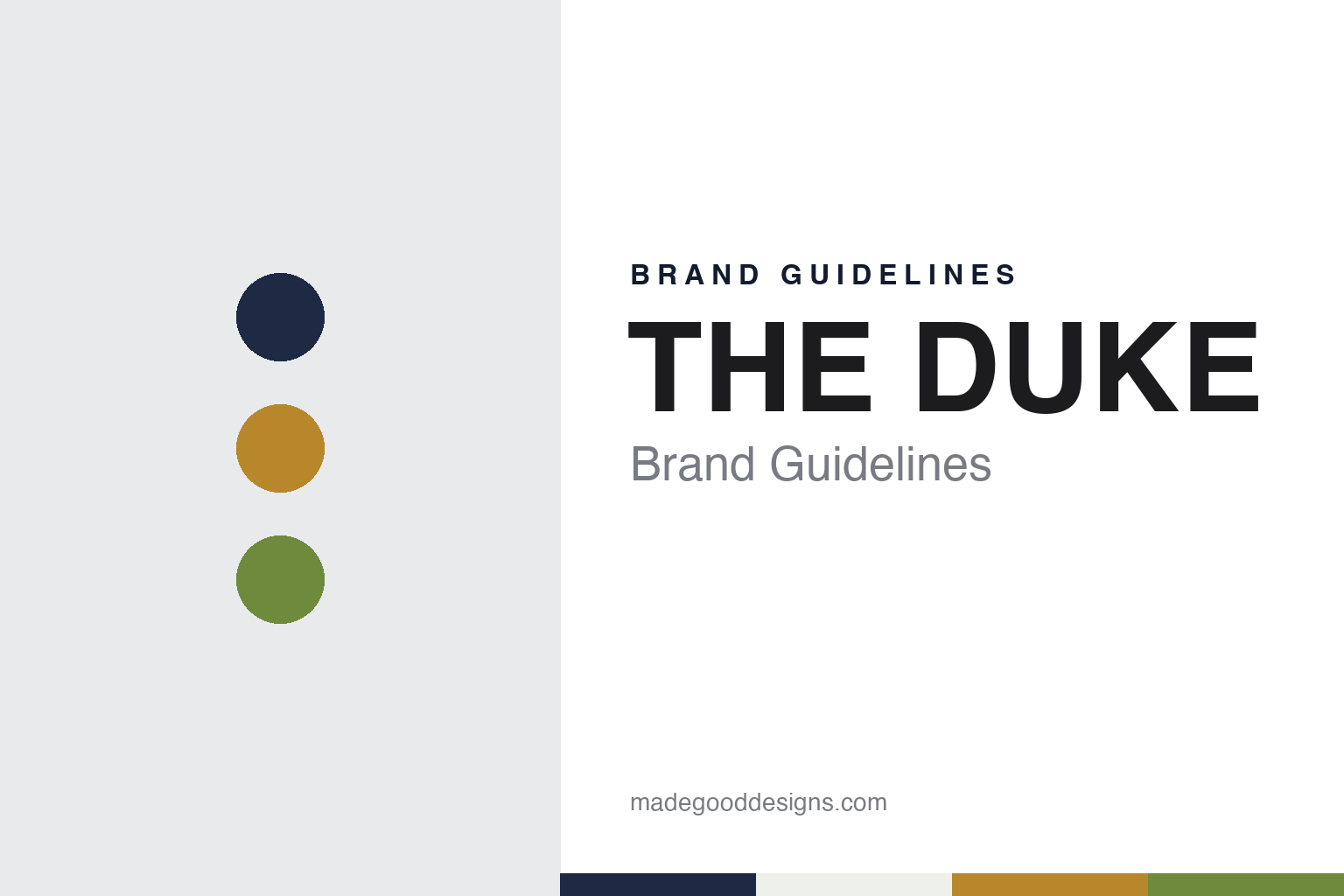
THE DUKE Brand Guidelines
The Munich dry gin named for Henry the Lion.
Aa
Two constants: a ducal navy, lion gold and hop green palette and a high-contrast display serif register. Abstract homage — not a THE DUKE product or mark; no label, logo or bottle is reproduced.
Two friends and a backyard still
A gin conceived over gin and tonics and distilled in the Maxvorstadt.
THE DUKE is a gin distillery from Munich, and its founding story is a small one by design. The company says the idea came to two friends, Max and Daniel, over a few gin and tonics one autumn evening in 2007. The trade and travel press name them in full: the British magazine Centurion wrote in December 2015 that the distillers Maximilian Schauerte and Daniel Schönecker spent a full year developing what they considered the ideal dry gin, and the hospitality news site Hogapage reported in December 2017 that the two distilled it on their own still in Munich’s Maxvorstadt district. The news portal t-online, in a 2016 round-up of German spirits, described the founders as two historians and former flatmates.
The company dates its start to 2008. Its own history describes a backyard room of about 80 square metres in central Munich, a copper still named “Carl” and roughly a year of experiments before the first Munich Dry Gin went on sale. In a 2017 interview with the sustainability magazine LifeVERDE, Schauerte described the beginning as two dreamers in a backyard, laying the foundation for gin production in Munich in 2008. The company says it labelled its bottles by hand for its first two years, buying its first semi-automatic labelling machine only in 2010.
Growth came slowly and locally. The company says it trained its first distiller in 2013, as demand from bars and retailers rose, and shipped its first export order, to Canada, in 2014. Centurion in 2015 still described the gin as available from selected purveyors across Munich. By 2021 the company’s releases named Maximilian von Pückler as THE DUKE’s founder, according to the drinks trade site about-drinks, and the restaurant trade site Tageskarte named him as managing director in July 2025.
Colour
A duke, a lion, hops and malt.
The name is a piece of civic history. Centurion reported in 2015 that the gin is named after Duke Henry the Lion — Heinrich der Löwe — who founded the city of Munich in 1158, and the company still presents the duke as its namesake. The figure has stayed on the packaging: when THE DUKE launched Entgeistert, its first alcohol-free gin alternative, in September 2021, about-drinks reported that the label showed Henry the Lion, Duke of Bavaria, with his wife Mathilde, and that the bottle was closed with a beech-wood cork.
The recipe is meant to taste of Bavaria as well as of juniper. Centurion listed 13 herbs and spices alongside hop blossom and malt in a gin bottled at 45 per cent, and Hogapage reported in 2017 that the makers credit the hops and malt with a softer, milder finish and a typically Bavarian character. Centurion described it as made at a certified organic distillery, and Hogapage wrote that the bottles carry an organic seal, which the founders said had not been the original plan but followed from their view that organically grown ingredients were the best.
The range grew around the original. LifeVERDE described three gins in 2017: the Munich Dry Gin, a juniper-forward Rough gin for purists and a more floral and fruity Wanderlust. Limited editions have let the bottle carry other designs. The fashion site Hypebeast reported in September 2013 on “LE GIN,” a collaboration with the Munich label Beastin, sold only at its BSTN store, limited to 89 bottles with a plain black label. In November 2020 the company released Liberalitas Bavarica with FC Bayern Munich, a gin whose red-and-white design, the company says, refers to the club’s colours, the Holledau hop region, the Allianz Arena and Munich’s Frauenkirche. A Bavaria Edition with an Oktoberfest motif by the Munich artist Carina Holtz changed the label, bottle and gift box while keeping the Munich Dry Gin inside, the company says.
Typography
Design and documentation.
The seven brands in this group are all German gins: Siegfried, Ferdinand’s, The Duke, Elephant, Gin Sul, Windspiel and Skin Gin. Gin brands in general sit at many different points in the trade, from small companies that still distil and bottle their own spirit to labels made under contract at another distillery or now owned, in whole or in part, by much larger drinks groups, and a single gin can be sold everywhere from a corner shop to a cocktail bar.
A gin’s identity is usually carried less by the liquid than by a bottle, a label and the place it names, because the company behind the name may have changed hands, moved its production or grown far beyond the town where it started. That makes the questions behind each name worth asking plainly: who started it, who owns it now, and where its gin is actually distilled and bottled.
Each guide separates what independent sources record from what the company says about itself — its founding story, its owners over time, where its gin is made and how its bottles and labels have changed — and marks plainly what rests only on the company’s own word.
Aa
A high-contrast display serif for a gin named after a medieval duke. (Specimen set in Playfair Display, a serif STAND-IN; NOT the THE DUKE logo.)
THE DUKE
From the city centre to a brick distillery in Aschheim.
The backyard did not last. The company says it moved in 2016 into a brick potato distillery built in the 19th century in Aschheim, just east of Munich, which it now runs as a working distillery with a shop; about-drinks placed the distillery shop in Aschheim in its 2021 report. The company says its production manager, Georg Zwiehoff, qualified as a master distiller in 2019, and that a THE DUKE bar opened at the distillery in 2021. In 2024 it added DUCHESSA, which it calls an Aperitivo Bavarese.
The alcohol-free gin brought the company into a legal dispute over packaging. Tageskarte reported in July 2025 that the Berlin-based Verband Sozialer Wettbewerb had challenged the sale of Entgeistert in one-way bottles without a deposit; a first court sided with THE DUKE, but the Higher Regional Court of Munich ruled against it on appeal. The paper reported that the affected bottles were taken off sale, that the alcohol-free gin moved into stoneware bottles, that von Pückler said the ruling threatened the company’s existence, and that THE DUKE was calling for one clear national rule on deposits while running a crowdfunding campaign under the title “Gin als Protest.”
The name needs care online: the brand’s site is theduke-gin.de, and “The Duke” is also the name of unrelated bars, hotels and products.
For a design guide, THE DUKE shows how a small distillery can borrow a city’s founding figure and carry him from a backyard label to stoneware and football editions. Compare Monkey 47, the Black Forest gin, and Augustiner, the Munich brewery. For this guide we use ducal navy, lion gold and hop green with a serif, an unofficial interpretation; no product or logo is reproduced.
Explore & save
Keep THE DUKE’s identity on hand — save it to a board in the Made Good inspiration library.
THE DUKE identity set
Pin the THE DUKE ducal navy, lion gold and hop green palette and the high-contrast display serif register to your own board.