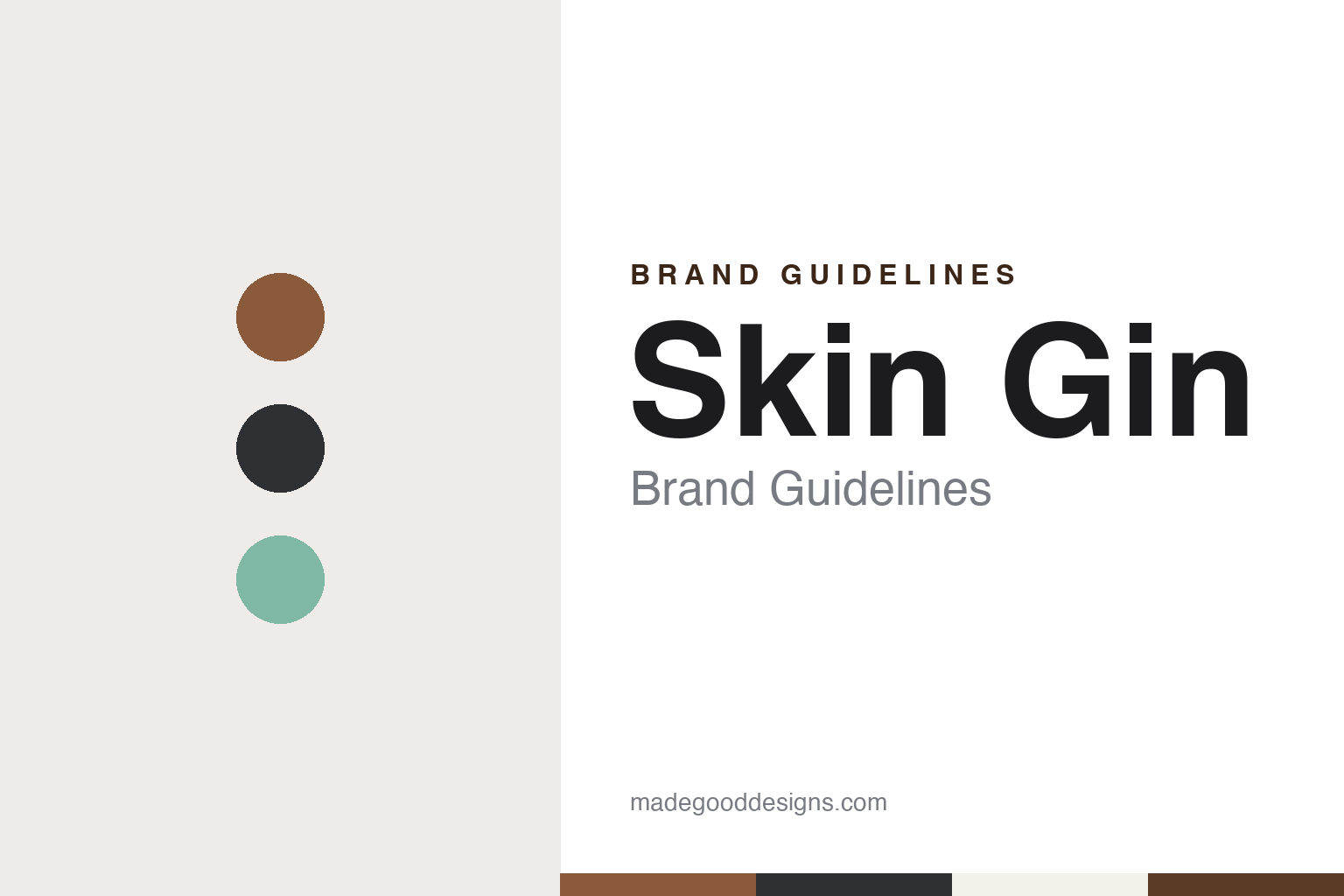
Skin Gin Brand Guidelines
A hand-wrapped dry gin from the Altes Land, launched 2015.
Aa
Two constants: a saddle leather, anthracite and mint palette and a clean geometric sans register. Abstract homage — not a Skin Gin product or mark; no label, logo or bottle is reproduced.
A Danish merchant in the Altes Land
From an orchard country on the Elbe to a gin of its own.
Skin Gin is a German dry gin made by Skin Gin GmbH, a small spirits company in Buxtehude, Lower Saxony, on the edge of the Altes Land, the fruit-growing country on the southern bank of the Elbe just west of Hamburg. The company’s website names Martin Birk Jensen as its managing director.
The brand’s first website, archived by the Internet Archive in March 2015, introduced it as the work of two people: the Danish merchant Martin Jensen and the Hamburg designer Mathias Rüsch, both of whom, the company said, had close ties to the Altes Land. At the time the company gave its address in Steinkirchen, a village in the Altes Land; it has since moved to Buxtehude. The British drinks blog Drinks Enthusiast wrote in August 2017 that Skin Gin had been on sale since its launch by Martin Birk Jensen in March 2015, and described it as produced in the Altes Land just outside Hamburg.
The recipe is short. The company says Skin Gin uses seven botanicals: Moroccan mint, the peels of orange, pink grapefruit, lime and lemon, juniper and Vietnamese coriander. Its current site adds that the juniper comes from the Lüneburg Heath and the citrus from Spain and Italy. Each botanical, the company says, is distilled on its own in an old copper still so as to keep as much of its essential oil as possible, and the separate distillates are then blended by hand. Drinks Enthusiast reported that the base is a wheat-based neutral spirit and that the gin is bottled at 42% ABV, and described a nose led by mint, followed by pink grapefruit and lemon.
Where the gin is made has been described in two ways over the years. In 2015 and 2016 the company’s site said Skin Gin was produced near Hamburg and bottled at a traditional distillery, which it did not name. Its website in 2026 calls the company a small distillery and says it distils its spirits in its own workshop in Buxtehude.
Colour
A name taken from the bottle, and a bottle that changes its skin.
The name comes from the packaging. The company’s launch text in 2015 said the name came to life as soon as you saw and touched the leathery surface of the bottle, and its current site describes each bottle as wrapped by hand and hot-embossed, so that every one is a one-off. The company said in 2015 that the gin would appear from the start in two different designs, with special editions to follow.
Those editions became the brand’s visual system. The liquid stays the same while the outer skin changes: the company lists standing editions called Reptile, Blanc and Anthrazit and a rosé-coloured Ladies Edition, and a Leo edition offered in three colour pairings, gold with orange, pink with gold and blue with pink. A series of place editions carries the landmarks of cities and islands; the company names Hamburg, Berlin, Sylt and London among them.
The skins have also been opened to other people’s designs. The Spirits Business reported in April 2017 that Skin Gin and its British importer, JBE Imports, had launched a competition inviting people in the UK to design the brand’s next bottle wrap. Entries had to include the Skin Gin logo, and the winning design was to appear on more than 100 limited-edition bottles. Jensen told the magazine that customers regularly asked for bespoke designs. A month later, in May 2017, the trade site about-drinks reported an edition designed with the German hip-hop group Die Beginner: a bottle covered in dark red leather and decorated with the band’s fox crest and an anchor.
The same idea is sold to companies. The company offers what it calls Eigeneditionen, its own editions, in which a customer’s logo and colours are worked into the wrapped bottle by hand, and a wedding version personalised with a couple’s names and date.
Typography
Design and documentation.
The seven brands in this group are all German gins: Siegfried, Ferdinand’s, The Duke, Elephant, Gin Sul, Windspiel and Skin Gin. Gin brands in general sit at many different points in the trade, from small companies that still distil and bottle their own spirit to labels made under contract at another distillery or now owned, in whole or in part, by much larger drinks groups, and a single gin can be sold everywhere from a corner shop to a cocktail bar.
A gin’s identity is usually carried less by the liquid than by a bottle, a label and the place it names, because the company behind the name may have changed hands, moved its production or grown far beyond the town where it started. That makes the questions behind each name worth asking plainly: who started it, who owns it now, and where its gin is actually distilled and bottled.
Each guide separates what independent sources record from what the company says about itself — its founding story, its owners over time, where its gin is made and how its bottles and labels have changed — and marks plainly what rests only on the company’s own word.
Aa
A clean geometric sans for a gin whose bottle does the talking. (Specimen set in Jost, a sans-serif STAND-IN; NOT the Skin Gin logo.)
Skin Gin
One gin, and the small spirits house that grew around it.
The gin has grown into a family. Under the name Skin Gin Kiss the company sells flavoured versions built on the original seven botanicals. Tea Kiss adds four distillates, hibiscus, apple, rosehip and peach, for eleven botanicals in all. Apple Kiss is a cooperation with Sansibar, the restaurant on Sylt, which the company says marked Skin Gin’s fifth birthday and adds an apple distillate from the Altes Land. Berry Kiss, the company says, is made with strawberries picked in the Altes Land.
The house now sells more than gin. Its website presents Barril Rum, a blend of rums from Barbados, the Dominican Republic, Panama and Nicaragua that the company says ends its journey in Buxtehude; Elbstoff, a vodka made with sea salt from Sylt and Kalamata olives; and Aperiva, an aperitif of rhubarb, bitter orange and herbs. Several editions are sold in a gift box with two bottles of Thomas Henry tonic water, the Berlin mixer brand.
The name needs a little care online. The brand’s own site is skin-gin.com, with a hyphen, and the company behind every one of these brands is still called Skin Gin GmbH.
For a design guide, Skin Gin shows how a gin can make its packaging the product’s name and then keep the liquid fixed while the skin changes, from reptile textures and city landmarks to a band’s crest and a customer’s logo. Compare Monkey 47, the Black Forest gin in an apothecary bottle, and Gin Sul, the Hamburg gin in a white clay bottle. For this guide we use saddle leather, anthracite and mint with a clean sans, an unofficial interpretation; no product or logo is reproduced.
Explore & save
Keep Skin Gin’s identity on hand — save it to a board in the Made Good inspiration library.
Skin Gin identity set
Pin the Skin Gin saddle leather, anthracite and mint palette and the clean geometric sans register to your own board.