Gin Sul Brand Guidelines
The Hamburg-Altona gin with Portuguese roots in a clay bottle.
Aa
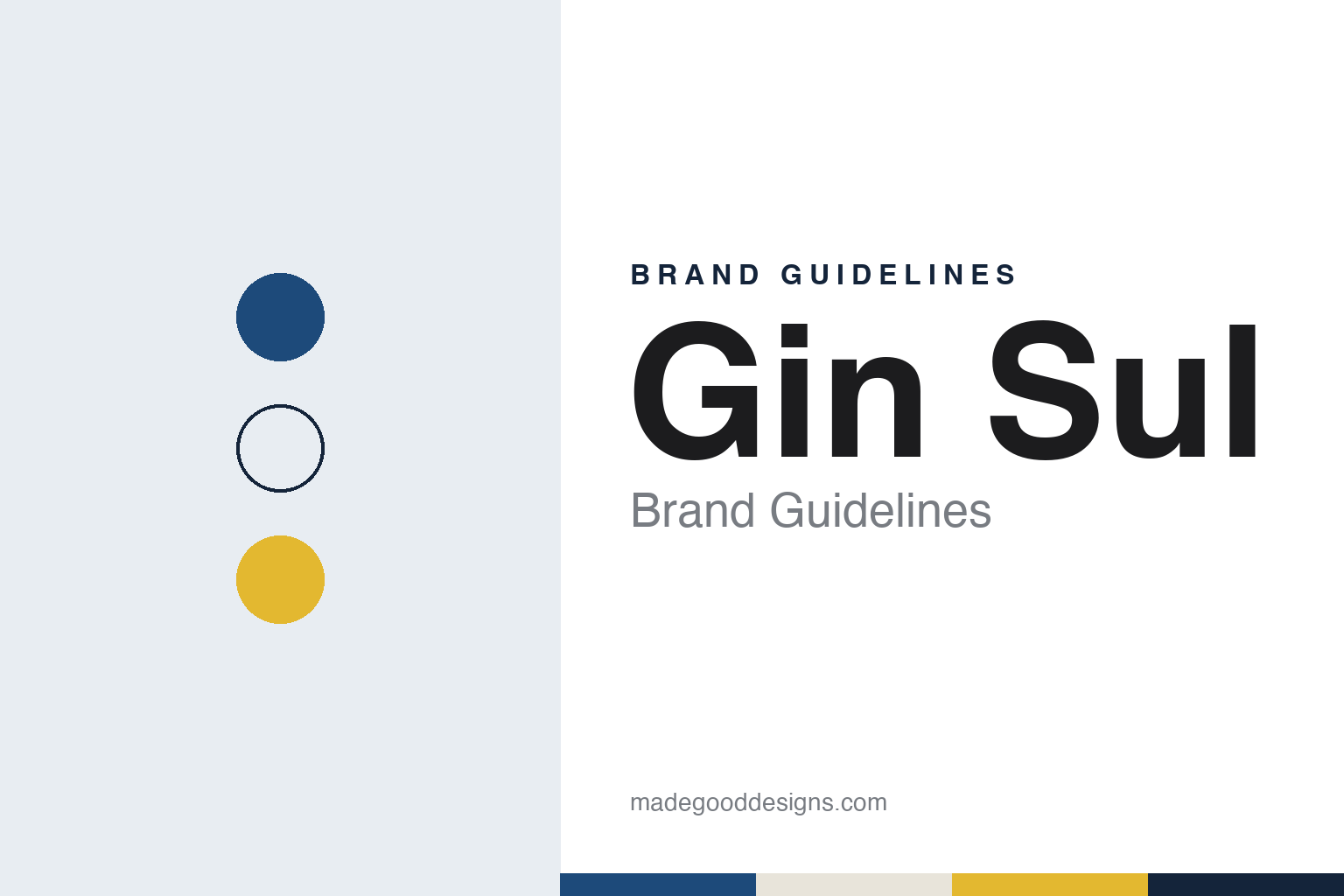
Two constants: a clay white, Atlantic blue and lemon palette and a clean geometric sans register. Abstract homage — not a Gin Sul product or mark; no bottle, label or logo is reproduced.
A Courtyard in Altona
A Hamburg distiller and a love letter to Portugal.
Gin Sul is made in Hamburg-Altona, in the west of the city, by a small company that trades today as ASM Altonaer Spirituosen Manufaktur GmbH. Its founder is Stephan Garbe, a Hamburg native. The Jüdische Allgemeine, profiling him in February 2016, reported that he had been building the gin business since late 2013, and Mast-Jägermeister’s own company page also gives 2013 as the founding year. A 2018 Mast-Jägermeister announcement, as reported by Lebensmittel Praxis, gave 2014 instead, so both dates circulate.
The name points south. Sul is the Portuguese word for south, and the brand describes itself as “the Hamburg gin with Portuguese roots” and as a declaration of love for Portugal. On its website the company says the gin’s roots lie on the rugged Costa Vicentina, the Atlantic coast of south-west Portugal. In 2016 Garbe told the Jüdische Allgemeine that the lemons in the gin all grew on a friend’s field in Portugal and were flown in once a week; Mast-Jägermeister likewise describes the spirit as crafted with fresh Algarve lemons.
The distillery itself sits in a courtyard. The Jüdische Allgemeine described a room in an old industrial building in Altona, a former working-class district, behind a heavy door, with turquoise Portuguese tiles on the walls and a copper still built specially for Gin Sul. Today the company says its copper stills come from the German still maker Arnold Holstein of Markdorf on Lake Constance, with capacities of 100 and 300 litres, and that it distils in small batches. It keeps the recipe close: in 2016 Garbe said that apart from his closest staff and the rabbi, nobody knew it.
Colour
A kosher gin and a pale clay bottle.
That mention of a rabbi is one of the more unusual parts of the Gin Sul story. The Jüdische Allgemeine reported in 2016 that Hamburg’s state rabbi, Shlomo Bistritzky, certified the gin as kosher. When the rabbi was not satisfied with the certificate for the original neutral alcohol, the company changed its supplier; the new base alcohol was made from molasses, and Garbe told the paper that it had turned out to be a gain, because it carried even less flavour of its own. The paper also reported that the annual special editions rested in wine barrels did not carry the kosher seal, because the kosher origin of the barrels could not be guaranteed.
Garbe framed the decision as personal. He told the Jüdische Allgemeine that he had grown up in a generation taught that persecution of Jews must never happen again, and the paper described kosher production as a kind of quiet protest on his part, prompted by anti-Jewish demonstrations in Germany two years earlier.
The pack is the brand’s most recognisable object. The 2016 article described a light-grey clay bottle, with the rabbi’s certificate screen-printed in small type on the back. Lebensmittel Praxis, reporting in July 2018, called Gin Sul “the Hamburg gin in the typical white clay bottle,” and Mast-Jägermeister’s company page today also describes the gin by its white clay bottle.
That range has grown from the original dry gin. The company’s shop lists Gin Sul, Laranjal and Lima Limão alongside a ready-to-drink Limão Fizz, and a run of limited editions under the name Jardim do Paraíso, each tied to a journey: Madeira in 2024, Zanzibar in 2025 and Japan, as Japão, in 2026. A 2025 special edition was called Amor do Sul. The Portuguese naming is consistent, and it keeps the brand anchored to its southern idea even when an edition travels further afield.
Typography
Design and documentation.
The seven brands in this group are all German gins: Siegfried, Ferdinand’s, The Duke, Elephant, Gin Sul, Windspiel and Skin Gin. Gin brands in general sit at many different points in the trade, from small companies that still distil and bottle their own spirit to labels made under contract at another distillery or now owned, in whole or in part, by much larger drinks groups, and a single gin can be sold everywhere from a corner shop to a cocktail bar.
A gin’s identity is usually carried less by the liquid than by a bottle, a label and the place it names, because the company behind the name may have changed hands, moved its production or grown far beyond the town where it started. That makes the questions behind each name worth asking plainly: who started it, who owns it now, and where its gin is actually distilled and bottled.
Each guide separates what independent sources record from what the company says about itself — its founding story, its owners over time, where its gin is made and how its bottles and labels have changed — and marks plainly what rests only on the company’s own word.
Aa
A clean geometric sans for a gin that reads as calm and southern. (Specimen set in Outfit, a sans STAND-IN; NOT the Gin Sul logo or lettering.)
Gin Sul
A Jägermeister gin since 2022.
The ownership story is short and well dated. Lebensmittel Praxis reported on 5 July 2018 that Mast-Jägermeister SE of Jägermeister fame, had taken a stake in Gin Sul with effect from 1 July 2018; the size of the stake was not disclosed. Mast-Jägermeister describes the deal on its own website as its first strategic partnership with another spirits maker. The investment was made through its venture arm, first known as M-Venture and later renamed Best Nights VC, and deutsche-startups.de reported in March 2024 that Gin Sul had belonged entirely to Mast-Jägermeister since 2022. Mast-Jägermeister has owned Gin Sul outright since 2022, and it says the gin is available in 17 countries.
The company’s management has changed with its ownership. Its legal notice names Fritz Grünefeld and Sven Mussler as managing directors, and Lebensmittel Zeitung reported on 1 October 2026 that Christian Bräunert, returning to Gin Sul, would take over the business from December.
For a design guide, Gin Sul shows how a single object, an opaque clay bottle, and a single idea, the south, can carry a small brand from a courtyard distillery into a large drinks group without losing its character. Compare Monkey 47, another German gin that joined a major group, and Elephant Gin, another German craft gin. For this guide we use clay white, Atlantic blue and a lemon yellow with a geometric sans, an unofficial interpretation; no product or logo is reproduced.
Explore & save
Keep Gin Sul’s identity on hand — save it to a board in the Made Good inspiration library.
Gin Sul identity set
Pin the Gin Sul clay white, Atlantic blue and lemon palette and the geometric sans register to your own board.