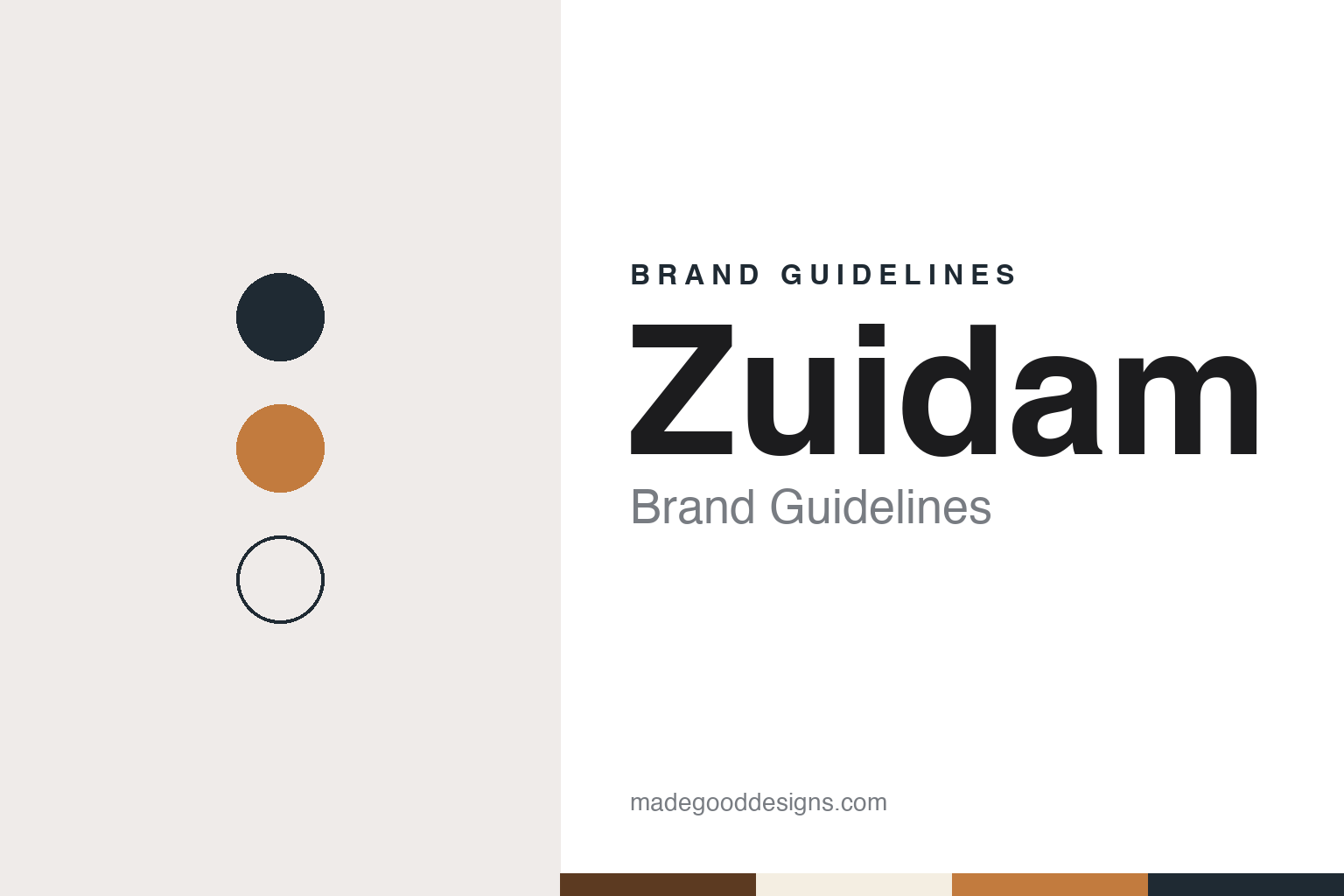
Zuidam Brand Guidelines
The Baarle-Nassau family distillery behind Millstone whisky.
Aa
Two constants: an oak, copper and slate palette and a distiller’s serif register. Abstract homage — not a Zuidam product or mark; no bottle, label or logo is reproduced.
Baarle-Nassau
A De Kuyper distiller goes out on his own.
Zuidam Distillers is a family distillery in Baarle-Nassau, which the company describes as a small border town near the point where the Netherlands and Belgium meet. Its founder, Fred van Zuidam, had been a senior distiller with De Kuyper, the liqueur house of Schiedam, Drinks International reported in a 2013 profile of his son. The sources give slightly different start dates. The company’s own website says that in 1976 Fred van Zuidam, as master distiller, and Hélène van Zuidam, as designer, began making liqueurs and genevers professionally, and that they have traded as Zuidam Distillers ever since; Drinks International dated Fred’s decision to move out to the country and start up on his own to 1974.
From the start the business paired a distiller with a designer. The company names Hélène as its designer, and the whisky writer Dominic Roskrow, writing for Connosr, described her as still involved with the distillery’s “outstanding design and packaging.” A 2019 profile on the Great Drams blog said the labels she made for the packaging were what helped the young business begin making real sales. The company’s website signs its welcome “Hélène, Fred, Patrick & Gilbert van Zuidam,” and says that the attention it gives to taste is reflected in the design of its bottles and packaging.
The second generation now runs the distillery. The company names Patrick van Zuidam as general manager and master distiller and Gilbert van Zuidam as sales director. In 2013 Drinks International described Patrick as managing director of “the family business,” with Gilbert as sales director and their parents “pretty much retired,” and placed the distillery in a light industrial unit close to the Belgian border.
Colour
Genever, gin and Millstone.
Liqueurs and genevers were Zuidam’s first trade, and genever is still a large part of its list. The company’s range runs from Jonge Genever and Oude Genever to Korenwijn aged for one, three or five years, with grain-specific bottlings such as rye (Rogge) and spelt genever. Alongside them sit numbered “Special” bottlings, several from single barrels, finished in casks that once held oloroso, Pedro Ximénez, port or moscatel.
Whisky came later. Patrick van Zuidam, the company says, had long dreamed of making his own whisky, and the first experimental casks were produced in 1996. The result was sold as Millstone, a name the company says refers to the Dutch mills that grind the grain used for the whisky. Drinks International reported that the grain had been milled in traditional Dutch windmills in exchange for a few bottles of Zuidam genever, and that Patrick had wanted to call the whisky “Lowlands” but was threatened over the name by a festival organiser and chose Millstone instead. Roskrow quoted him as saying the distillery used seven local windmills, and wrote that the arrangement began when Patrick asked a local miller for help and the miller agreed in exchange for a bottle of genever.
The company says it grows most of the barley and rye for the Millstone range itself, which lets it control each grain variety and its terroir, that it ferments for seven days — longer than average, it says — and that slow distillation in small copper stills gives the whisky a fruity character. The Millstone range now includes rye whiskies and peated expressions alongside expressions aged in American oak and in oloroso and Pedro Ximénez casks.
Gin is sold as Dutch Courage, in dry, aged dry and Old Tom’s versions. The company says the dry gin is made from nine ingredients — among them juniper, orris root from Italy, coriander from Morocco and vanilla from Madagascar — distilled separately, in fourteen distillations in all. Rum, vodka and liqueurs complete the list.
Typography
Genever and documentation.
The seven brands in this group are all genever names from the Netherlands and Belgium: Rutte, Nolet, Wenneker, Hooghoudt, Filliers, Zuidam and A. van Wees. Genever — also spelled jenever — is the juniper-flavoured spirit of the Low Countries, traditionally distilled from malt wine (moutwijn), and English Wikipedia says modern gin derives from the historical genevers introduced to Great Britain.
The name is protected. English Wikipedia says the European Union protects genever as a geographical indication, with eleven specific types, which may be made only in the Netherlands and Belgium and in small neighbouring areas of France and Germany. The best-known distinction is between jonge (young) and oude (old) genever, which refers to the recipe rather than to age: under the rules Wikipedia summarises, jonge genever may contain no more than 15 per cent malt wine, oude genever at least 15 per cent, and korenwijn between 51 and 70 per cent.
The craft itself has heritage status in the Netherlands. In September 2016 the Dutch Centre for Intangible Heritage, KIEN, added fijndistillatie — fine distillation, in which, KIEN says, genever is distilled from purchased malt wine with juniper berries and herbs — to the national inventory of intangible cultural heritage.
Genever has its own geography. English Wikipedia names Schiedam, Groningen, Amsterdam and Delft in the Netherlands, and Hasselt, Deinze, Aalst and Liège in Belgium, among the towns known for it, and the brands here are spread across both countries rather than gathered in one place. Each guide separates what independent sources record from what the company says about itself — its founding story, its owners over time, where its genever is distilled and how its bottles and labels have changed — and marks plainly what rests only on the company’s own word.
Aa
A distiller’s serif — warm, bookish and steady. (Specimen set in Lora, a serif STAND-IN; NOT the Zuidam logo.)
Zuidam
A designer at the founding table.
Zuidam says it makes and processes its own distillates and extracts within the family business. It calls itself a “farm to glass distillery” and says its products are made from natural raw materials, without artificial fragrances, colours or flavours; a line on its home page, attributed to Patrick van Zuidam, sums this up as “pure & natural.” Its official website is zuidam.nl, to which zuidam.eu redirects; zuidam.com is an unrelated parked domain.
The brand family is split by spirit. On the company’s own site the genevers appear as Zuidam Genever, the whiskies as Millstone Whisky and the gins as Dutch Courage Gin, each on its own page, with rum, vodka and liqueurs under further headings. The company names one of its two founders, Hélène van Zuidam, as a designer.
For a design guide, Zuidam shows how a family distillery can carry several brand names from one still house, with packaging treated as part of the craft from the start. Compare De Kuyper, where Fred van Zuidam worked before going out on his own, and Filliers, a family genever distillery in Flanders. For this guide we use oak brown, copper and slate with a serif, an unofficial interpretation; no product or logo is reproduced.
Explore & save
Keep Zuidam’s identity on hand — save it to a board in the Made Good inspiration library.
Zuidam identity set
Pin the Zuidam oak, copper and slate palette and the distiller’s serif register to your own board.