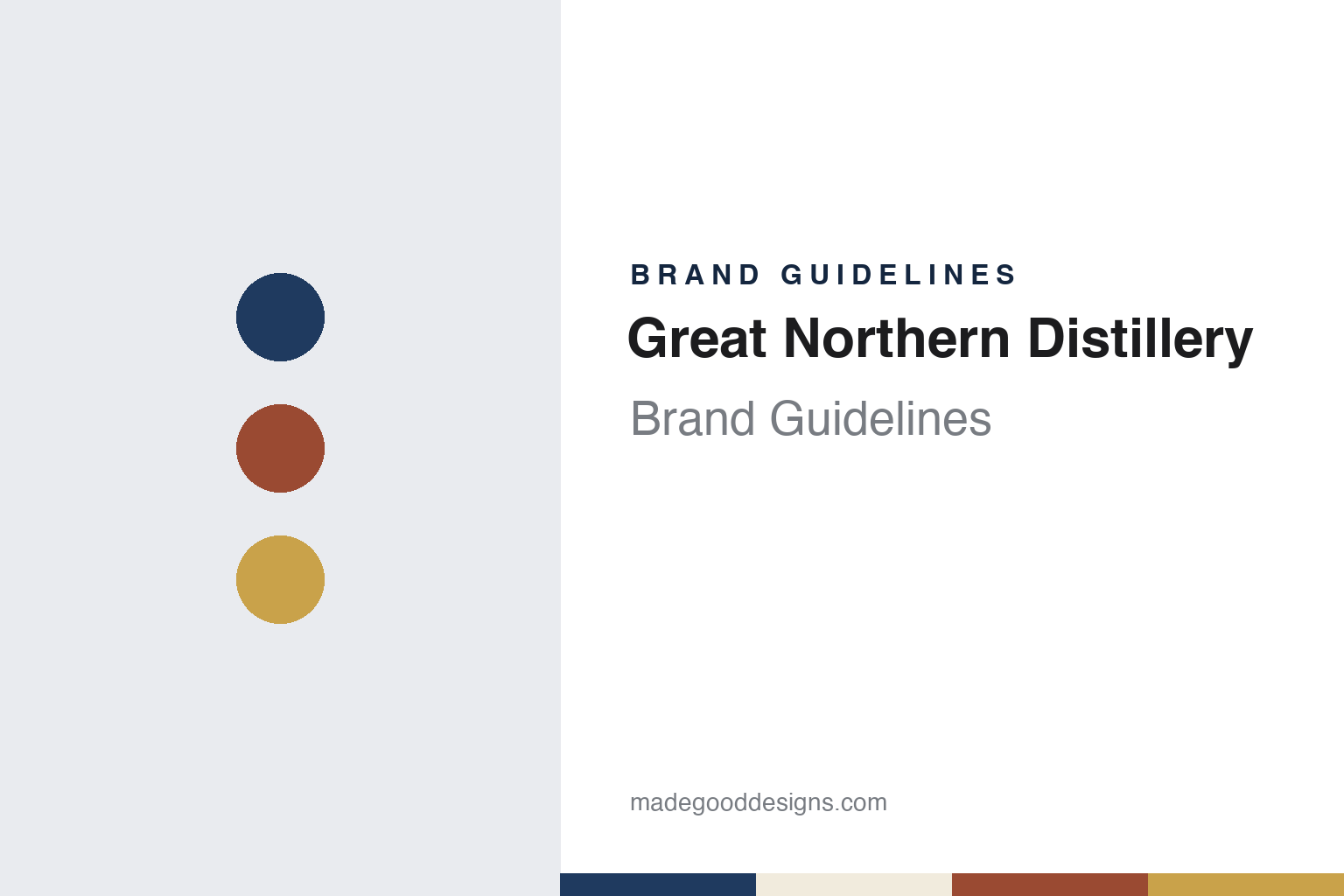
Great Northern Distillery Brand Guidelines
A Harp Lager brewery that became a whiskey distillery.
Aa
Two constants: a northern navy, brewery brick and grain gold palette and a condensed industrial sans register. Abstract homage — not a Great Northern Distillery product or mark; no label, logo or bottle is reproduced.
From Harp Lager to whiskey
A Dundalk brewery, a Diageo closure and the founder of Cooley.
Great Northern Distillery occupies the former Great Northern Brewery in Dundalk, County Louth, the site best known as the home of Harp Lager. English Wikipedia, citing Diageo Ireland, says Harp was created there in 1960 with the German master brewer Dr Hermann Muender, formerly of the Dom brewery in Cologne. The brewery came to belong to Guinness, later part of Diageo, and in January 2013 Diageo announced that it would stop brewing in Dundalk, Hospitality Ireland reported that August, with production consolidated at St James’s Gate in Dublin.
The buyer was John Teeling, who founded the Cooley distillery in 1987 and later reopened the Kilbeggan site, The Spirits Business has reported. Teeling sold Cooley to Beam at the end of 2011, WhiskyCast reported, and the new owner cut off most of the bulk whiskey Cooley had sold to independent bottlers so that its output could go to Beam’s own brands. In August 2013 The Spirits Business reported that Teeling had formed the Irish Whiskey Company with his sons Jack and Stephen and the former Cooley directors Jim Finn and David Hynes, and had agreed to take over the brewery once Diageo moved its brewing to Dublin that September. Hospitality Ireland reported that a public plea for investment in the brewery by Paddy Malone, then president of the local Chamber of Commerce, had prompted Teeling to look at the site.
The first plan was to distil in 2014; it took longer. Distilling began on 31 July 2015, English Wikipedia says, citing the company’s announcement, and the brewery took the name Great Northern Distillery. WhiskyCast reported in August 2015 that a grain distillery with three column stills had been fired up first, with a second distillery for pot still and single malt whiskey, with three copper pot stills, due later that month. John Teeling told Checkout that it was 95 years since the last whiskey stills had gone dark in Dundalk, where the Dundalk Distillery had operated since 1800, and 120 years since brewing had begun on the site.
Colour
A distillery built to make whiskey for other people’s labels.
Great Northern was set up as a supplier rather than as a consumer brand. The Spirits Business reported in 2013 that Teeling wanted an efficient, low-cost distiller serving the private label and bulk whiskey trade and the emerging craft distilling sector, and WhiskyCast wrote in 2015 that it would supply grain whiskey for blending to Ireland’s new pot still and malt distilleries, and bulk blended whiskeys to independent bottlers and retailers worldwide — the business Cooley had done under the Teeling group.
That is still how the company presents itself. Its website says it has been operational since 2015 and works with brand owners and buyers on bulk whiskey, private label products, contract-distilled spirits and retail own-brand partnerships, as well as supplying smaller distilleries in Ireland and abroad. It says its pot and column stills produce grain, triple malt, double malt, peated malt and pot still whiskey, that it also runs a small gin still, and that the first three-year-old whiskey made at the distillery came of age in 2018. Among the partners it quotes are the Irish whiskey brands Two Stacks, Natterjack and Egan’s.
For a design reader, that makes Great Northern a business-to-business name. The company’s own line, “We make what you want,” speaks to brand owners rather than drinkers, and the name it trades under is the one the brewery carried before it, now paired with the word distillery.
Typography
Design and documentation.
The seven brands in this group are all Irish distilleries: Killowen, Great Northern, Lough Gill, Clonakilty, Walsh Whiskey, Blackwater and Hinch. They are spread across the island rather than gathered in one district — Killowen in the Mourne Mountains and Hinch near Ballynahinch, both in County Down; Great Northern in Dundalk, County Louth, on the site of the former Harp brewery; Lough Gill in County Sligo; Clonakilty in west Cork; and Blackwater at Ballyduff in County Waterford.
Irish whiskey is a protected geographical indication. English Wikipedia notes that, under the rules set out in the 2014 technical file for Irish whiskey and checked by the Irish revenue authorities from January 2016, it must be matured for at least three years in wooden casks, and it recognises four styles: single pot still, single malt, single grain and blended. The word “single” may be used only when a whiskey is wholly distilled at one distillery.
The modern industry was rebuilt from very few distilleries. English Wikipedia records that Jameson, Powers and the Cork Distilleries Company merged as Irish Distillers in 1966, that Bushmills joined in 1972, and that Cooley Distillery was established by John Teeling in 1987; Great Northern, which Hospitality Ireland reported in August 2015 had begun distilling, was co-founded by him.
Ownership varies, and some of these names now sit inside larger drinks groups: BeverageDaily reported in November 2021 that Amber Beverage Group had acquired Walsh Whiskey, and in June 2022 that the Sazerac Company was buying Lough Gill Distillery, which Sazerac renamed Hawk’s Rock in 2025.
Each guide separates what independent sources record from what the company says about itself — who founded it, who owns it now, and where its whiskey is actually distilled, matured and bottled — and marks plainly what rests only on the company’s own word.
Aa
A condensed industrial sans for a brewery site turned whiskey works. (Specimen set in Oswald, a sans STAND-IN; NOT the Great Northern Distillery logo.)
Great Northern Distillery
A Teeling family company, separate from Teeling Whiskey.
Ownership has stayed with the founding group. WhiskyCast reported in 2015 that Great Northern was owned by the Teeling family together with Jim Finn and David Hynes, and the company describes itself as a private company whose owners previously established the Cooley Distillery and rebuilt the Kilbeggan Distillery before selling them in 2012. The Irish Times reported in June 2024 that Jack and Stephen Teeling remained major shareholders in Great Northern, and that in a corporate restructuring several shareholders — the brothers, their sister Emma Teeling, Jim Finn and David Hynes — had moved their shares from their own names into newly formed companies.
Great Northern should not be confused with the Teeling Whiskey Company. That business, formed by Jack and Stephen Teeling, was always to run as a separate entity, The Spirits Business reported in 2013, and it opened its distillery in Dublin’s Liberties in 2015; The Irish Times reported in June 2024 that the brothers had since sold a majority of it to Bacardi. The distillery trades online at gndireland.com and also uses the initials GND.
For a design guide, Great Northern Distillery shows how an industrial site can carry a name through a change of trade — from Harp Lager to whiskey — and how a business that fills other people’s bottles positions itself through service rather than a label. Compare Teeling, the Dublin brand built by John Teeling’s sons, and Kilbeggan, the Westmeath distillery his Cooley company reopened. For this guide we use northern navy, brewery brick and grain gold with a condensed sans, an unofficial interpretation; no product or logo is reproduced.
Explore & save
Keep Great Northern Distillery’s identity on hand — save it to a board in the Made Good inspiration library.
Great Northern Distillery identity set
Pin the Great Northern Distillery northern navy, brewery brick and grain gold palette and the condensed industrial sans register to your own board.