Kilbeggan Brand Guidelines
The Westmeath distillery dated 1757, revived in 2007.
Aa
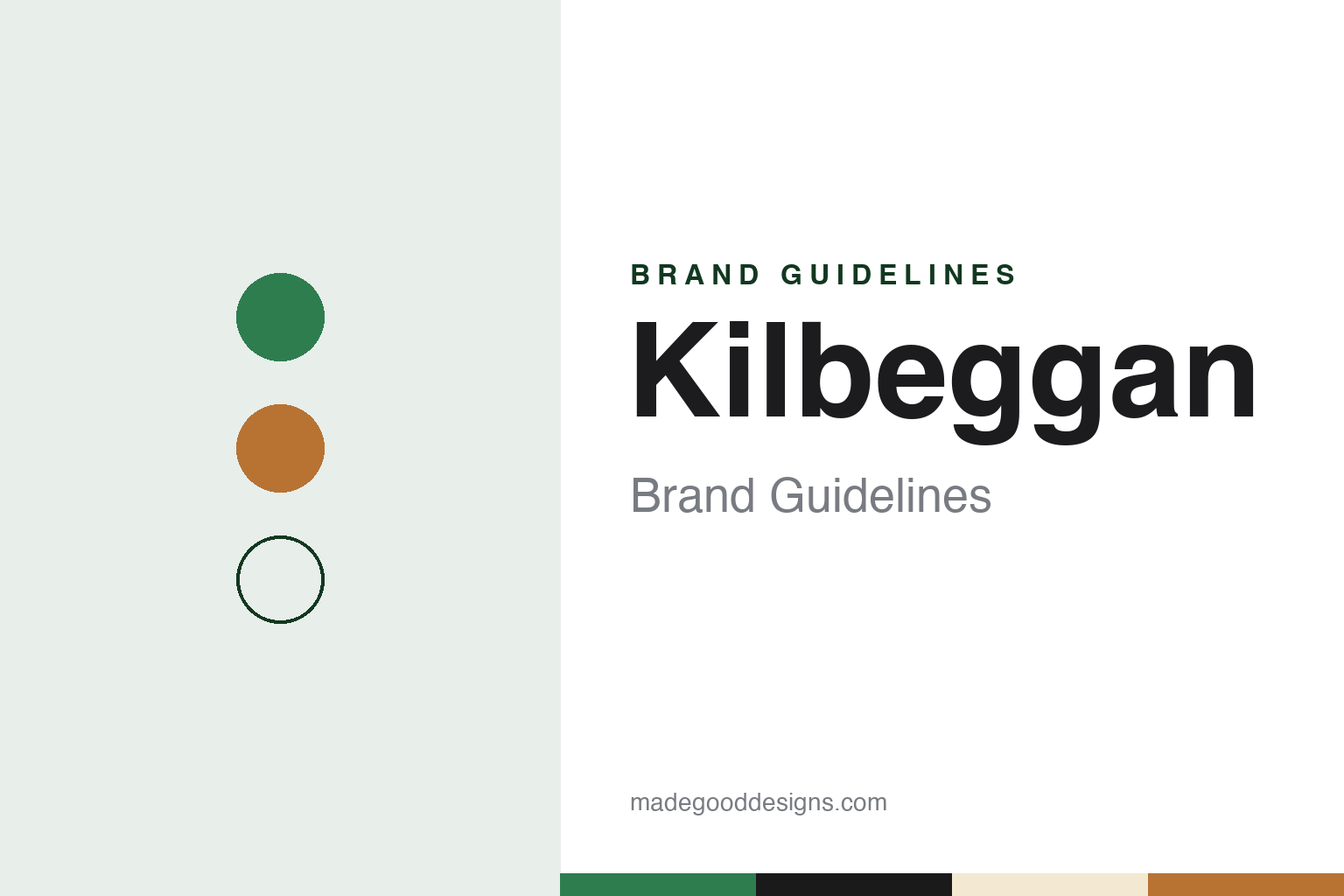
Two constants: a Kilbeggan green, copper and cream palette and a transitional serif register. Abstract homage — not a Kilbeggan product or mark; no label, logo or bottle is reproduced.
A licence from 1757
A small-town distillery on the River Brosna.
Kilbeggan takes its name from a market town in County Westmeath, in the Irish midlands. English Wikipedia says the distillery there was founded in 1757 by Matthew MacManus, who may have distilled elsewhere first, and that a copy of the 1757 distilling licence is displayed on site. In the early 1800s it was run by John and William Codd, and it was put up for sale in 1841 after a partnership dissolved.
The name most tied to the place is Locke. English Wikipedia says John Locke took over the distillery in 1843 and that it flourished under him. It records a moment that says something about the town and the plant: after an accident disabled the steam boiler in 1866, local people bought a replacement and presented it to Locke with a note begging his acceptance of a new boiler. When Alfred Barnard visited for his 1887 survey of distilleries, he called it the Brusna Distillery, after the river that drove its water wheel, and wrote that it was “said to be the oldest in Ireland.” The business became a limited company, John Locke & Co., in 1893.
The twentieth century was harder. English Wikipedia says ownership passed in the 1920s to John Locke’s granddaughters, Mary Evelyn and Florence Emily, that no new spirit was made between 1924 and 1931, and that a sharp rise in excise duty in 1952 cut domestic sales. Production halted in November 1953, and receivers were called in on 27 November 1958, “bringing to an end 201 years of distilling in the town”; the article’s summary box gives 1957 as the year the plant was mothballed. In 1947 a collapsed sale to a supposed Swiss investor, fronted by an impostor, became known as the Locke’s Distillery Scandal, the article says.
Colour
Copper, a water wheel and the year on every label.
The buildings outlived the business. English Wikipedia says a Hamburg businessman, Karl-Heinz Möller, bought the distillery in 1962, that it passed to Powerscreen in 1969, and that its stills were scrapped in the early 1970s. In 1982 the Kilbeggan Preservation and Development Association, a local group, reopened the site as a museum.
The brand came back before the stills did. English Wikipedia says the Cooley Distillery, which John Teeling had converted in 1987 from a former potato-alcohol plant in County Louth, bought the Kilbeggan assets that year and relaunched the Kilbeggan and Locke’s whiskeys, and that the Kilbeggan blend was originally distilled at Cooley. Distilling returned to the town in 2007, the 250th anniversary of the licence. One of the pot stills fired that year was, the article says, about 180 years old and came from the old Tullamore distillery, and it describes it as the oldest working pot still producing whiskey in the world. A mash tun and fermentation vats followed in 2010, making the site fully operational again.
The label tells that story. Shanken News Daily reported in March 2013 that Beam was launching new Kilbeggan packaging across the United States alongside a national advertising campaign, and that the label’s copper colour and shape reflect the pot still used to make the whiskey, with an image of the distillery and its water wheel. The Irish trade magazine Shelflife reported in May 2013 that the label also carries 1757 as the founding year, and that the new look launched in the US on St Patrick’s Day. It quoted Bob Gorman, Beam’s director of marketing for world whiskeys, and noted that Beam describes the town as home to Ireland’s oldest operating distillery and the blend as double distilled.
Typography
Design and documentation.
The seven brands in this group are all Irish whiskey names: Redbreast, Teeling, Powers, Kilbeggan, Writers’ Tears, Green Spot and Midleton. Irish whiskey brands in general sit at many different points in the trade, from family firms that still carry a founder’s name to labels that now belong to much larger drinks groups, and a single brand can be sold everywhere from a corner shop to a hotel bar.
An Irish whiskey brand’s identity is usually carried less by a single bottle than by a label, a name and the place it promises, because the company behind the name may have changed hands, moved its production or grown far beyond the place where it started. That makes the questions behind each name worth asking plainly: who started it, who owns it now, and where its whiskey is actually distilled, matured and bottled.
Each guide separates what independent sources record from what the company says about itself — its founding story, its owners over time, where its whiskey is made and how its labels have changed — and marks plainly what rests only on the company’s own word.
Aa
A transitional serif for a heritage distillery label. (Specimen set in Libre Baskerville, a serif STAND-IN; NOT the Kilbeggan logo.)
Kilbeggan
From an Irish independent to a Japanese-owned group.
The current owner arrived in two steps. English Wikipedia says Beam Inc. announced its purchase of Cooley on 16 December 2011 and completed it in January 2012, taking Kilbeggan along with Connemara, Tyrconnell and Greenore; Shanken News Daily called Kilbeggan Beam’s priority Irish whiskey in the US in 2013. Japan’s Suntory agreed to buy Beam in January 2014 and closed the deal in April 2014, creating Beam Suntory, which renamed itself Suntory Global Spirits in May 2024 with a new website and visual identity, English Wikipedia says.
The distillery now makes whiskey from start to finish again. English Wikipedia says spirit distilled on site became mature enough for market around 2014, and lists a Distillery Reserve single malt and a Small Batch Rye. The brand’s own site describes the rye as the first whiskey distilled and matured entirely at the Kilbeggan Distillery since its restoration was completed in 2010, and today lists a blend, the rye, a single pot still and a Triple Cask, among others, under the line “For over 250 years.”
The name needs a little care online: Kilbeggan is also the name of the town itself, so the whiskey is usually written Kilbeggan Irish Whiskey, and its own site is kilbegganwhiskey.com.
For a design guide, Kilbeggan shows how a date, a copper pot still and a water wheel can carry a whiskey through two centuries of distilling, half a century of silence and a revival under three owners. Compare Tullamore D.E.W., the midlands whiskey whose old distillery supplied one of Kilbeggan’s stills, and Jim Beam, the Kentucky bourbon whose parent company bought Cooley. For this guide we use Kilbeggan green, copper and cream with a serif, an unofficial interpretation; no product or logo is reproduced.
Explore & save
Keep Kilbeggan’s identity on hand — save it to a board in the Made Good inspiration library.
Kilbeggan identity set
Pin the Kilbeggan green, copper and cream palette and the transitional serif register to your own board.