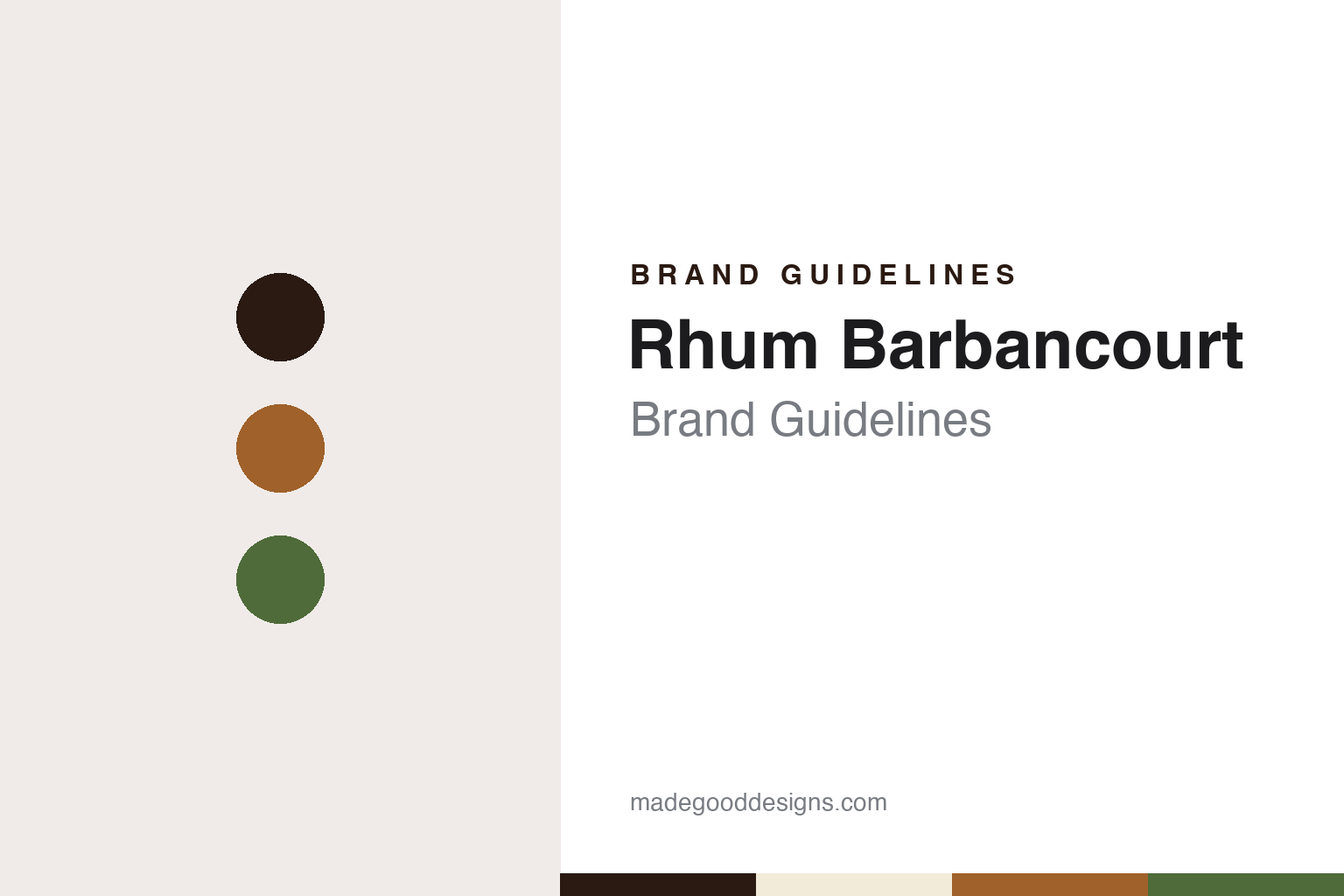
Rhum Barbancourt Brand Guidelines
The Haitian cane-juice rum house of 1862 and the Gardère family.
Aa
Two constants: an aged amber, cane-field green and cane-juice cream palette and a cognac-house serif register. Abstract homage — not a Barbancourt product or mark; no bottle, label or logo is reproduced.
Dupré Barbancourt
A rum house from 1862 and a family that inherited it.
Rhum Barbancourt dates from 1862. English and French Wikipedia both give the founding date as 18 March 1862 and name the founder as Dupré Barbancourt, who, they say, came from the Charente, the cognac country of western France; a 2020 legal-press notice on the company’s change of ownership also records that it was founded in Haiti in 1862 by Dupré Barbancourt. Wikipedia says he brought with him the double-distillation method used for cognac, and French Wikipedia adds that the rum was aged in oak casks from the Limousin. The business is still called the Société du Rhum Barbancourt.
The founder’s name stayed on the bottle, but the company passed to his wife’s family. Imbibe reported in 2021 that when Dupré Barbancourt died in 1907, his widow, Nathalie, ran the distillery for a time. She was a Gardère, and the next generation of managers came from her side of the family: her nephew Paul Gardère led the company until 1946, after which his son Jean Gardère took over, according to both Wikipedia and the French spirits magazine Rumporter, which published a profile of the house in October 2022. Jean Gardère ran Barbancourt until 1990, when his son Thierry Gardère succeeded him.
Imbibe reported that Thierry Gardère died in March 2017 and that his only child, Delphine Gardère, who had been working in finance and then in marketing in the perfume trade in Europe, returned to Haiti for the funeral and stayed to run the distillery as the fifth generation of the family to do so. Imbibe also noted that her middle name is Nathalie, after the widow who had run the business more than a century earlier.
Colour
Cane juice, the Cul-de-Sac and an earthquake.
Barbancourt is made from fresh sugar cane juice rather than molasses, the by-product of sugar making. The company’s website described its rum in 1999 as an “agricultural” rum made from cane grown on the Plaine du Cul-de-Sac and Imbibe wrote in 2021 that the distillery had worked from fresh cane juice for more than a century. Wikipedia says Jean Gardère moved production in 1949 to a new distillery in the middle of the cane fields of the Domaine Barbancourt on the Cul-de-Sac plain, and that from 1952 the plant began making rum from cane grown on its own estate.
The stills have changed over time. Imbibe reported that Barbancourt’s rums were for decades a blend of spirit from pot stills and column stills, and that the pot stills went out of service during the embargo imposed on Haiti in the early 1990s, when spare parts could not be obtained. Rumporter wrote in 2022 that the house now distils on columns alone and that Delphine Gardère was considering bringing pot stills back.
The range is graded by age. Wikipedia lists a white rum; Three Star, aged four years; Five Star Réserve Spéciale, aged eight years; and the Réserve du Domaine, aged 15 years and sold in some markets as Estate Reserve. Rumporter reported in 2022 that the white rum was becoming an overproof bottled at 55% and that Three Star would move to 43%, the strength of the older rums; the company’s website now lists a Haitian Proof alongside the three aged rums, plus anniversary and finish editions.
The 12 January 2010 earthquake hit the distillery hard. The trade paper Beverage Business reported in February 2010 that an exterior wall had collapsed, equipment was damaged, barrels of ageing rum were destroyed and two employees had died, and that production was not expected to restart for at least a month. English Wikipedia says production had resumed by May 2010, and Rumporter reported in 2022 that stocks of ageing rum had since been rebuilt above their level before the earthquake.
Typography
Design and documentation.
The seven brands in this group are all rum names: Foursquare, Doorly’s, Chairman’s Reserve, Ron Matusalem, Pusser’s, Don Papa and Barbancourt. Their stories run through Barbados, Saint Lucia, Cuba, the Dominican Republic, Haiti and the Philippines, as well as the Royal Navy’s old rum ration, and at least one of them began in one country and is now made in another. Rum brands in general sit at many different points in the trade, from family distilleries that still carry a founder’s name to labels that now belong to much larger drinks groups.
A rum’s identity is usually carried less by a single bottle than by a label, a name and the place it promises, because the company behind the name may have changed hands, moved its distilling or grown far beyond the place where it started. Rum is made from sugar cane, either from molasses or from fresh cane juice, and the rules on what may be called rum, how long it is aged and what may be added differ from one country to the next. That makes the questions behind each name worth asking plainly: who started it, who owns it now, and where its rum is actually distilled, aged and bottled.
Each guide separates what independent sources record from what the company says about itself — its founding story, its owners over time, where its rum is made and how its labels have changed — and marks plainly what rests only on the company’s own word.
Barbancourt
A cognac-house serif for a Haitian rum made by cognac’s double-distillation method. (Specimen set in Cormorant Garamond, a serif STAND-IN; NOT the Barbancourt logo or label lettering.)
Barbancourt
One owner, a new identity and an old slogan.
For most of its history Barbancourt was a family company with several Gardère shareholders. Imbibe reported that after Thierry Gardère’s death his daughter inherited his shares and became managing partner, that other family members contested control, and that she won an arbitration under the company’s bylaws. On 19 November 2020 the French legal paper Le Monde du Droit reported that her holding company, Delphine Gardère Holdings, had acquired 100% of the Société du Rhum Barbancourt in a management buyout backed by financial partners and Haitian banks, ending the family shareholders’ stake and opening a strategy aimed at the brand’s international reach. Delphine Gardère has owned the company through that holding since November 2020 and continues to run it.
The look of the brand has been part of that change. Rumporter reported in October 2022 that since 2017 the company had expanded its ageing cellars, set up a research team, tested finishes in other casks and introduced new packaging, cork stoppers and a revised brand identity, while returning to markets including Italy, the Benelux countries, the United Kingdom and Switzerland. The company’s current website carries the line “Fait en Haïti avec amour” — made in Haiti with love — and describes the house as producing rums “à l’image d’Haïti” for more than 160 years.
Barbancourt’s advertising has long leaned on prestige. Imbibe noted that advertisements in the 1930s billed the rum as “The Toast of the World’s Elite,” and that drinkers have long compared it with fine cognac. Delphine Gardère told the magazine in 2021 that the house style was a light-bodied rum with a citrus aroma, and that new releases would have to fit that profile.
For a design guide, Barbancourt shows how a founder’s surname, a range graded by stars and years and a single growing region can carry a family rum house through five generations and a change of ownership. Compare Rhum Clément and Rhum J.M, two cane-juice rum houses of Martinique, and Brugal, the Dominican rum family on the other side of Hispaniola. For this guide we use an aged amber, a cane-field green and a cane-juice cream with a high-contrast serif, an unofficial interpretation; no product or logo is reproduced.
Explore & save
Keep Rhum Barbancourt’s identity on hand — save it to a board in the Made Good inspiration library.
Rhum Barbancourt identity set
Pin the Barbancourt aged amber, cane-field green and cane-juice cream palette and the cognac-house serif register to your own board.


