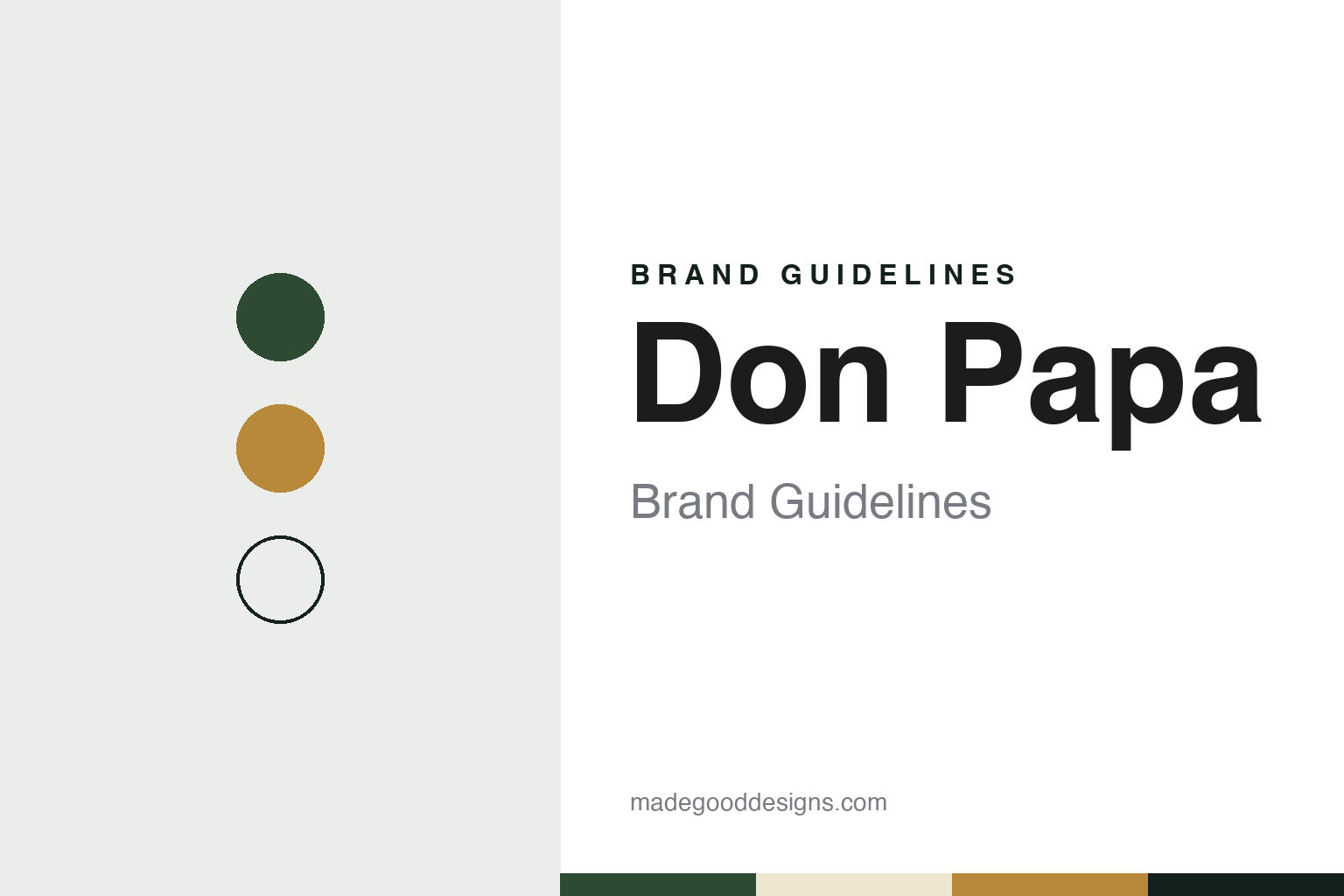
Don Papa Brand Guidelines
The Negros rum with a label full of hidden animals.
Aa
Two constants: a Don Papa jungle green, gold and parchment palette and an Illustrated serif register. Abstract homage — not a Don Papa product or mark; no bottle, label or illustration is reproduced.
Sugarlandia
A rum named after a revolutionary.
Don Papa is a young brand built on an old story. It was launched in 2012 by Stephen Carroll and Andrew John Garcia, Diageo said when it announced its purchase of the brand in January 2023. English Wikipedia describes Carroll as a former executive of Rémy Cointreau, the French spirits group, and says he founded the Bleeding Heart Rum Company to make the rum after a trip to Bacolod, where he heard that the surrounding island grew some of the finest sugarcane in the world.
The island is Negros, and the province is Negros Occidental, which Diageo says is nicknamed locally “Sugarlandia.” According to English Wikipedia, the rum made its debut in Bacolod, the provincial capital, in 2012 and reached Manila later that year; it then went on sale in the United Kingdom and Spain, and arrived in the United States in 2017.
The name comes from a person. Diageo describes Papa Isio as a leader in the Philippine revolution of the late nineteenth century who had worked as a foreman on a sugar plantation. VinePair, in an April 2023 profile of the brand, gives his name as Dionisio Magbuelas and says he drove the Spanish from Negros in 1898. VinePair says the figure on the label is based on him.
Colour
Fifty animals on one label.
Don Papa’s label is the centre of its identity, and its designer is documented. VinePair reported in 2023 that the original label was created by the New York design firm Stranger & Stranger, and The Spirits Business listed the same firm against Don Papa 10 Year Old when it featured the bottle in its Design & Packaging Masters round-up in December 2015.
The label is an illustration rather than a typographic badge. The Spirits Business described it as giving an “exotic twist” to images of the island’s old Spanish landlords, with at least 50 detailed images of animals and insects; its judges praised the bottle’s “storytelling” and its “unique brand heritage.” VinePair says around 50 animals are hidden in the design, among them a tarsier, and that the monocle over Don Papa’s eye is in fact a gecko. The figure himself is based on Papa Isio, set among the wildlife of Negros.
The brand has extended that illustrated world to many editions. English Wikipedia counts about 40 canister designs released for the bottles, some treated as collectibles, and lists series including the 7-year-old, Baroko, Masskara, Sevillana and Rare Cask. Its website now gathers the brand world under the name Sugarlandia, “an odd but very marvellous place where senses are heightened,” and calls Don Papa “The Don of the Philippines.”
Typography
Design and documentation.
The seven brands in this group are all rum names: Foursquare, Doorly’s, Chairman’s Reserve, Ron Matusalem, Pusser’s, Don Papa and Barbancourt. Their stories run through Barbados, Saint Lucia, Cuba, the Dominican Republic, Haiti and the Philippines, as well as the Royal Navy’s old rum ration, and at least one of them began in one country and is now made in another. Rum brands in general sit at many different points in the trade, from family distilleries that still carry a founder’s name to labels that now belong to much larger drinks groups.
A rum’s identity is usually carried less by a single bottle than by a label, a name and the place it promises, because the company behind the name may have changed hands, moved its distilling or grown far beyond the place where it started. Rum is made from sugar cane, either from molasses or from fresh cane juice, and the rules on what may be called rum, how long it is aged and what may be added differ from one country to the next. That makes the questions behind each name worth asking plainly: who started it, who owns it now, and where its rum is actually distilled, aged and bottled.
Each guide separates what independent sources record from what the company says about itself — its founding story, its owners over time, where its rum is made and how its labels have changed — and marks plainly what rests only on the company’s own word.
Aa
An illustrated serif — “The Don of the Philippines.” (Specimen set in IM Fell English, a serif STAND-IN; NOT the Don Papa logo.)
Don Papa
Owned by Diageo since 2023.
The brand did not stay independent. Diageo announced on 17 January 2023 that it would acquire Don Papa Rum, describing it as “a super-premium, dark rum from the Philippines,” and said Carroll would remain involved with the brand. It announced completion on 10 March 2023, saying the rum was then available in more than 30 countries. Diageo has owned Don Papa since March 2023.
The deal was framed around the founder. In the January announcement John Kennedy, president of Diageo Europe and India, said the company was “excited by the opportunity to bring Don Papa into the Diageo portfolio,” and Carroll said that Diageo “has a strong track record in nurturing founder-led brands.” By then the brand had already spread well beyond the Philippines: its arrival in the United States in 2017 was covered by Forbes and by The New York Times, in a May 2017 piece titled “A Sipping Rum From the Philippines,” according to English Wikipedia’s citations.
On where the rum is made, Diageo says Don Papa is distilled and aged on Negros Occidental, in American oak barrels, from Negros sugarcane. The brand’s website places it on the foothills of “the active volcano Mt. Kanlaon” and describes the rum as an aged, small-batch, single-island rum, with sugarcane milled into molasses, fermented, distilled and blended by a master blender; it does not name a distillery. English Wikipedia says the flagship is aged for at least seven years, and VinePair describes it as distilled from molasses and aged for more than seven years in American oak. We give those as the company’s and the publications’ accounts.
The brand’s visual world rests on three elements that the sources document: a character based on Papa Isio, the island nickname Sugarlandia, and a dense illustration by Stranger & Stranger in which, VinePair says, around 50 animals are hidden. Its website also has a section devoted to art, alongside its cocktails, press and range pages, and it presents the range as a portfolio of aged and cask-finished rums from one island.
For a design guide, Don Papa shows how an illustrated label can carry a whole brand — character, place and play in one image. Compare Tanduay, the Manila rum with a heraldic crest, and Zacapa, the Guatemalan rum wrapped in a woven petate band. For this guide we use jungle green, cane gold and parchment with a serif, an unofficial interpretation; no product or logo is reproduced.
Explore & save
Keep Don Papa’s identity on hand — save it to a board in the Made Good inspiration library.
Don Papa identity set
Pin the Don Papa jungle green, gold and parchment palette and the Illustrated serif register to your own board.