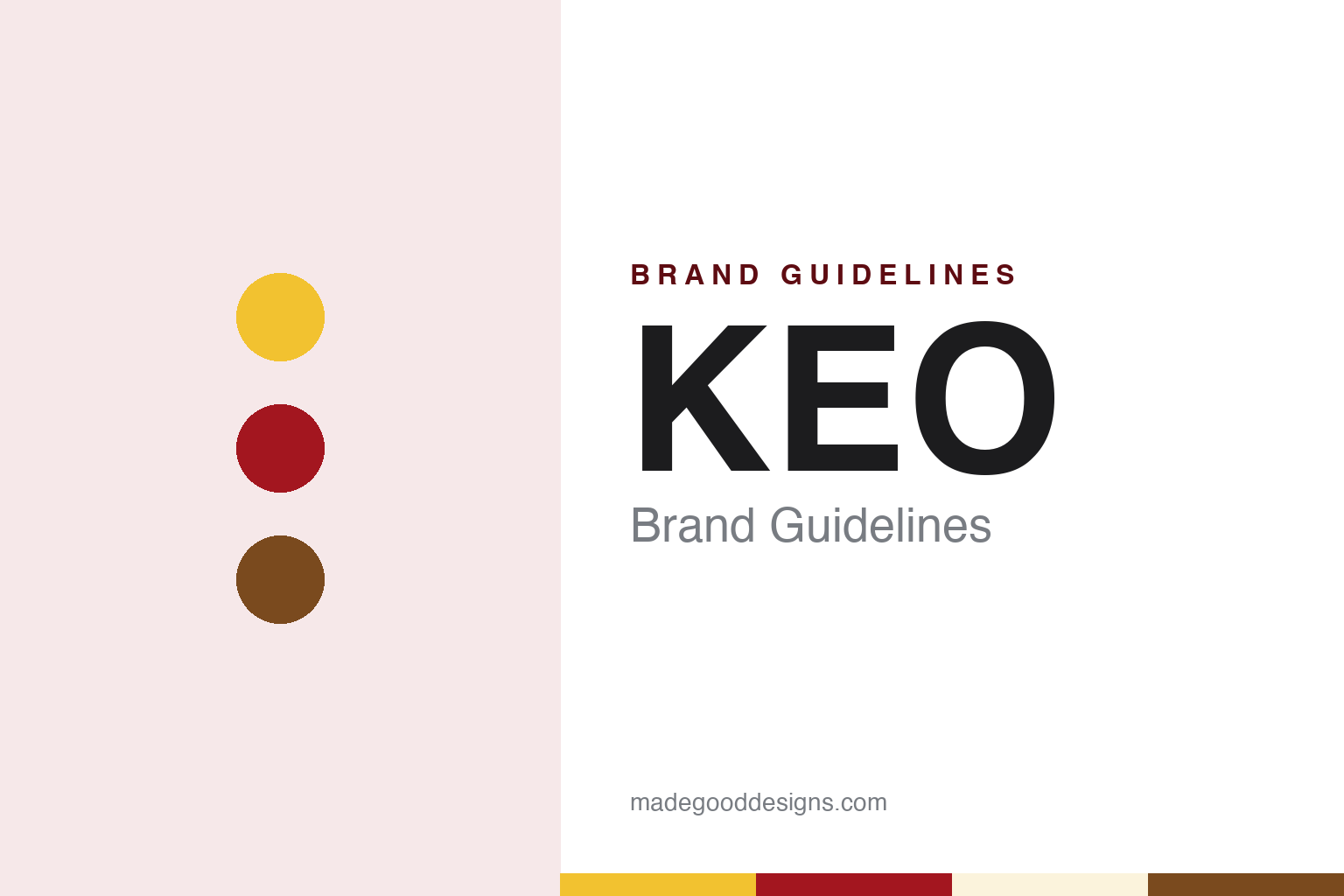
KEO Brand Guidelines
The Cyprus Wine Company behind the island’s 1951 lager.
Aa
Two constants: a sun yellow, label red and Commandaria amber palette and a heavy grotesque register. Abstract homage — not a KEO product or mark; no label, logo or bottle is reproduced.
A wine company that learned to brew
A Greek acronym, a Limassol plant and a lager made with Czechoslovak help.
The three letters on the can are an acronym. KEO stands for Κυπριακή Εταιρεία Οίνων, the Cyprus Wine Company, and English Wikipedia says the business began as a wine producer in the Limassol district. The company dates itself to 1927 and describes itself as a public limited company formed that year, with its shares quoted and traded on the Cyprus Stock Exchange. Its own timeline says the plant was relocated to Limassol in 1939, and the Limassol site remains its headquarters.
Beer came a generation later. KEO’s milestones record that production of KEO beer began on 17 May 1951, and the company describes the result as a pilsner-type lager. English Wikipedia says the original recipe and technical advice came from Czechoslovakia, and that the recipe was kept as the brewery’s equipment was upgraded over the following decades. The beer is a light straw-coloured lager, and Wikipedia gives its strength as 4.5 per cent.
The company kept widening its range. Its timeline lists the founding of SWS, a juice and canned-food business, in 1963; the launch of Saint Nicholas natural mineral water in 1995; KEO Light in 2015; and the seventieth anniversary of KEO beer in 2021. Beyond the Limassol winery, KEO says it runs three more wineries in the Krasochoria, the wine villages on the slopes of the Troodos mountains, among them Mallia and Pera Pedi.
Colour
A yellow label first drawn in Britain, refreshed for a younger crowd in 2013.
KEO’s look rests on one colour. In August 2013 the Cyprus Mail reported that the original beer label had been designed in the United Kingdom in 1951, and that its replacement — printed in Brussels and launched on 1 July that year — kept the traditional yellow, now enlarged, with the KEO name in red. The paper said the year 1951 was now displayed prominently, the KEO logo had been turned to a vertical position, and the word “proudly” had been added to the line “Brewed on the Island of Cyprus”. KEO’s own timeline lists the change as the 2013 packaging facelift.
The brand manager at the time, George Georgiou, told the Cyprus Mail that the yellow had been kept so as not to alienate loyal drinkers, and that it represents “the sun in Cyprus”. The aim of the refresh, the paper reported, was to keep the brand fresh and to reach a younger audience. The same article described KEO as one half of a near-duopoly in the Cypriot beer market, with Carlsberg as the other.
The brand’s own line is shorter still. The beer’s website presents KEO under the slogan “The Taste of Cyprus”, says the beer has been part of island life since 1951, and describes it as brewed from malt and hops by a traditional method on modern equipment. KEO says the beer is bottled fresh and unpasteurised, and that it is sold in cans, in bottles and on draught. The group uses the same phrase, “The Taste of Cyprus”, as the title of its corporate site, so the slogan works for the company as well as for the lager.
The beer has also carried the name onto the football pitch. English Wikipedia says that in 2016 KEO announced its sponsorship of the Cyprus national football team for the qualifying stages of the 2018 World Cup.
Typography
Design and documentation.
The seven brands in this group are drinks names from Greece, Cyprus and Turkey: Barbayanni, Vallindras, KEO, Mythos, Babatzim, Efe Rakı and Tekirdağ Rakı. Around the eastern Mediterranean, anise spirits, grape spirits, citron liqueur, wine and beer sit at many different points in the trade, from family houses that still carry a founder’s name to labels that began inside a state monopoly or now belong to much larger drinks groups.
A drinks brand’s identity is usually carried less by a single bottle than by a label, a name and the place it promises, because the company behind the name may have changed hands, moved its production or grown far beyond the town where it started. That makes the plain questions worth asking: who started it, who owns it now, and where its drinks are actually distilled, brewed or bottled.
Each guide separates what independent sources record from what the company says about itself — its founding story, its owners over time, where its drinks are made and how its labels have changed — and marks plainly what rests only on the company’s own word.
Aa
A heavy grotesque for a three-letter acronym on a yellow label. (Specimen set in Archivo Black, a sans STAND-IN; NOT the KEO logo.)
KEO
Commandaria, zivania and brandy from a company held largely by the Church.
The wine side of the name has not gone away. KEO’s portfolio lists Commandaria St. John, a sweet amber wine that the company says is vinified from the indigenous Cypriot grapes Mavro and Xynisteri, alongside table wines such as Othello, Heritage Maratheftiko and the KTHMA KEO range, and a red made entirely from the native Yiannoudi grape.
Spirits sit beside the wines. The company lists its own zivania, which it describes as a traditional Cypriot spirit distilled from local grape varieties, together with KEO Ouzo Extra Fine and KEO V.S.O.P brandy, which it says is double-distilled in copper pot stills and matured in oak. Its portfolio also includes Five Kings brandy, and a long list of imported brands that KEO sells in Cyprus, among them Greek labels such as Babatzim ouzo and tsipouro.
Ownership is unusual for a listed drinks company. According to shareholder disclosures reported by Cyprus Business Now in July 2023, with a reference date of 30 June 2023, the Holy Archdiocese of Cyprus and the Central Church Fund held the two largest stakes in KEO plc, with the remaining shares distributed among the public. English Wikipedia likewise describes the Church of Cyprus as a major shareholder.
One practical note: the beer has its own site, keobeer.com.cy, separate from the group site keogroup.com, and “KEO” is also an acronym used by unrelated organisations, so pairing the name with Cyprus or Limassol helps when searching.
For a design guide, KEO shows how a single colour — a yellow its own brand manager linked to the Cyprus sun — can carry a label through more than six decades, with the 2013 refresh adding a date and a red name rather than starting again. Compare Metaxa, the Greek spirit with its own brandy-and-wine story, and Efes, the Turkish pilsner across the eastern Mediterranean. For this guide we use sun yellow, label red and Commandaria amber with a heavy sans, an unofficial interpretation; no product or logo is reproduced.
Explore & save
Keep KEO’s identity on hand — save it to a board in the Made Good inspiration library.
KEO identity set
Pin the KEO sun yellow, label red and Commandaria amber palette and the heavy grotesque register to your own board.


