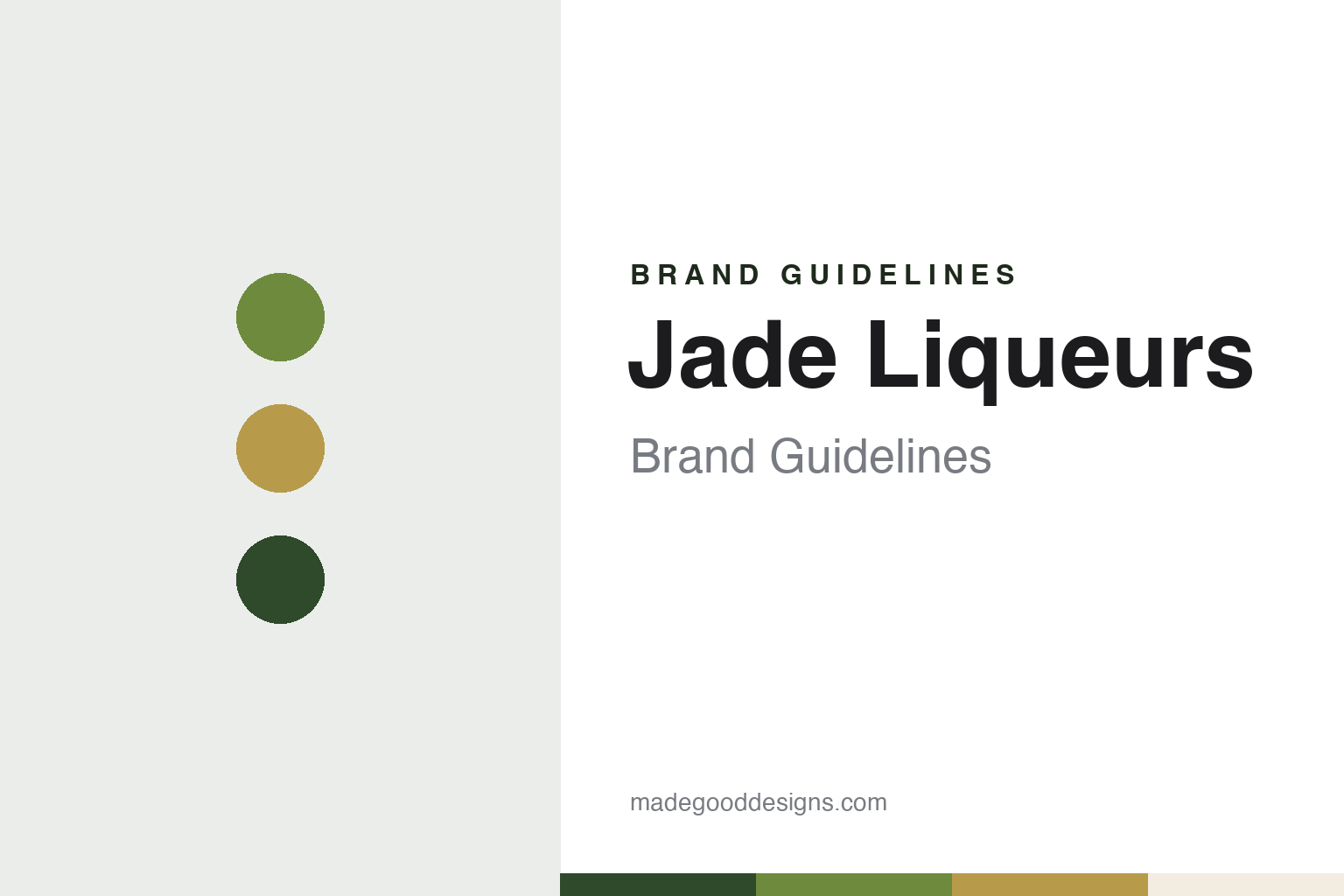
Jade Liqueurs Brand Guidelines
The New Orleans scientist’s house of recreated Belle Époque absinthes.
Aa
Two constants: a Jade green, olive and antique gold palette and a Belle Époque serif register. Abstract homage — not a Jade Liqueurs product or mark; no bottle, label or logo is reproduced.
A scientist’s house
Ted Breaux and the sealed bottles.
Jade Liqueurs is the absinthe house of T. A. Breaux, known as Ted. The company’s own history page says it “was founded in 2000 by T.A. Breaux, a professional scientist,” and describes him as “a native of New Orleans, Louisiana.” Its website signs off in his name as “Founder and President” of Jade Liqueurs, LLC, and carries a copyright line running from 2005 to 2016. Its welcome page offers the site in English and in French, and says its products are “handcrafted in France” on “original antique alembic stills.”
The idea behind the house is reconstruction. Jade says it was set up “for the sole purpose” of offering “unequivocal recreations of the classic absinthes” of the Belle Époque, and that this was possible only because it found and bought “immaculately preserved bottles of the most famous original absinthes of the 19th century.” Breaux, the company says, used his training in applied analytical sciences, working with other scientists, to study the contents of those bottles, and some of that research has appeared in scientific journals. The company also says he contributed to two books on absinthe: Absinthe, Sip of Seduction: A Contemporary Guide, in English, and Absinthe, A Myth Always Green, published in French by L’Esprit Frappeur.
Jade’s story is told through a laboratory and a cellar of antique bottles: the company says it keeps intact examples of originals in its archive, and its product pages read as accounts of what each original was, who made it and when it disappeared, before describing the new spirit made to match it.
Colour
Five absinthes and a Loire distillery.
Jade’s range is built around named recreations. By the company’s own account, Esprit Edouard was its first release reverse-engineered from sealed antique bottles, a tribute to a celebrated pre-ban 72-degree absinthe; Jade 1901 was the second, recreating a widely studied absinthe “as it appeared circa 1901”; and C.F. Berger, also sold as Verte Suisse 1898, recreates the 65-degree absinthe verte of the C.F. Berger distillery, which Jade says was founded at Couvet, in the Swiss canton of Neuchâtel, in 1823 and stopped making absinthe with the Swiss ban of 1910. Terminus Oxygénée, which the company calls the final release in its series of historically accurate absinthes, is modelled on a Belle Époque brand that was advertised for a hot oxygenation process.
Nouvelle-Orléans is different. Jade presents it not as a copy but as “the inspired work of native New Orleanian T. A. Breaux,” rooted in the absinthes drunk in the city before the American ban of 1912, and it calls the spirit “L’esprit du Vieux Carré” — the spirit of the French Quarter. The company says it was the first Jade absinthe released in the United States, at the end of 2008. Beyond absinthe, Jade sells Coeur de Jade, the grape eau de vie it describes as the base spirit for its absinthes, a Perique tobacco liqueur that it says was released in 2006, and DeGroff Bitters.
All of it is made in France. Jade says its absinthes come “from the famed Combier distillery,” and its Jade 1901 page places that distillery in Saumur, in the Loire Valley. The same page says Combier bought two 1,100-litre copper absinthe stills from the original distiller in Pontarlier after the bans, and that Gustave Eiffel redesigned the distillery in 1894; those are the company’s statements. Jade also says its team grows key plants in the Loire, including two cultivars of grande wormwood, and that each absinthe is pot-distilled from French eau de vie with whole botanicals and rested for an average of three years before bottling.
Typography
Design and documentation.
The seven brands in this group are all absinthe names: La Fée, Kübler, Jade, Lucid, Émile Pernot, Duplais and Vieux Pontarlier. Between them they run from a Pontarlier distillery that says it first labelled absinthe in 1889 to names launched after the drink became legal again.
Two places sit behind most absinthe stories. One is the Val-de-Travers, a valley in the Swiss canton of Neuchâtel: English Wikipedia records that Major Dubied opened a distillery at Couvet in 1797, and that the village of Môtiers in the Val-de-Travers became a focal point of production after the Swiss ban was lifted. The other is Pontarlier, just across the border in the French department of the Doubs, where the same source records that the Pernod family built a distillery under the name Maison Pernod Fils in 1805.
The bans shaped every brand here. English Wikipedia records that Switzerland held a referendum on 5 July 1908 and that the production and sale of absinthe were prohibited there from 1910 until 1 March 2005. In France, Parliament voted the law banning absinthe production on 16 March 1915, according to the Pontarlier distillery Les Fils d’Émile Pernot; English Wikipedia records that the French ban of 1915 was repealed in May 2011, and that in the United States the Alcohol and Tobacco Tax and Trade Bureau effectively lifted its long-standing ban in 2007.
A label is therefore often doing more than naming a drink: it is placing it in one of these two places, or in the years before or after a ban. Each guide separates what independent sources record from what the company says about itself — who started the brand, who owns it now, where its absinthe is actually distilled and how its labels have changed — and marks plainly what rests only on the company’s own word.
Aa
A Belle Époque serif — recreations of the classic absinthes. (Specimen set in Cormorant Garamond, a serif STAND-IN; NOT the Jade Liqueurs logo.)
Jade Liqueurs
History as the brand.
Jade’s place in the American story runs through another brand. The company’s FAQ says that “the efforts of T. A. Breaux and Viridian Spirits” — the New York company behind Lucid — led to the lifting of the American ban on 5 March 2007. English Wikipedia’s article on Lucid gives the same date for the federal label approval granted to that brand, citing the Alcohol and Tobacco Tax and Trade Bureau’s record. Lucid, which Breaux created, is also distilled at Combier, according to Shanken News Daily in 2013.
The brand’s language is consistent: “authenticity,” “artisanal,” “historical accuracy,” “Belle Époque.” Several of its product names borrow the names, dates or degrees of the originals — 1901, 1898, Edouard, Berger — so that each bottle is introduced through the absinthe it recreates. Jade’s pages give tasting notes and composition in a fixed pattern, and list ratings from critics; we give those only as the company’s own claims.
For a design guide, Jade Liqueurs shows a brand that builds its identity from archival research, naming each product after the history it reconstructs. Compare Lucid, the absinthe Breaux created for the American market, and Pernod, the Pontarlier name central to the pre-ban era. For this guide we use a deep jade green, an olive and an antique gold with a serif, an unofficial interpretation; no product or logo is reproduced.
Explore & save
Keep Jade Liqueurs’s identity on hand — save it to a board in the Made Good inspiration library.
Jade Liqueurs identity set
Pin the Jade Liqueurs green, olive and antique gold palette and the Belle Époque serif register to your own board.