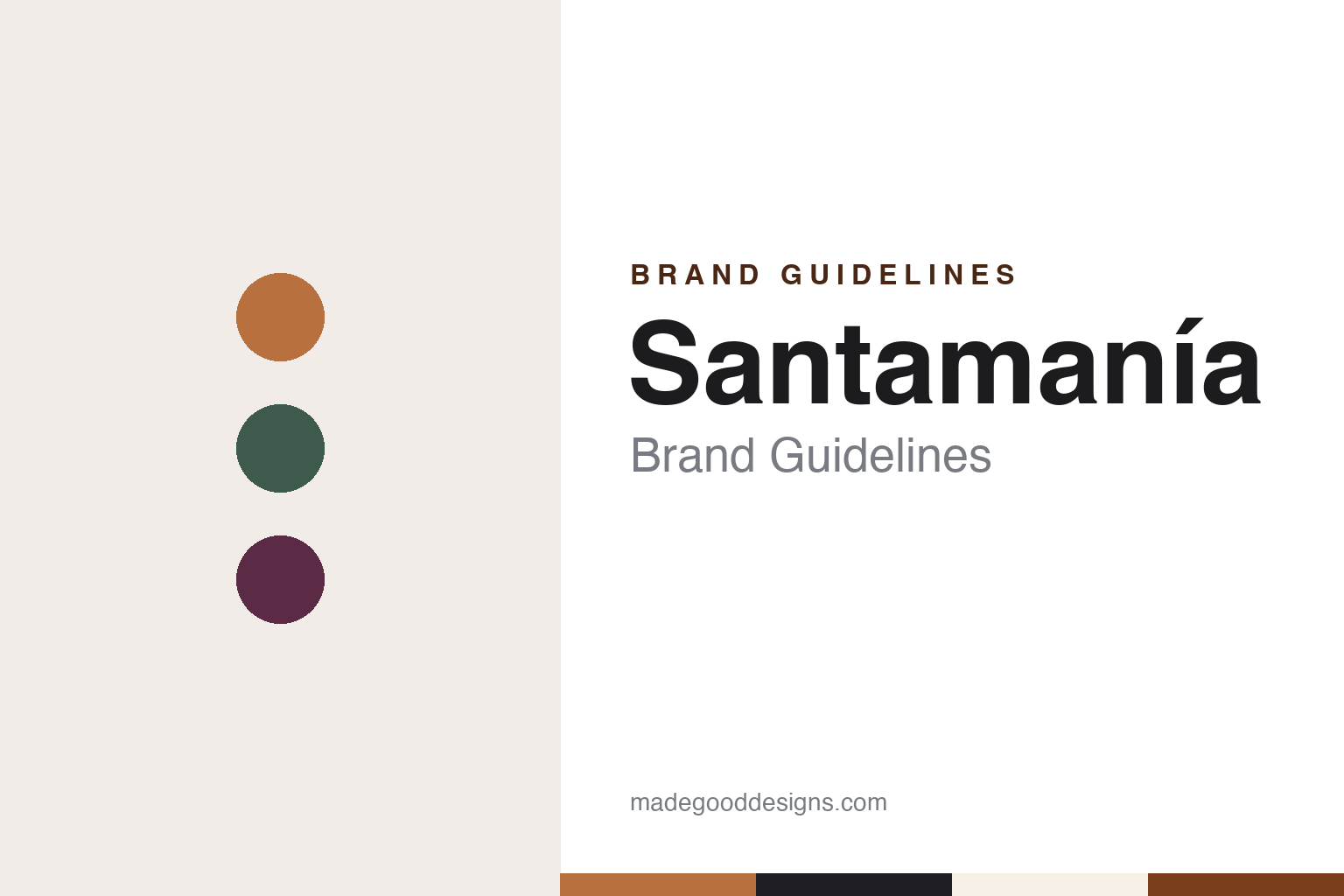
Santamanía Brand Guidelines
A grape-based craft gin from Madrid, distilled since 2014.
Aa
Two constants: a still copper, Tempranillo and juniper green palette and a high-contrast display serif register. Abstract homage — not a Santamanía product or mark; no label, logo or bottle is reproduced.
Three founders and a still in Madrid
A small-batch gin made in the Madrid region since 2014.
Santamanía is a craft gin made in the Madrid region. It began in 2014: the Spanish trade journal Alimarket described the project in December 2016 as the work of three young engineers who had set up their distillery that year, and The Spirits Business named the three founders in July 2015 as Javier Domínguez, Ramón Morillo and Victor Fraile. Domínguez has held the senior titles: The Spirits Business called him managing director in 2014 and chief executive in 2015, Drinks International called him co-founder and CEO in 2019, and the brand’s own website now names him as its master distiller.
The first product was a gin. When The Spirits Business reported the opening in August 2014, it described a London Dry gin made from grapes, produced in batches of no more than 330 bottles. The company behind the brand was a newly created Madrid firm called Unique Spirits, Alimarket reported in October 2014, when it added a reserve gin as the third product under the Santamanía name.
The brand’s website says the gin combines tradition and creativity with a “meticulosa obsesión por el detalle,” a meticulous obsession with detail. Early coverage in English stressed the setting as much as the spirit: in July 2015 The Spirits Business presented Santamanía as a city-centre micro-distillery in Madrid.
According to The Spirits Business in July 2015, the gin is built on a neutral spirit made from Tempranillo grapes and uses juniper, coriander seed, liquorice root, angelica and orris alongside Spanish lime and lemon and Spanish pistachios. That same month the magazine reported that the gin would be launched across the United Kingdom for the first time through Gin Foundry.
Colour
Copper stills, numbered batches and a distillery with a window.
As demand grew the business moved to a larger site. Alimarket reported in October 2015 that Unique Spirits, known commercially as Santamanía, had opened a site of more than 1,000 square metres on the Európolis industrial estate in Las Rozas, Madrid, with space for bottling, storage, production, offices, a shop and a tasting room. The report named the company’s two stills: Vera, the copper still the firm called its flagship, and Lola, a second still added for production. The Spirits Business reported the same month that the new distillery, on the northern outskirts of Madrid, brought all production under one roof and that the stills were set behind a glass display, above a five-metre copper-plated bar, with a room for seminars, tastings and private events.
The two stills soon gave their names to a product: Alimarket listed a gin called Lola & Vera among the company’s products in December 2016, together with a London Dry Gin Reserva and a tonic water of its own. The barrel-aged gin remains part of the range. The company says Santamanía Reserva rests for six months in Spanish oak casks that previously held Pedro Ximénez, and that each single barrel yields 465 hand-numbered bottles.
Small, numbered batches are the brand’s main production story. In 2014 the batch limit reported by The Spirits Business was 330 bottles; the brand’s current website says the core gin is now distilled in micro-batches of 736 numbered bottles. The company describes the current recipe as a grape-spirit gin bottled at 43 per cent, distilled in copper stills with a mix of cold maceration and vapour infusion, and built from 13 botanicals, including juniper, coriander, green cardamom, cinnamon, angelica, raspberries, lavender, almond, orris, liquorice, rosemary and Spanish citrus. The website also lists a third gin, Black Edition.
The Spirits Business reported in July 2015 that Santamanía had partnered with the Madrid craft brewery Cervezas La Virgen in May that year to make a vodka distilled from beer. In February 2016 the same magazine reported a limited-edition grape-based London Dry gin made with Four Pillars of the Yarra Valley in Australia, whose team travelled to Spain to make it; the gin mixed Australian and Spanish botanicals, was bottled and labelled for both countries, and was the first Santamanía product sold in Australia.
Typography
Design and documentation.
The seven brands in this group are all Spanish gins: Nordés, Xoriguer, Puerto de Indias, Larios, Gin Raw, Le Tribute and Santamanía. They come from different corners of the country, from Galicia and the Balearic Islands to Andalusia, Catalonia and Madrid, and they sit at different points in the trade, from family distilleries and small independent producers to names that now belong to much larger drinks groups.
A gin brand’s identity is usually carried less by the liquid than by a bottle, a label and the place it names, because the company behind the name may have changed hands, moved its distilling or grown far beyond the town where it began. That makes the questions behind each name worth asking plainly: who started it, who owns it now, and where its gin is actually distilled and bottled.
Each guide separates what independent sources record from what the company says about itself — its founding story, its owners over time, its recipe and botanicals, where its gin is made and how its bottles and labels have changed — and marks plainly what rests only on the company’s own word.
Aa
A high-contrast display serif for a capital-city craft gin. (Specimen set in Playfair Display, a serif STAND-IN; NOT the Santamanía logo.)
Santamanía
From one gin to a Madrid distillery with several names.
The distillery did not stop at gin and vodka. In March 2019 Drinks International reported that Santamanía had launched a Madrid single malt under the name Mentidero. Two versions were described: G Edition, a single-cask whisky made from peated Castilian malt, triple-distilled in copper stills and aged in Rioja wine casks, and Archetype, made from unpeated Castilian malt with half aged in Rioja barrels and half in ex-Pedro Ximénez casks before blending. Domínguez told the magazine the whisky contained no additives or colouring.
Today the gin sits inside a wider business. The brand’s website, which carries a 2025 copyright line and the phrase “Desde 2014,” states in its legal notice that it is operated by JG Magnus Spirits, a company based in Las Rozas, Madrid. Its shop link leads to Destilería de Madrid, whose own website presents Santamanía gin alongside Ron Mentidero, Navabi gin, Bendita Cocktails and El Rey, and offers distilling for other companies’ brands as well. The gin is still described on its own site as “Ginebra intensa de Madrid,” and the company says it is made with grape alcohol in copper stills, as it was in 2014.
The name is easy to confuse in a search. The brand’s website is santamania.com, and the current site writes the name in capitals without the accent, as SANTAMANIA, while trade coverage often writes Santamanía; Santamañak, by contrast, is the name of the village fiestas of Otxandio in the Basque Country and has nothing to do with the gin.
For a design guide, Santamanía shows how a small distillery can build an identity out of a single word, a grape-based recipe and the copper stills it put on display, then carry it to a larger site and a family of spirits. Compare Gin Mare, the Mediterranean gin from Catalonia, and Four Pillars, the Australian distillery that made a gin with Santamanía in 2016. For this guide we use still copper, Tempranillo and juniper green with a serif, an unofficial interpretation; no product or logo is reproduced.
Explore & save
Keep Santamanía’s identity on hand — save it to a board in the Made Good inspiration library.
Santamanía identity set
Pin the Santamanía still copper, Tempranillo and juniper green palette and the high-contrast display serif register to your own board.


