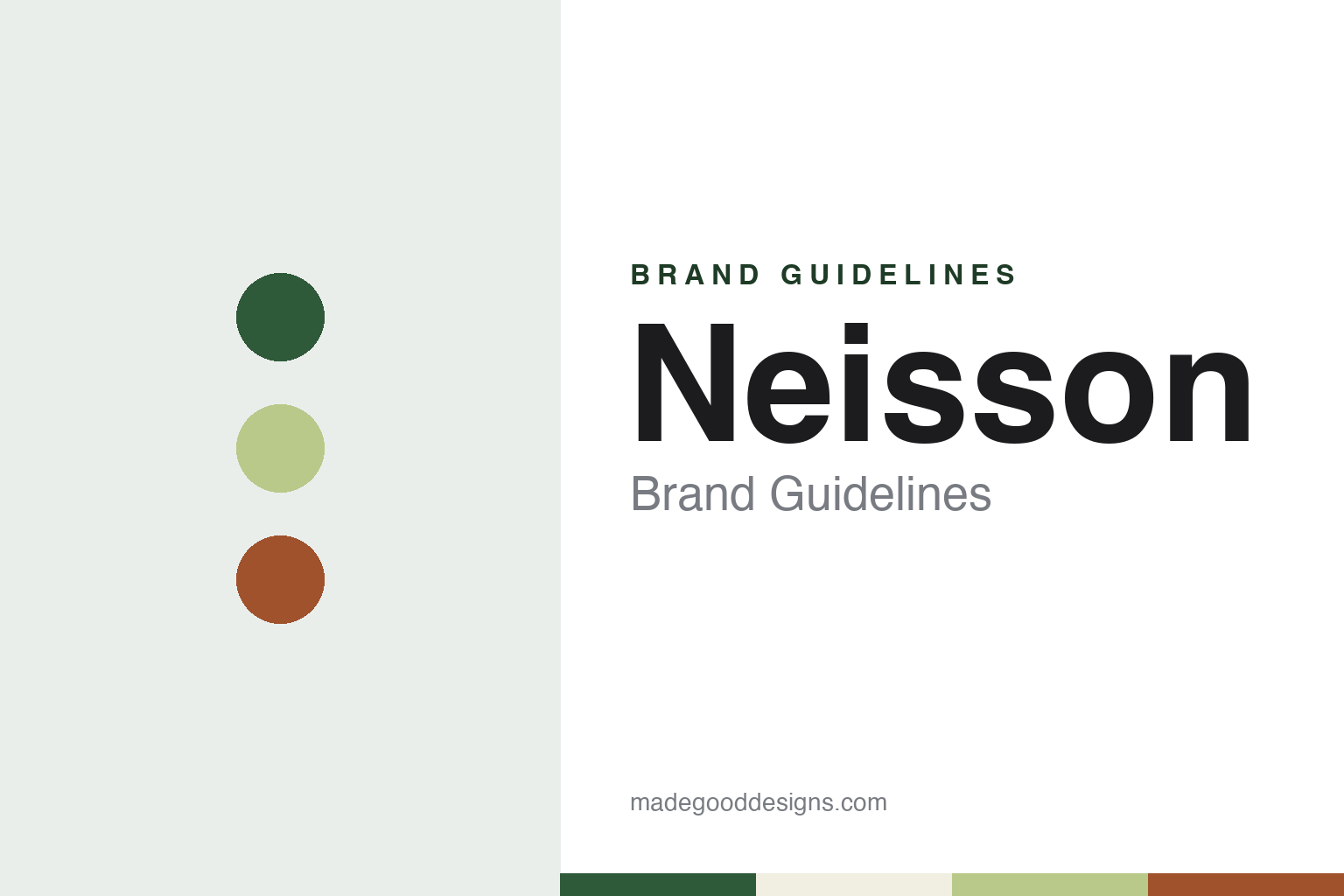
Neisson Brand Guidelines
The Le Carbet rhum of the square shoulders.
Aa
Two constants: a cane green, cane juice and Carbet earth palette and a geometric capital sans register. Abstract homage — not a Neisson product or mark; no label, logo or bottle is reproduced.
Two brothers and the Thieubert estate
Adrien and Jean Neisson, 20 hectares of cane and a governor’s decree.
Neisson is a rhum agricole house at Le Carbet, on the Caribbean coast of northern Martinique, near Saint-Pierre. Its story begins with two brothers, Adrien and Jean Neisson. The company says that in 1931 Adrien bought 20 hectares of the Thieubert estate at Le Carbet and planted sugar cane there to make rhum from pure cane juice, and that in 1932 the distillery was authorised by a decree of the colonial governor. The specialist auction house Rum Auctioneer gives the same sequence — land in 1931, distillery in 1932 — and the company’s own site dates the family story “depuis 1931” on the Thieubert property.
The brothers fitted out the new distillery with second-hand Babcock boilers and Mariolle cane mills, the company says. Their roles soon divided. Jean, who had studied chemistry in Paris, set up an import business to sell the rhum in mainland France, according to Rum Auctioneer and the French rum retailer Rhum Attitude, while production stayed in the cane fields at Thieubert.
The step that defined the house came in 1952. The company says that year Jean installed a thick copper Savalle creole column and reworked its plates and settings himself, aiming for a delicate, smooth spirit, and that he fermented slowly with yeasts gathered from the estate’s own cane. Rum Auctioneer also dates the Savalle column to 1952 and lists it as still in use. In The Oxford Companion to Spirits & Cocktails (2021), the Neisson entry by the author Martin Cate describes cane cut by hand, juice fermented for three days and distillation in a single copper column — the kind of still the rules for AOC Martinique rhum agricole require.
Colour
A bottle with square shoulders, a deposit scheme and artists on the label.
The same year gave Neisson its most recognisable object. The company says Jean created the Z’épol Karé bottle in 1952 for export to mainland France, launching it together with a deposit system for returning the glass. The Creole name means “square shoulders,” The Oxford Companion explains, and locals use it as a nickname for the rhum itself. Rum Auctioneer calls the square bottle the brand’s best-known design.
The deposit idea has come back. In 2021, the company says, Neisson relaunched the historic deposit scheme for its Zépol’Karé bottles, and on its current website Grégory Vernant presents returnable glass as a more responsible way to produce. The house also ties its name to the appellation: the company says that in 1996 all of its land at Le Carbet and Saint-Pierre and its whole production came under AOC Martinique, and that in 1997 its white rhum at 55% was the first to carry the words “Appellation d’Origine Contrôlée Martinique” on its label. In 2018, the company says, it received the French state’s Entreprise du Patrimoine Vivant label for living-heritage companies.
Anniversaries have become occasions for special labels. The company lists an Armada range for its 85th anniversary in 2017, Cuvée Sacha, a 2003 vintage released in a limited run in 2020, and a Nonaginta anniversary cuvée in 2022. It also credits outside artists: Neisson says the colour-led work of the artist Carole Aurore has appeared on its bottles as a visual reading of the blends, that murals by Gribouilliz decorate the distillery shop, and it names the painter Catherine Théodose and the artist Philippe Baudelocque among its collaborators. For the core range, The Oxford Companion lists unaged rhum agricole blanc, an Élevé Sous Bois aged 18 months, a Réserve Spéciale and the high-strength L’Esprit, and the company’s site now presents its white rhum at 50% alongside aged, organic and single-profile bottlings.
Typography
Design and documentation.
The seven brands in this group are all Caribbean rum houses: Neisson, Saint James, Trois-Rivières, La Favorite and Depaz from Martinique, and Hampden Estate and Worthy Park from Jamaica. Rum houses in general sit at many different points in the trade, from estates still run by the families that named them to labels that now belong to much larger drinks groups, and a single name can cover a white rum, a long-aged bottling and rum sold in bulk to other bottlers.
The two islands also make rum under different rules. Rum labelled with the French appellation Rhum de la Martinique must be a rhum agricole, made from the fermented juice of the sugar cane rather than from molasses; the appellation was first recognised by a decree of 5 November 1996, and its current specification, published by France’s INAO, names continuous column distillation as the traditional method and sets a distilling season that runs from January to early September. Jamaica’s rum geographical indication, enacted in 2016, allows both pot and column stills, requires pot stills to be made of copper and limits fermentation and distillation to defined areas of the island, Cocktail Wonk reported in its 2018 account of the full text.
A rum brand’s identity is usually carried less by a single bottle than by a label, a name and the place it promises, because the company behind the name may have changed hands, moved its distilling or grown far beyond the estate where it started. Each guide separates what independent sources record from what the company says about itself — its founding story, its owners over time, where its rum is actually distilled and aged, and how its labels have changed — and marks plainly what rests only on the company’s own word.
Aa
A geometric capital sans for a rhum known by the shape of its bottle. (Specimen set in Josefin Sans, a sans STAND-IN; NOT the Neisson logo.)
Neisson
A family house at Le Carbet, now in its third generation.
Neisson has stayed with the founding family. The company says Claudine Neisson-Vernant, Jean Neisson’s daughter, and her son Grégory Vernant took over the business in 1995; its team page lists Claudine as manager and Grégory as master distiller, both since that year, with Alex Bobi as cellar master. Rum Auctioneer says Claudine and Grégory Vernant run the distillery through the family company Domaines Thieubert, and The Oxford Companion describes Neisson as independent and family-run.
The third generation has pushed the farm towards organic production. The company dates the start of organic conversion on the Thieubert land to 2012 under Grégory Vernant; Rhum Attitude gives 2013 for the start of conversion and 2016 for the first organic rhum, and Rhum Attitude also records a research programme begun in 2011 to develop the distillery’s own yeast strains. The estate has grown from the original 20 hectares: the company says it now farms 49 hectares at Le Carbet and Saint-Pierre. Rum Auctioneer says the distillery works with fresh cane juice from sixteen nearby fields and lists the 1952 column as still active.
One practical note for searchers: the official site is neisson.com, and the house’s rhums appear in the trade under several names — Neisson, Rhum Neisson and Distillerie Neisson all refer to the same Le Carbet producer.
For a design guide, Neisson shows how a small house can make a bottle shape its signature: the square shoulders of 1952 gave the rhum a Creole nickname, and the returnable glass has become part of its story again. Compare Rhum Clément, the Le François house founded in 1887, and Rhum J.M, the 1845 distillery at Macouba in the far north of the island. For this guide we use cane green, cane juice and Carbet earth with a geometric sans, an unofficial interpretation; no product or logo is reproduced.
Explore & save
Keep Neisson’s identity on hand — save it to a board in the Made Good inspiration library.
Neisson identity set
Pin the Neisson cane green, cane juice and Carbet earth palette and the geometric capital sans register to your own board.


