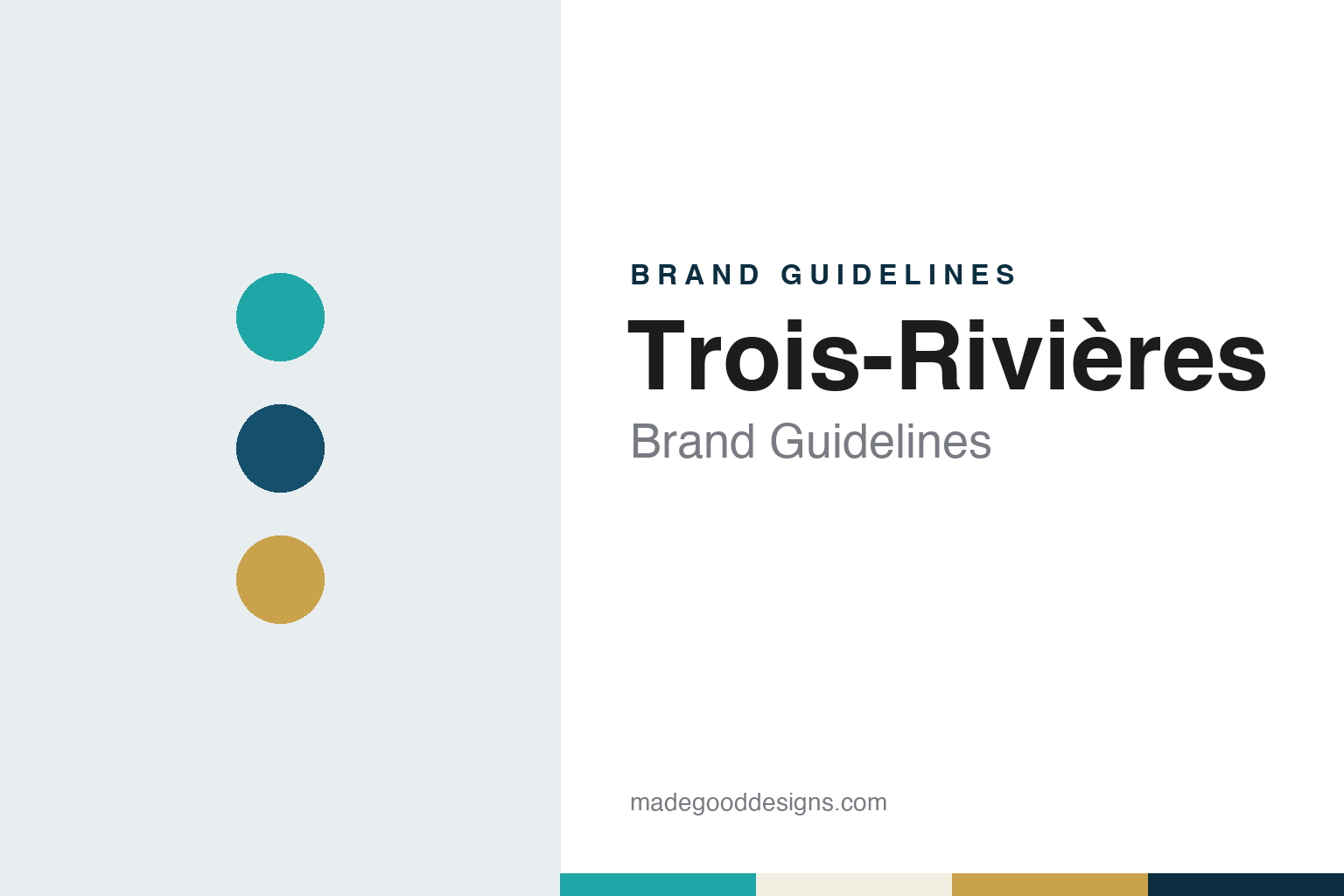
Trois-Rivières Brand Guidelines
A south-coast estate, a restored windmill and a turquoise thread.
Aa
Two constants: a turquoise, deep blue and gold palette and an estate serif register. Abstract homage — not a Trois-Rivières product or mark; no label, logo, windmill or bottle is reproduced.
Three streams
An estate on Martinique’s south coast.
Trois-Rivières takes its name from a place. In a history of the brand published in March 2016, the French rum magazine Rumporter explained that colonists founded a settlement in the early seventeenth century where three small streams meet, on the south coast of Martinique, in what is now the commune of Sainte-Luce. The brand still uses the year 1660: according to the same article, that is when Nicolas Fouquet, the superintendent of finances who was later imprisoned, acquired an estate of more than 2,000 hectares on that coast.
Rum came much later. Rumporter says that around 1785 Étienne Isaïe Marraud des Grottes bought the property with the idea of distilling spirits, but that his successors let it fall largely out of use while a neighbouring sugar works took the lead. In 1905, the magazine writes, Amédée Aubéry modernised the estate, stopped making sugar and concentrated on rum; in 1940 his son moved production from molasses to fresh cane juice, the raw material of rhum agricole.
The name on the bottle changed more than once. Around 1950, Rumporter says, a descendant of Marraud des Grottes bought the plantation; that family had been linked since 1908 with the Plissonneau-Duquesne family, which ran a distillery near Fort-de-France making a rum called Duquesne. The Duquesne name was used at the Trois-Rivières site until 1972, when the Trois-Rivières brand came back; it was registered in 1975. The magazine adds that Martini & Rossi later developed the brand in mainland France and across Europe and modernised the site at Sainte-Luce.
Colour
A windmill, a date and a turquoise thread.
The brand’s emblem is a building. Rumporter wrote in 2016 that the estate’s stone windmill had become the emblem of the range, that it was fully restored in 2005, and that it now houses an information centre on how Trois-Rivières is made. French Wikipedia’s article on the brand carries a 2015 photograph of the estate shop and the mill.
The latest packaging is built around the same symbols. In June 2026, Rumporter reported that the house had put its whole range of aged rums into a new bottle without changing the liquids. Vertical markings run up the glass to evoke the rows of cane on the southern estate, so that the five expressions, set side by side, form what the magazine called a miniature landscape. The date 1660 and the restored windmill are embossed directly into the glass.
Colour does the work of an age statement. According to the same report, the bottles extend the turquoise blue that has distinguished the house for decades: a bright turquoise for the youngest expressions, a deeper blue as the rums spend longer in oak, and gold for the capsule and lettering of the rarest cuvées. The range covered runs from the V.O Cuvée du Moulin and a four-year Cellar Reserve through the VSOP Réserve Spéciale to two vintage releases. The magazine said the new bottles would appear first at the Trois-Rivières shop in Martinique.
The article did not name a designer or a glassmaker. The design agency Mazarine lists Trois-Rivières among its projects and says it designed the graphic universe, the bottle shapes and the packaging for the entire collection; its project page is not dated, so it is not possible to say which generation of bottles that describes.
Typography
Design and documentation.
The seven brands in this group are all Caribbean rum houses: Neisson, Saint James, Trois-Rivières, La Favorite and Depaz from Martinique, and Hampden Estate and Worthy Park from Jamaica. Rum houses in general sit at many different points in the trade, from estates still run by the families that named them to labels that now belong to much larger drinks groups, and a single name can cover a white rum, a long-aged bottling and rum sold in bulk to other bottlers.
The two islands also make rum under different rules. Rum labelled with the French appellation Rhum de la Martinique must be a rhum agricole, made from the fermented juice of the sugar cane rather than from molasses; the appellation was first recognised by a decree of 5 November 1996, and its current specification, published by France’s INAO, names continuous column distillation as the traditional method and sets a distilling season that runs from January to early September. Jamaica’s rum geographical indication, enacted in 2016, allows both pot and column stills, requires pot stills to be made of copper and limits fermentation and distillation to defined areas of the island, Cocktail Wonk reported in its 2018 account of the full text.
A rum brand’s identity is usually carried less by a single bottle than by a label, a name and the place it promises, because the company behind the name may have changed hands, moved its distilling or grown far beyond the estate where it started. Each guide separates what independent sources record from what the company says about itself — its founding story, its owners over time, where its rum is actually distilled and aged, and how its labels have changed — and marks plainly what rests only on the company’s own word.
Aa
An estate serif for a name tied to a 1660 estate and a windmill. (Specimen set in Cormorant Garamond, a serif STAND-IN; NOT the Trois-Rivières logo.)
Trois-Rivières
A brand that moved distilleries and changed owners.
The rum is no longer distilled at Sainte-Luce. In 1994, Rumporter says, the Trois-Rivières site was taken over by Bellonnie & Bourdillon Successeurs (BBS), a group whose owners included the Bellonnie brothers, owners of the La Mauny distillery since 1923, and Jean-Pierre Bourdillon, who worked on the creation of the Martinique appellation. BBS then closed the Trois-Rivières distillery and moved production a few kilometres away to La Mauny at Rivière-Pilote, taking the two distillation columns with it; the magazine gives 2003 for the move, while French Wikipedia, citing La Route des Rhums, gives 2004. In 2016 Rumporter reported that the estate’s cane still supplied most of the juice.
Ownership has changed several times since. According to Rumporter, BBS was bought in 2007 by Quartier Français, a sugar group from La Réunion, which passed in 2010 to Tereos and then to La Martiniquaise; because La Martiniquaise already owned other rums, including Saint James, the authorities required it to sell part of its rum holdings, and in 2012 it went to the Chevrillon group. On 5 September 2019 Campari Group announced that it had signed to buy Rhumantilles, the owner of 96.5% of BBS, from Groupe Chevrillon and minority shareholders, describing Trois-Rivières and Maison La Mauny as premium brands and Duquesne as a brand designed for the local market; it expected completion in the fourth quarter of that year.
Another change is under way. In August 2026, Outremers360 reported that Les Bienheureux, a French company near Bordeaux known for whisky brands such as Bellevoye, had signed a preliminary agreement with Campari Group to acquire BBS, subject to approval by the rural land agency SAFER for the farmland involved. Its president, Jean-Christophe Coutures, said the company had long admired the three brands. The rum carries the AOC Martinique, created by a decree of November 1996.
For a design guide, Trois-Rivières shows how a place, a date and one building can hold a brand together through changes of distillery and owner. Compare Rhum Clément, another Martinique house distilled away from its historic estate, and Appleton Estate, a Jamaican rum in the same Campari portfolio. For this guide we use turquoise, deep blue and gold with a serif, an unofficial interpretation; no product or logo is reproduced.
Explore & save
Keep Trois-Rivières’s identity on hand — save it to a board in the Made Good inspiration library.
Trois-Rivières identity set
Pin the Trois-Rivières turquoise, deep blue and gold palette and the estate serif register to your own board.