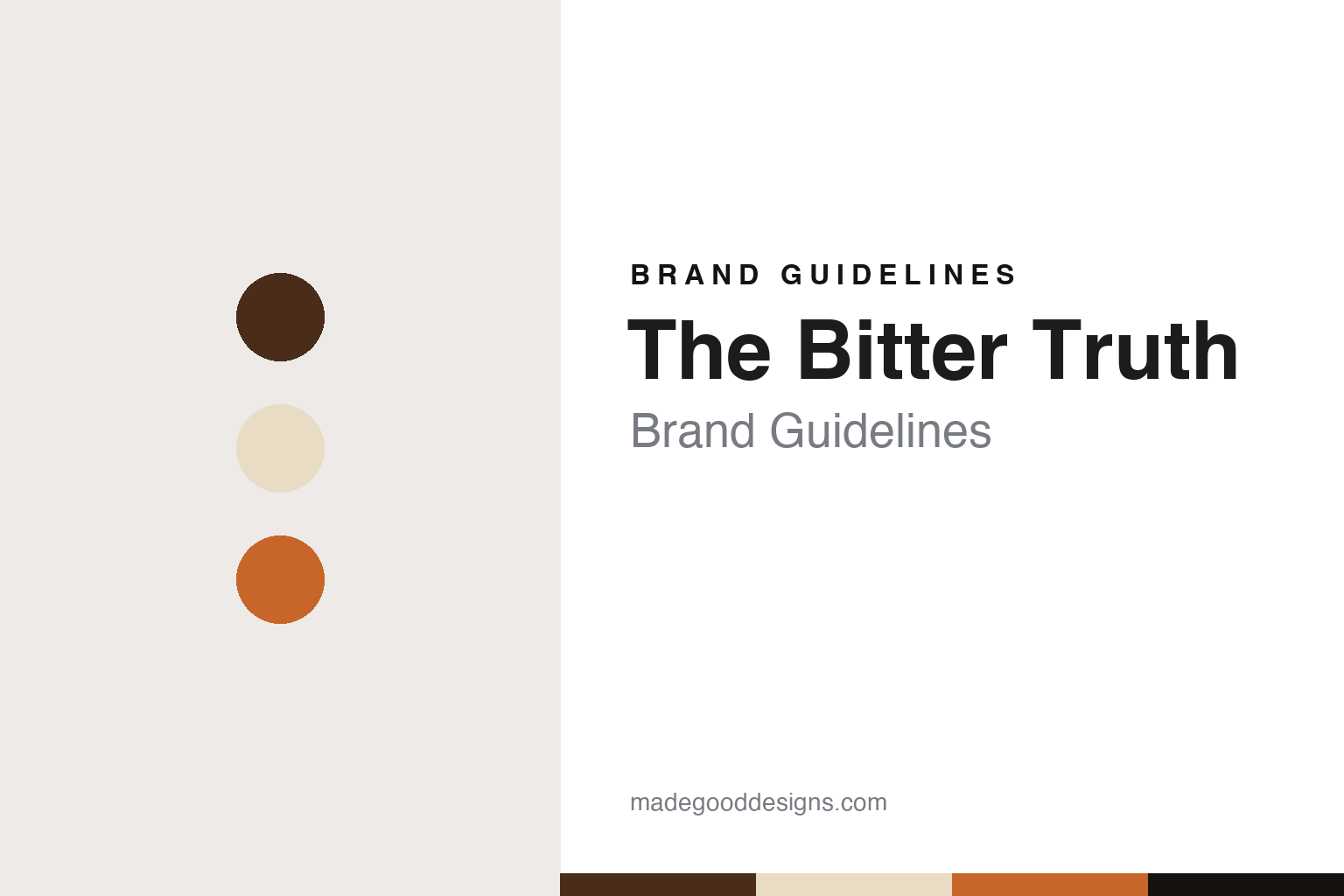
The Bitter Truth Brand Guidelines
The Munich bartenders who revived celery bitters.
Aa
Two constants: a Bitter Truth brown, cream and orange palette and an Apothecary serif register. Abstract homage — not a Bitter Truth product or mark; no bottle, label or logo is reproduced.
Two bartenders
A collection of old bottles and a trip to London.
The Bitter Truth was founded in 2006 by two Munich bartenders, Stephan Berg and Alexander Hauck. The company says the idea took shape at the London Bar Show in June 2006, at a time when cocktail bitters were hard to find in Germany. Both men had already been making bitters by hand for the bars where they worked, and Berg, the company says, owned a large collection of current and historical bitters, some of which had not been produced for decades.
Berg described the gap to the Los Angeles food site FoodGPS in February 2010: “we were unable to find anything besides Angostura Bitters on the German market.” In a March 2026 episode of The Philip Duff Show, a drinks-trade podcast, the two founders said they decided to go ahead over a drink at Sketch, the London bar, during that trip, and that they took the name from an article titled “The Bitter Truth.” They also said the venture began from enthusiasm rather than a business plan.
The first products followed within weeks. The company says it released an Orange Bitters and an Old Time Aromatic Bitters in August 2006 — its German-language history says autumn — followed shortly by a Lemon Bitters. By January 2007 its website was online, describing Berg and Hauck as producing “different kinds of bitters.” Hauck went full-time first, the founders told Duff, and Berg stopped bartending in mid-2007.
Colour
Old recipes, new bottles.
Much of the range revives older styles. The company describes its Celery Bitters as the first celery bitters commercially available in decades, and says the founders drew on old cocktail recipes that could no longer be made faithfully because the right bitters were missing. In March 2017 Drinks Industry Ireland reported that the same product had also been named best new product at Bar Convent Berlin.
The early 2010s brought collaborations. In February 2010 FoodGPS listed the Bittermens Xocolatl Mole bitters among the products The Bitter Truth was then selling in Los Angeles, alongside its own celery, orange and grapefruit bitters, and said the company had recently begun distribution in the United States, with Creole bitters due next. In April 2012 the German trade site about-drinks reported a Tonic Bitters developed with Thomas Henry, the Berlin mixer maker, for gin and tonic and other long drinks, and said it was produced in Pullach, near Munich.
The range soon moved beyond bitters. In 2012 about-drinks listed a sloe gin, the herbal liqueur Elixier and bar liqueurs such as Violet Liqueur and Pimento Dram. The founders told Duff that the liqueurs began in 2008 and the Tiki Lovers rums in 2012, and the current range also includes a Pink Gin. The company says it presented a re-creation of Bogart’s Bitters in 2018, after more than ten years of work based on a sealed original bottle the founders had acquired.
Typography
Bitters and the bar trade.
The seven brands in this group are all cocktail-bitters names: Peychaud’s, Fee Brothers, Regans’, Bittermens, Scrappy’s, The Bitter Truth and Bob’s Bitters. Cocktail bitters are concentrated flavourings, usually made by steeping herbs, spices, roots, peels or other ingredients in alcohol, and they are used a few dashes or drops at a time to season a drink rather than as a drink in their own right.
That small dose shapes how a bitters brand looks. The product is sold in a small bottle, often fitted with a dasher top or a dropper, so the label has to carry a name, a flavour and a maker in very little space, and the same bottle may sit on a bar back, a shop shelf or a kitchen counter. The brands here range from names with long histories to small makers started in this century, and some now belong to much larger drinks companies while others are still run by the people who founded them.
Each guide separates what independent sources record from what the company says about itself — who founded the brand and when, who owns it now, where its bitters are made and how its labels and packaging have changed — and marks plainly what rests only on the company’s own word.
Aa
An apothecary serif — a bartenders’ bitters. (Specimen set in Playfair Display, a serif STAND-IN; NOT The Bitter Truth logo.)
The Bitter Truth
Products for bartenders by bartenders.
The company describes its bottles as built for the bar: a built-in dasher, brown glass to protect the contents from light, and a coated label. Berg told FoodGPS in 2010 that the labels could be washed down to keep the bottles clean, and the site described the packaging as contemporary and vintage at once. The company says its products are made in Germany by maceration, percolation and distillation, from natural ingredients and without artificial flavourings.
Exports came early. Hauck told Drinks Industry Ireland in 2017 that the range was then sold in 60 countries, and summed up the business as “products for bartenders by bartenders.” He told the magazine the range then ran to eleven bitters, each made with between ten and thirty ingredients, and called bitters “the spice rack for your bar,” to be used a dash or two at a time. The company also sells its bitters in sets: a Traveler’s Set of five flavours in small bottles, which its German-language history describes as a metal tin, and a Bar Pack of five newer flavours. The company calls itself bartender-owned; its website, in 2026, names the business as The Bitter Truth GmbH of Pullach im Isartal, near Munich, with Berg and Hauck as its managing directors. In March 2026, the company’s twentieth year, the founders told Duff that Axel Klubescheid, formerly of Monkey 47 and Absolut, had recently joined to support the company.
For a design guide, The Bitter Truth shows how a brand built on old recipes can still look made for today’s bar, with a bottle designed around the dash. Compare Thomas Henry, the Berlin mixer brand behind its Tonic Bitters, and Bittermens, whose Xocolatl Mole it once sold. For this guide we use a brown, a cream and an orange with a serif, an unofficial interpretation; no product or logo is reproduced.
Explore & save
Keep The Bitter Truth’s identity on hand — save it to a board in the Made Good inspiration library.
The Bitter Truth identity set
Pin The Bitter Truth brown, cream and orange palette and the Apothecary serif register to your own board.