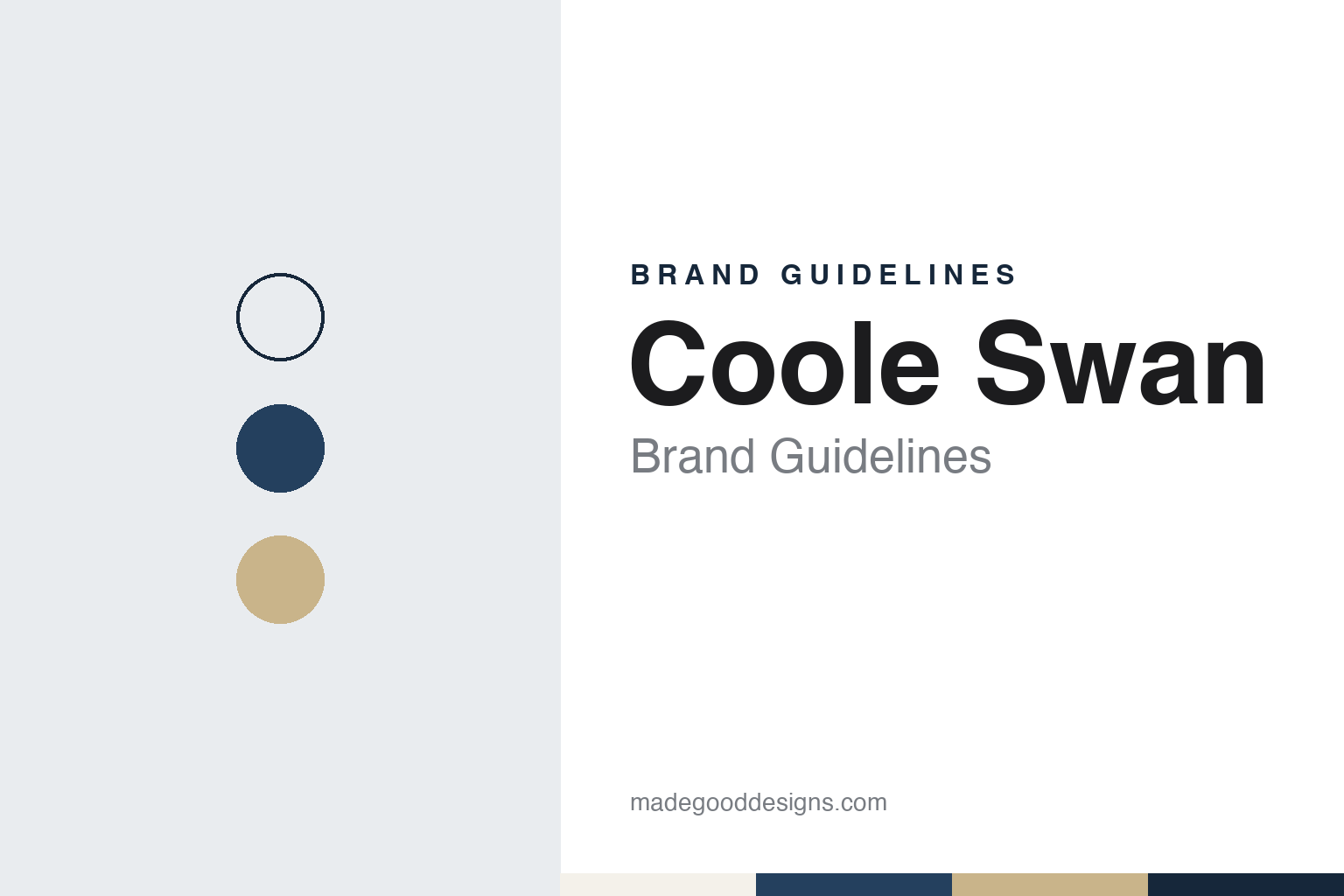
Coole Swan Brand Guidelines
The Irish cream in a white milk bottle, named after Yeats.
Aa
Two constants: a swan white, lough blue and cream gold palette and a literary serif register. Abstract homage — not a Coole Swan product or mark; no label, logo or bottle is reproduced.
Three drinks veterans and a poem
A super-premium Irish cream, built by people who knew the category.
Coole Swan is an Irish cream liqueur made by the Scion Spirits Company, whose name appears on the brand’s trademarks. The Irish Times reported its arrival on 16 March 2007, describing a new super-premium cream liqueur from a company set up by David Phelan, Adrian Walker and David Gluckman, all with long careers in the Irish and international drinks trade. The paper noted that Phelan had been a young executive at C&C and was a co-founder and former managing director of Castle Brands, where he had created Boru vodka, and that Enterprise Ireland was backing the venture as a high-potential start-up.
Gluckman had worked on an Irish cream before. English Wikipedia’s article on Baileys names him among the consultants who proposed an Irish whiskey and cream drink to Gilbeys of Ireland in the early 1970s and says he suggested the Baileys name; that drink went on sale in 1974. Writing on his Booze Business blog in March 2021, the drinks commentator Arthur Shapiro recounted that Gluckman spent 36 years at International Distillers and Vintners, the company that became Diageo, and left in 2005 to develop products with former colleagues, Coole Swan among them.
According to Bank of Ireland’s ThinkBusiness, writing in November 2020, Walker created the original recipe in 2007, and the owners say it has not been changed since. The company says the recipe was perfected on the 231st attempt, a number the trade title The Moodie Davitt Report also gave in July 2008. That report said the brand was officially launched in Dublin in March 2007, reached Dublin Airport that July and went on sale in the United States, starting in New York, in September 2007; in the United Kingdom it opened with an exclusive listing at Selfridges in October 2007.
Colour
A painted milk bottle, a lake and a cat.
The name is literary rather than a play on “cool.” The company says it comes from W. B. Yeats’s poem “The Wild Swans at Coole,” and that Coole refers to Coole Park in County Galway, where Yeats wrote it. The Irish Times recorded the same source in 2007. In Shapiro’s 2021 account, Gluckman had struggled to find a name that fitted and was not already taken, and came across the poem in a book while catching a flight out of Dublin.
The bottle breaks deliberately with the cream-liqueur shelf. The company says it was based on a 19th-century Irish milk bottle and that its satin white finish is painted on, and The Moodie Davitt Report described in 2008 a frosted bottle with blue labelling, modelled on a traditional milk bottle, on which the swans of Coole Park are reflected. Speaking to ThinkBusiness in 2020, CEO Mary Sadlier contrasted the upright white bottle with the dark brown bottles usual for Irish cream and said the white paint contains a UV blocker to protect the cream from light.
Two smaller details carry the story further. The company says the small picture on the front of the bottle is an artist’s impression of the lake at Coole Park, and that an embossed motif on the back shows a cat enjoying a bowl of cream. The launch itself was framed as entertainment: The Irish Times reported in 2007 that the film director Mike Figgis was making a series of short films called “Coole Stories” as part of the brand’s marketing.
What goes into the bottle is listed on it. The company names single malt Irish whiskey, fresh Irish dairy cream and Belgian white chocolate as the main ingredients, at 16 per cent alcohol by volume, and sums it up on its own pages as whiskey, chocolate and cream.
Typography
Design and documentation.
The seven brands in this group are all coffee or cream liqueurs: Mr Black, Carolans, Saint Brendan’s, Kamora, Caffè Borghetti, Dooley’s and Coole Swan. Some are sweetened spirits flavoured with coffee; others blend dairy cream with a spirit such as Irish whiskey. Brands like these sit at many different points in the trade, from small independent companies to labels that now belong to much larger drinks groups, and the same bottle can turn up on a supermarket shelf, in an airport shop or behind a cocktail bar.
A liqueur brand’s identity is usually carried less by the liquid than by a bottle, a label and the story it tells, because the company behind the name may have changed hands, moved its production or licensed its name to others. That makes the questions behind each name worth asking plainly: who created it, who owns it now, and where it is actually made and bottled.
Each guide separates what independent sources record from what the company says about itself — its founding story, its owners over time, where its liqueur is made and how its bottles and labels have changed — and marks plainly what rests only on the company’s own word.
Aa
A literary serif for a name taken from a poem. (Specimen set in Cormorant Garamond, a serif STAND-IN; NOT the Coole Swan logo.)
Coole Swan
From a start-up of industry veterans to a Meath family business.
Leadership has since passed to a farming family. The Irish Farmers Journal reported in March 2023 that Mary Sadlier, who had been involved from an early stage, became chief executive in June 2011; the company’s own site dates the moment she and her husband, Philip Brady, stepped into Coole Swan to 2012. The company today describes itself as independently owned and family run, with Sadlier as CEO and Brady as head of operations.
The business is rooted in farming. The Irish Times described it in June 2014 as a family-owned cream-liqueur company near Navan in County Meath, and the Irish Farmers Journal reported in 2023 that it is run from the Brady family’s dairy, beef and sheep farm in the Boyne Valley. The liqueur is blended and bottled in neighbouring County Cavan, the Farmers Journal said, which matches the company’s statement that every batch is blended in Co. Cavan. In Ireland and Britain it has been sold through retailers including John Lewis, Dunnes Stores, SuperValu and Tesco, ThinkBusiness reported in 2020; the Farmers Journal said in 2023 that the brand has a strong export market, particularly in North America.
The name needs a little care online. “Coole” is not a misspelling of “cool,” the company points out, and searches for the brand can drift towards Coole Park in Galway or the poem itself; the brand’s own site is cooleswan.com.
For a design guide, Coole Swan shows how a late arrival in a crowded category set itself apart with a poem, a lake and a white bottle borrowed from the dairy rather than the distillery. Compare Baileys, the Irish cream Gluckman helped to conceive, and Sheridan’s, the twin-bottled coffee-and-cream liqueur. For this guide we use swan white, lough blue and cream gold with a serif, an unofficial interpretation; no product or logo is reproduced.
Explore & save
Keep Coole Swan’s identity on hand — save it to a board in the Made Good inspiration library.
Coole Swan identity set
Pin the Coole Swan swan white, lough blue and cream gold palette and the literary serif register to your own board.