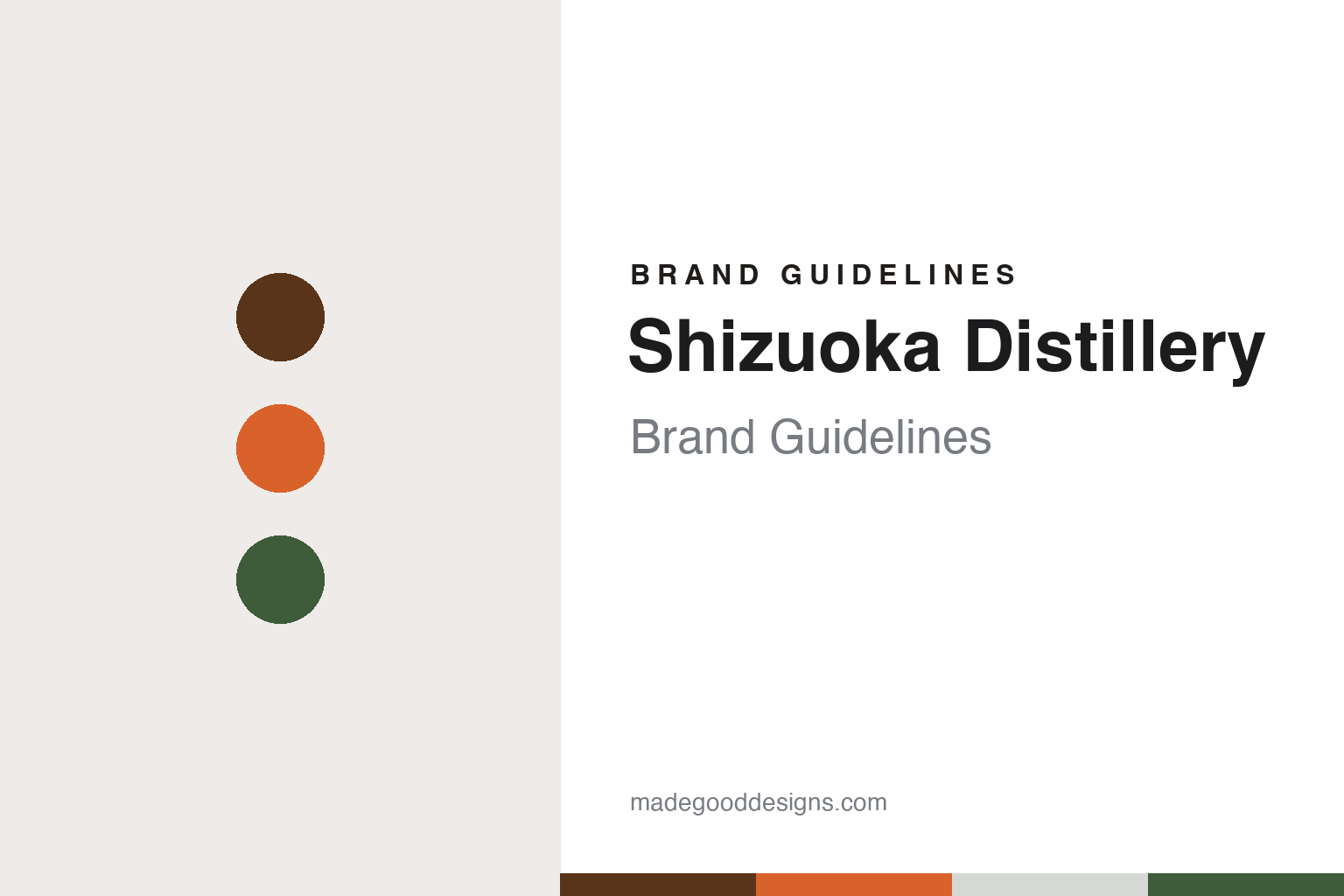
Shizuoka Distillery Brand Guidelines
The Shizuoka distillery that names its whiskies after its stills.
Aa
Two constants: a cedar brown, ember orange and forest green palette and a still-letter sans register. Abstract homage — not a Shizuoka Distillery product or mark; no bottle, label or logo is reproduced.
From importer to distiller
An Islay trip, a city-owned plot and a closed distillery’s equipment.
Shizuoka Distillery is owned by Gaiaflow, a company that Taikō Nakamura founded in Shizuoka city in January 2012. Gaiaflow’s website gives its business as the import and sale of whisky, and the distillery’s own history says the company gained a liquor import licence in November 2012 and began selling imported whisky in April 2013. Nakamura’s idea for a distillery, that history says, came on a trip to Scotland in June 2012, when the last distillery he visited on Islay was Kilchoman, a small new venture whose handmade whisky was sold around the world. Nakamura’s conclusion, as the distillery tells it, was that his task was to make whisky in Japan and sell it to the world.
Japanese Wikipedia says that after that trip Nakamura visited more than 170 distilleries and drinks makers, and that Gaiaflow became the Japanese distributor for the independent bottler Blackadder in April 2013. The same article dates the order for its Scottish pot stills from Forsyths to May 2014. J-CAST News reported in 2015 that exports were the main aim, with domestic sales to be kept to less than half.
The site is at Tamagawa, in the mountainous part of Aoi ward known as Oku-Shizuoka, on land owned by the city in the Abe River basin. Gaiaflow places it at the southern end of the Southern Alps, about an hour by bus from Shizuoka station, and the distillery says water from the mountains runs through the land to the Abe River and on to Suruga Bay. J-CAST News reported the plan in July 2015, quoting Nakamura comparing the land to Scotland and reporting that the group had won the production equipment of the closed Karuizawa distillery, in Miyota, Nagano, at auction in March 2015. The distillery says construction finished in summer 2016, its production licence was granted on 28 September 2016 and production began that October.
Japanese Wikipedia says the building was designed by West Coast Design and uses hinoki cypress from Shizuoka, and that Nakamura studied distillery operations at Chichibu before building his own.
Colour
Three stills and two kinds of wood.
The still house is the distillery’s signature. Karuizawa closed in 2011, and of its stills, the distillery says, parts of three were used to rebuild one, now still K, a steam-heated wash still. Beside it stands still W, a wash still made by Forsyths of Scotland and heated directly by a wood fire; the distillery says it burns thinnings from local forests, split on site and air-dried for months, in a firebox that reaches about 800°C. A Scottish-made spirit still, S, completes the set. The mill is a Porteus machine built in England in 1989 and moved from Karuizawa.
The washbacks are wooden rather than stainless steel: some of Oregon pine, the wood used at Karuizawa, and others of cedar grown in Shizuoka city, the distillery says. It also says it uses Japanese and Shizuoka-grown malt each year alongside imported barley.
The letters became product names. The first official release, Prologue K, went on sale in December 2020; Nomunication reported that it was distilled entirely on the ex-Karuizawa still and was being called a “single wash still whisky.” Japanese Wikipedia lists Prologue W and Contact S, a combination of both wash stills’ spirit, in 2021; then in 2022 Blended M, which pairs Shizuoka malt with grain whisky from overseas, and the first Pot Still K and Pot Still W editions, labelled by whether the barley was Japanese or foreign. United S, which the distillery now calls its house style, followed in December 2022.
Typography
Japan’s new distilleries.
The seven names in this group are all Japanese whisky distilleries: Fuji Gotemba, Nagahama, Akkeshi, Shizuoka, Saburomaru, Sakurao and Yuza. Some sit inside long-established drinks companies, some were built by sake or shochu makers adding a new spirit to an old business, and others are newer ventures built specifically to make whisky, in regions far from one another.
The phrase “Japanese whisky” on a label carries more weight than it used to. In 2021 the Japan Spirits & Liqueurs Makers Association introduced a voluntary labelling standard, with a grace period that ended in 2024, under which, English Wikipedia says, a whisky sold as Japanese must be fermented, distilled, matured and bottled in Japan. A distillery’s identity therefore rests not only on its label and its name but on where its spirit is actually made, how long it has been aged and what, if anything, has been blended in.
Each guide separates what independent sources record from what the company says about itself — who founded the distillery and when, who owns it now, where its whisky is distilled and matured, and how its bottles and labels have changed — and marks plainly what rests only on the company’s own word.
Aa
A clean sans — for names built from single letters. (Specimen set in Zen Kaku Gothic New, a sans STAND-IN; NOT the Shizuoka Distillery logo.)
Shizuoka Distillery
A naming system built from equipment.
Gaiaflow has owned the distillery since it opened and still runs its import business beside it; its website lists brands including Blackadder, Amrut and Zuidam alongside its own Shizuoka whisky. In 2026 the distillery marked its tenth anniversary with a dedicated page and anniversary releases of United S and its private-cask archive, and in September 2026 it added a multilingual smartphone audio guide for visitors to the site. Beyond its core range, the distillery sells private-cask bottlings, a series it lists back to 2017 casks, and runs paid tours and a whisky school at the site.
The naming system is unusually literal. Single letters — K, W and S — tie each bottling to a piece of equipment, while “Pure Japanese Barley” and “Pure Foreign Barley” name the other variable on the label. The 2026 range shows the system still at work: a five-year Pot Still K made from Golden Promise barley grown outside Japan sits beside editions of United S and the private-cask archive. The distillery describes its aim as whisky-making “in harmony with Shizuoka’s nature,” and points to its cedar washbacks and its still fired with local wood.
For a design guide, Shizuoka Distillery shows how a production story can become a brand vocabulary. Compare Kilchoman, the Islay farm distillery that set Nakamura’s direction, and Chichibu, where Japanese Wikipedia says he studied distilling. For this guide we use cedar brown, ember orange and forest green with a sans, an unofficial interpretation; no product or logo is reproduced.
Explore & save
Keep Shizuoka Distillery’s identity on hand — save it to a board in the Made Good inspiration library.
Shizuoka Distillery identity set
Pin the Shizuoka Distillery cedar brown, ember orange and forest green palette and the still-letter sans register to your own board.


