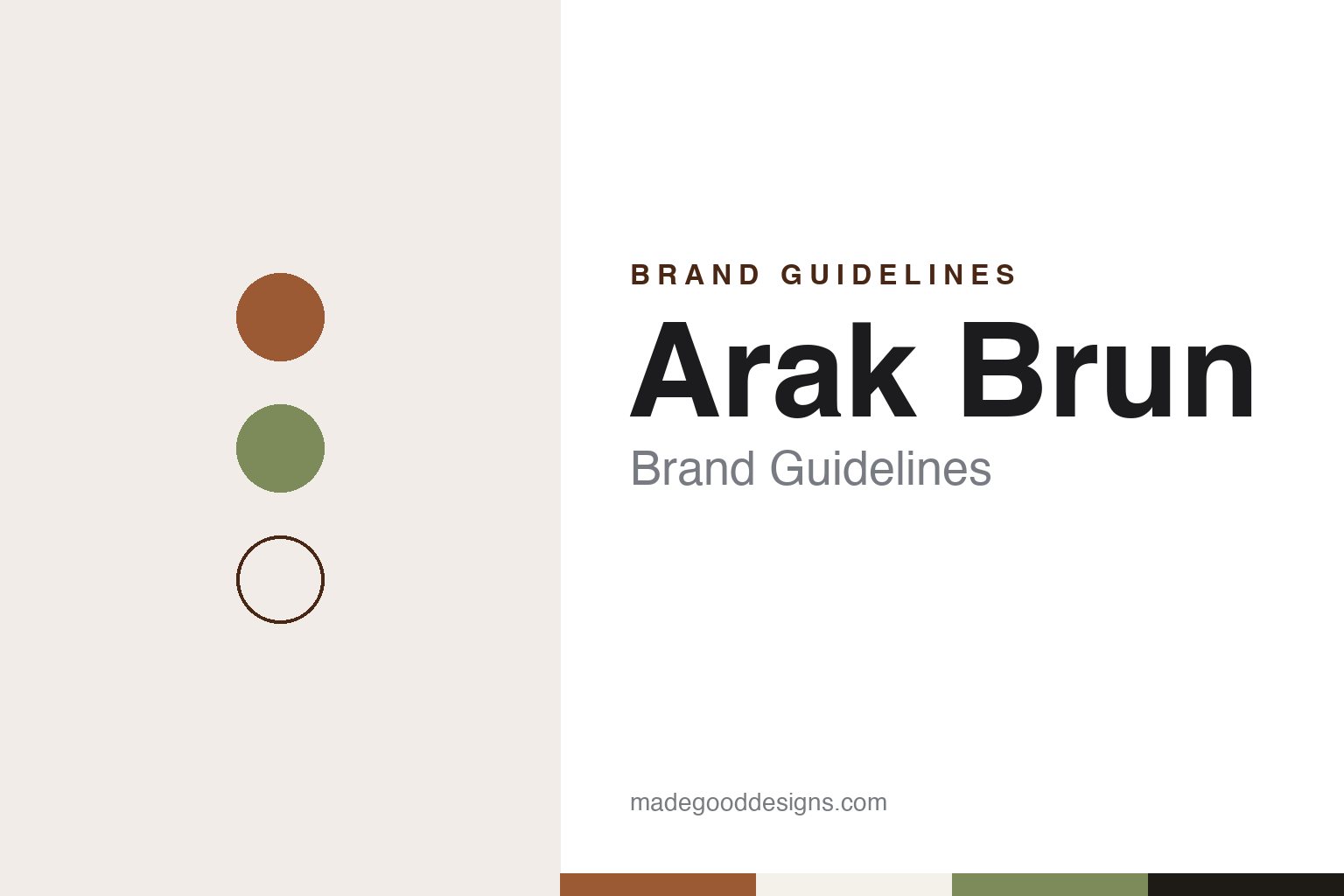
Arak Brun Brand Guidelines
Domaine des Tourelles’ arak from Chtaura, since 1868.
Aa
Two constants: a clay, anise green and milky white palette and a classical serif register. Abstract homage — not an Arak Brun product or mark; no label, logo or bottle is reproduced.
A road engineer in the Bekaa
A Frenchman, a road to Damascus and a house in Chtaura.
Arak Brun is the arak of Domaine des Tourelles, a wine and spirits estate in Chtaura, in Lebanon’s Bekaa Valley. The estate dates itself to 1868 and names its founder as François-Eugène Brun, a Frenchman who, the company says, was first recruited by a French company working on the road between Beirut and Damascus, fell for the Bekaa and stayed to make wine and arak. Euronews reported in October 2017 that Brun, a French engineer, had come to Lebanon in 1860 to build the road to Damascus and settled at Chtaura, about twelve miles from the Syrian border.
The Lebanese food and travel blog No Garlic No Onions, writing after a visit in July 2014, described the estate as an old mansion that Brun built in 1868 with stone walls and wood ceilings in the traditional Lebanese manner; the blog says Brun first built a hotel and later a winery, and that red bricks were added to the roof in the twentieth century, giving the building the form it keeps today.
The estate stayed in the Brun family for three generations, the company says, passing from François-Eugène to Louis Brun and then to Pierre Brun. The arak that carries the family name came out of that line. The company says the recipe was created by the Brun family, who gave it their name in the early twentieth century, and that Pierre Brun, whom it calls the third and last generation of the founders, perfected it.
Pierre Brun’s presence is still part of how the estate presents itself. Euronews reported in 2017 that the current owners had kept the room where he used to rest during the harvest, with his chair still set among sacks of anise seed; No Garlic No Onions described the same “aniseed room” in 2014, with his table, lamp and sofa left as they were.
Colour
Grapes, anise, copper and clay.
Lebanese arak is a grape spirit flavoured with aniseed, and it is often called the national drink of Lebanon, English Wikipedia notes; it turns a milky white when water is added. Arak Brun follows that pattern, and the company describes its method in some detail. It says the grape alcohol comes from old Obeidi vines grown on terraces, a grape native to Lebanon; that its distillery has a series of old copper alembics with relatively small pots; and that the spirit is distilled three times, with the anise added at the final stage. No Garlic No Onions named the grapes used in 2014 as the white Obeidy and Merwah, plus Cinsault.
Euronews saw one of those stills in 2017 and reported it to be more than 150 years old and to have come from the Syrian city of Aleppo.
Anise is the other half of the recipe. The company says the plant was long sourced mainly from Syria and the wider region, and that the estate has brought its cultivation back to Lebanon.
The ageing is where the brand draws its range. The company says Arak Brun is rested in clay jars, chosen because clay is porous and can breathe, and that its jars were made by the Fakhoury family of Beit Chabeb. It gives the ageing as about one year for the classic Arak Brun, five years for the Special Reserve and ten years for the 10 Years Old. Euronews in 2017 gave a range of eighteen months to five years in jars and listed the standard arak and a Five Years Reserve; the blog in 2014 described a standard bottle aged one year in old clay jars and a special reserve aged five.
The name itself is spelled more than one way in English: the company and most retailers write Arak Brun, while Euronews wrote “Araq Brun.”
Typography
Design and documentation.
The six brands in this group are amaro and anise spirits: Vecchio Amaro del Capo, Rabarbaro Zucca, Amaro Sibilla, Henri Bardouin, Pastis 51 and Arak Brun. They come from two old families of drinks. Amaro, English Wikipedia says, is a descriptor for an Italian, or Italian-style, herbal liqueur, usually bittersweet and usually served after a meal. Pastis and arak belong to the anise family: English Wikipedia says pastis was first sold commercially by Paul Ricard in 1932, and describes arak, often called the national drink of Lebanon, as a spirit traditionally made from grapes and aniseed.
The anise spirits share one visual effect. Add water and the clear spirit turns a cloudy, milky white — the effect English Wikipedia calls the louche, or the ouzo effect.
The owners behind these names range widely. English Wikipedia lists Pastis 51 as made by Pernod Ricard, the French drinks group, and Henri Bardouin as made by Distilleries et Domaines de Provence, while Arak Brun belongs to a Lebanese wine estate that changed hands in 2000.
A drinks brand’s identity is usually carried less by a single bottle than by a label, a name and the place it promises, because the company behind the name may have changed hands or grown far beyond where it started. Each guide separates what independent sources record from what the company says about itself — its founding story, its owners over time, where its spirit is made and how its labels have changed — and marks plainly what rests only on the company’s own word.
Aa
A classical serif for a family name on a spirit label. (Specimen set in Cormorant Garamond, a serif STAND-IN; NOT the Arak Brun logo.)
Arak Brun
A family name kept by new owners.
The Brun line did not continue at the estate. Euronews reported in 2017 that the sale of Domaine des Tourelles followed the death of Pierre Brun. The company says that in 2000 Elie F. Issa and Nayla Kanaan Issa-el-Khoury took over the property, and describes Nayla Issa-el-Khoury as a relative of the Brun family. The Issa and Issa el Khoury families have owned the estate since then, and the company says their next generation now runs it.
The new owners kept the Brun name on the arak. The company credits Elie Issa with the concept behind the Special Reserve, the five-year expression. Euronews reported in 2017 that Faouzi Issa co-owned the winery and had started there when his family and another family joined to buy it; No Garlic No Onions wrote in 2014 that he had come back to Lebanon in 2008 after studying in Montpellier.
On the design side, the company names Johanne Issa as its creative director and says her artistic touch shapes all of its products. The company’s own pages lead with the family name, the date 1868, the Bekaa and the clay jar.
The arak sits alongside the estate’s wines, which Euronews listed in 2017 under names including Marquis des Beys and Syrah du Liban. The company’s own website today presents Domaine des Tourelles under the line “A Love Story Since 1868.”
For a design guide, Arak Brun shows how a founder’s surname can outlast the founder’s family and become the asset a new owner protects. Compare Ksarak, the arak of another Bekaa Valley house, and Château Musar, a Lebanese wine name. For this guide we use clay, anise green and milky white with a serif, an unofficial interpretation; no product or logo is reproduced.
Explore & save
Keep Arak Brun’s identity on hand — save it to a board in the Made Good inspiration library.
Arak Brun identity set
Pin the Arak Brun clay, anise green and milky white palette and the classical serif register to your own board.