West Cork Distillers Brand Guidelines
The Union Hall whiskey makers of Skibbereen.
Aa
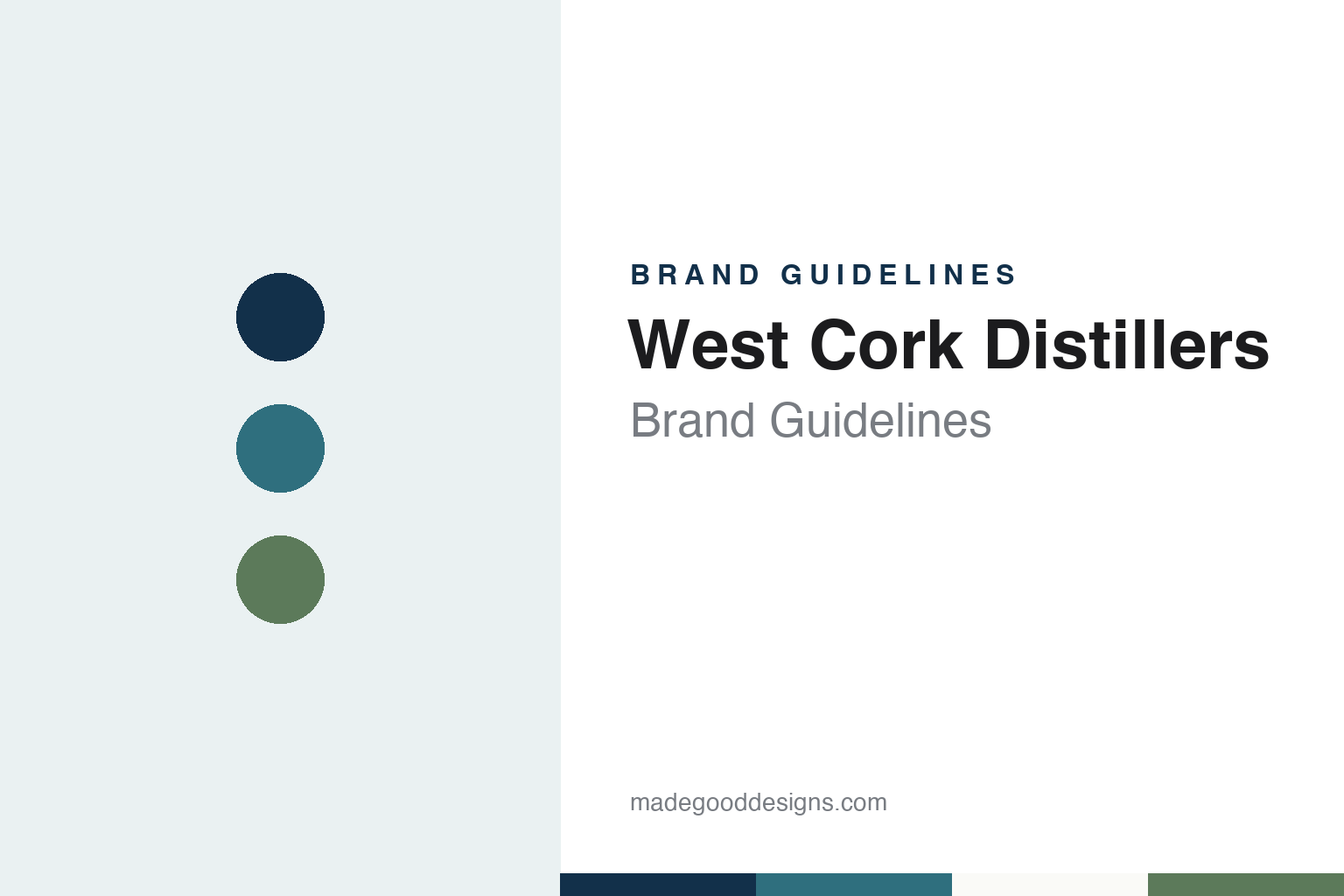
Two constants: a harbour navy, Atlantic teal and label white palette and a sturdy grotesque sans register. Abstract homage — not a West Cork Distillers product or mark; no label, logo or bottle is reproduced.
Trawlermen and a food scientist
From a workshop in Union Hall to a distillery in Skibbereen.
West Cork Distillers began in the fishing village of Union Hall, County Cork, in 2003. Its founders are John O’Connell, a food scientist, and Denis and Ger McCarthy, former deep-sea trawlermen from the same village, Fora reported in 2017. O’Connell told the Irish Farmers Journal in May 2019 that the three had grown up within a short walk of one another, that he had studied chemistry but found no work near home, and that pressure on the local fishing industry had brought them together to start a distilling business. The company and most reports give 2003 as the founding year; one 2017 trade report in Hospitality Ireland gave 2004.
The business started small. O’Connell described its first home as a very small workshop in Union Hall, and said whiskey was the plan from the beginning and remained the flagship. Because whiskey takes years to mature and revenue was needed sooner, the company also made vodka, poitín and gin.
In November 2013 West Cork Distillers moved to Skibbereen, taking over a former Heineken plant in the town, O’Connell told the Irish Farmers Journal. Hospitality Ireland reported in January 2017 that a new facility in Skibbereen had brought most of the company’s warehousing in-house, and in 2019 O’Connell said a second distillery had opened about two years earlier and a third was being built. The Southern Star placed the plant on Marsh Road in 2019 and reported that it was distilling seven days a week, and the company now gives Marsh Road, Skibbereen, as its home. In March 2025 The Currency reported that Cork County Council had allowed the company to retain expansion works at the Skibbereen distillery.
Colour
A logo that joins the sea and the laboratory.
West Cork’s visual identity draws on the founders’ two worlds. When the importer M.S. Walker introduced two limited-release West Cork whiskeys to the United States in June 2016, BevNews Online reported that the company was also refreshing the packaging of its ten-year-old single malt and its Bourbon Cask blend. The refresh brought a new West Cork logo described as a fusion of fishing and science, a nod to the founders’ roots, along with a bright-white paper label stock and a heavier glass mould.
One element was kept. The labels, the same report said, continue to show the southern coast of Ireland, underlining the brand’s sense of place.
The range has grown under several names. Drinks International described in July 2016 a West Cork blended whiskey of single malt and grain whiskey finished in sherry and bourbon casks, and a ten-year-old single malt aged in sherry casks. Hospitality Ireland listed Kennedy and Drombeg whiskeys and Two Trees vodka and gin in 2017, alongside three twelve-year-old single malts finished in sherry, port and rum casks, and Fora also named Lough Hyne among the company’s brands. Later limited bottlings have carried the name Glengarriff Series.
West Cork also makes whiskey for a band. Fora reported in 2017 that The Pogues Irish whiskey, developed in partnership with the band, is produced by West Cork Distillers in Skibbereen.
Typography
Design and documentation.
The seven brands in this group are all names from the newer generation of distilleries on the island of Ireland: Dingle, Waterford, Glendalough, West Cork, Pearse Lyons, Boann and Echlinville. Distillery brands in general sit at many different points in the trade, from family-run sites that still carry a founder’s name or a farm’s fields to labels that belong to larger drinks groups, and a single name can cover a whiskey, a gin, a vodka or a poitín.
A young distillery’s identity is often carried less by its own aged spirit than by a place, a story and a label, because whiskey takes years in the cask before it can be sold as whiskey, and some distilleries sell gin, bought-in whiskey or spirit they have finished themselves while their own stock matures. That makes the questions behind each name worth asking plainly: who started it, who owns it now, and where its spirit is actually distilled, matured and bottled.
Each guide separates what independent sources record from what the company says about itself — its founding story, its owners over time, where its spirit is made and how its labels have changed — and marks plainly what rests only on the company’s own word.
Aa
A sturdy grotesque sans for a plain-spoken, working-harbour register. (Specimen set in Archivo, a sans-serif STAND-IN; NOT the West Cork Distillers logo.)
West Cork Distillers
Outside investment, then back to the founders.
The company has not always been wholly in its founders’ hands. Drinks International reported on 26 July 2016 that the British drinks group Halewood had bought a significant, but not majority, stake in West Cork Distillers, having already distributed its whiskeys in eight markets; Fora added that Halewood had also taken half of The Pogues whiskey that year. The magazine named O’Connell as managing director and said Halewood saw the deal as a way to benefit from growing consumer interest in imported Irish whiskeys, pointing to the North West of England and Scotland as strong markets for the category. Three years later the stake came back. The Southern Star reported in September 2019 that the founders had bought back the holding of the Halewood group, and that the State’s Ireland Strategic Investment Fund had reportedly backed an expansion of the business.
The company describes much of its work as done on its own site. It told the Irish Farmers Journal in 2019 that it does everything in-house, and its own website lists pot stills, column stills, bottling lines and warehouses at Marsh Road. O’Connell said the malting barley it used was Irish, bought mostly from Dairygold and the Malting Company of Ireland, and that local farmers take the spent grain and pot ale from the distillery. He named the Irish market as the most important, followed by the United States, Russia, France and Germany.
The name needs a little care online. West Cork is also the name of the wider coastal region of County Cork, used by many unrelated businesses; the distiller’s own site is westcorkdistillers.com.
For a design guide, West Cork Distillers shows how a regional name, a stretch of coastline and a logo that joins the trawler to the laboratory can carry a whiskey from a village workshop to shelves abroad. Compare Midleton, the County Cork distillery’s signed annual whiskey, and Dingle, the County Kerry distillery. For this guide we use harbour navy, Atlantic teal and label white with a grotesque sans, an unofficial interpretation; no product or logo is reproduced.
Explore & save
Keep West Cork Distillers’s identity on hand — save it to a board in the Made Good inspiration library.
West Cork Distillers identity set
Pin the West Cork Distillers harbour navy, Atlantic teal and label white palette and the sturdy grotesque sans register to your own board.