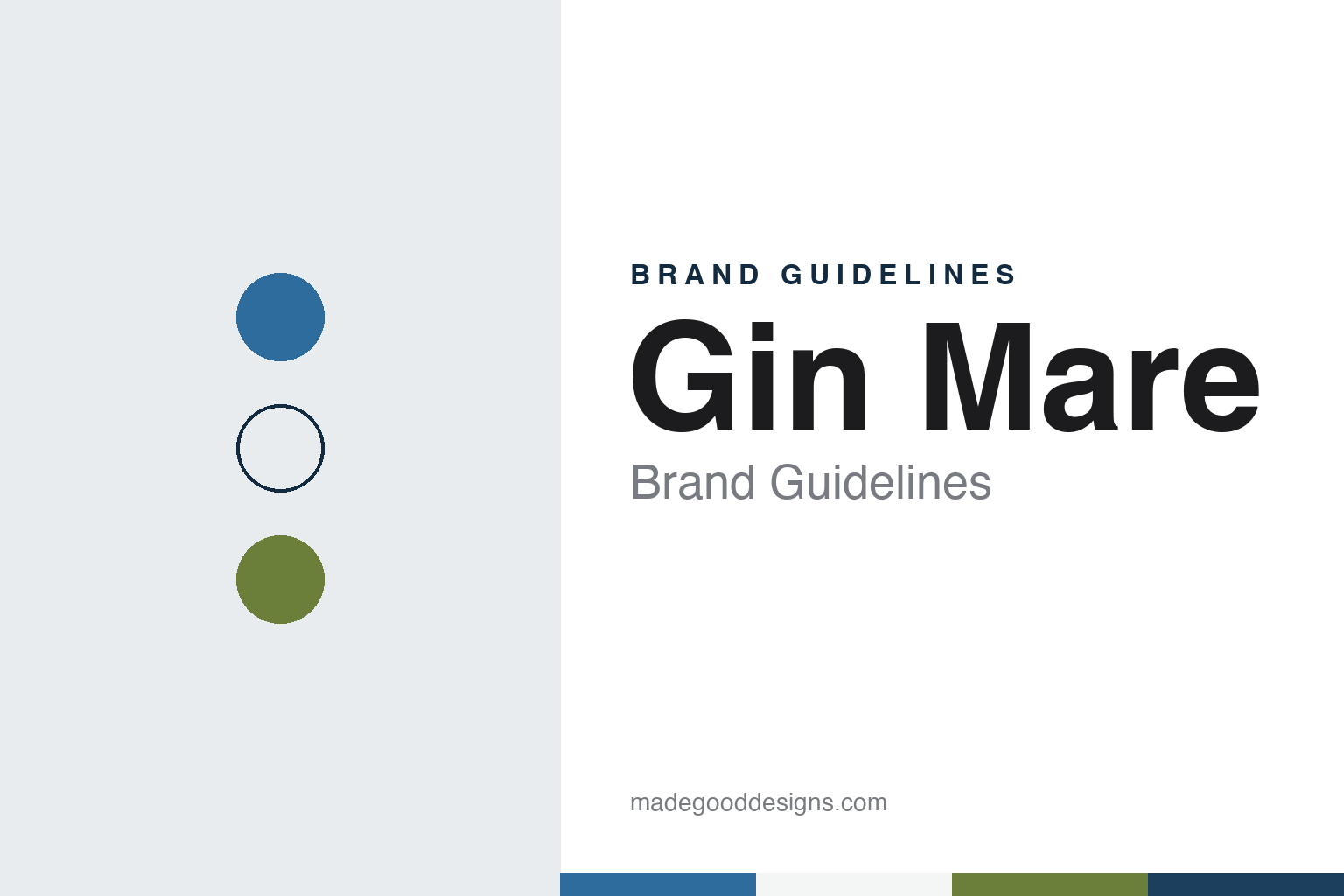
Gin Mare Brand Guidelines
The Mediterranean gin from Vilanova i la Geltrú, launched 2010.
Aa
Two constants: a Mediterranean blue, surf white and olive palette and a classical serif register. Abstract homage — not a Gin Mare product or mark; no label, logo or bottle is reproduced.
A distilling family on the Catalan coast
From a family gin of 1940 to a Mediterranean idea.
Gin Mare is made at Vilanova i la Geltrú, a seaside town on the Catalan coast south-west of Barcelona, by MG Destilerías, the distillery of the Giró family. The family business is old: the design magazine Neo2 reported in October 2017 that the house was founded in 1835 and that Manuel Giró created the recipe for Gin MG, the family’s first gin, in 1940. Neo2 described the family as being in its fifth generation at the head of the distillery.
That gin was developed with a partner from outside the family. In an interview published by Global Drinks Intel in 2022, Alfonso Morodo, co-founder of the Spanish brand company Vantguard with Antonio Pardo, said the Giró family approached Vantguard in 2008 about a gin they were developing, at first conceived as a luxury Spanish gin. Vantguard repositioned it as a Mediterranean gin, and development took about two years. The division of work was simple, Morodo said: the Giró family made the gin, and Vantguard handled sales, marketing and distribution around the world. The Spanish trade journal Alimarket reported in 2022 that the brand was created in 2010 by the Giró family and by Morodo and Pardo.
Gin Mare went on sale in Spain in March 2010, according to Morodo. The United Kingdom followed about five months later, then Belgium, the Netherlands and Germany; Spain, the UK, Germany and Italy became the brand’s four largest markets, he said, while sales in the United States took about three years to start.
Colour
Olive, basil, thyme and rosemary.
The idea is the Mediterranean in a gin, and the botanicals carry it. Brown-Forman’s 2022 announcement lists the four that define the recipe: Arbequina olives, thyme, rosemary and basil, distilled on a base of barley spirit. Morodo told Global Drinks Intel that each botanical is distilled separately before the spirits are blended, and the company describes a delicate maceration and independent distillation. Brown-Forman says the gin is made in a custom-built still housed in an 18th-century chapel at the distillery in Vilanova i la Geltrú. The gin is bottled at 42.7% alcohol by volume, the brand’s site says.
The bottle was planned as part of the story. Morodo said Vantguard invested heavily in a differentiated bottle that would tell the brand’s story. The Spirits Business picked it for a list of top gin bottle designs in October 2014, describing a cut-out olive-leaf pattern, a wave-inspired base, a chunky cap that doubles as a 50ml measure and a blue and white colour scheme meant to suggest sky and clouds, sea and surf. A United States trademark application for the bottle, filed in 2022, claims silver, blue, white and black as its colours.
The brand’s language follows the same line. Its site uses the phrase “Mediterranean is more than a place, it’s an attitude,” and the gin’s name itself is the Latin and Italian word for sea.
The range has stayed small. Gin Mare Capri, introduced in 2021 according to Brown-Forman, adds Italian bergamot and lemons to the four principal botanicals of the original.
Typography
Design and documentation.
The seven brands in this group are all gin and vodka names: The Botanist, Bulldog, Malfy, Gin Mare, Brockmans, Cîroc and Skyy. Gin and vodka brands in general sit at many different points in the trade, from small distilleries that still carry a founder’s name to labels that now belong to much larger drinks groups, and a single brand can be sold everywhere from a corner shop to a cocktail bar.
A gin or vodka brand’s identity is usually carried less by the spirit itself than by a bottle, a name and the place it promises, because the company behind the name may have changed hands, moved its production or grown far beyond the place where it started. That makes the questions behind each name worth asking plainly: who started it, who owns it now, and where its gin or vodka is actually distilled and bottled.
Each guide separates what independent sources record from what the company says about itself — its founding story, its owners over time, where its spirit is made and how its bottles and labels have changed — and marks plainly what rests only on the company’s own word.
Aa
A classical serif for a gin that sells the Mediterranean. (Specimen set in Cormorant Garamond, a serif STAND-IN; NOT the Gin Mare logo.)
Gin Mare
From a family distillery and a brand builder to Brown-Forman.
Twelve years after the launch the partners sold. In September 2022 Brown-Forman, the Louisville company behind Jack Daniel’s, announced that it had agreed to buy Gin Mare and Gin Mare Capri from Vantguard and MG Destilerías, and on 3 November 2022 it said the purchase was complete. Lawson Whiting, Brown-Forman’s president and chief executive, called Gin Mare “a unique gin with a distinctive taste profile.” Gin Mare became Brown-Forman’s second gin brand after Fords Gin, which it bought in 2019, and the company said production would continue at MG Destilerías in Vilanova i la Geltrú.
For Vantguard the sale marked the end of a long build. “It’s time for this baby to leave home!” Morodo told Global Drinks Intel, adding that the company saw itself as a brand creator and meant to keep doing that. Brown-Forman, in its own announcement, describes Gin Mare as the world’s leading ultra-premium gin.
The family distillery has kept its older gin as well. Neo2 reported in October 2017 that Gin MG had been given a new bottle and label recalling the original, with its strength raised from 37.5% to 40%.
The name needs care online. “Mare” means sea in several languages and appears on many unrelated products; the brand’s own site is ginmare.com.
For a design guide, Gin Mare shows how a gin can be built around a region rather than a recipe tradition — olive, herbs, a chapel by the sea and a bottle shaped like a wave. Compare Malfy, the Italian gin built on the Amalfi Coast, and Licor 43, the Spanish liqueur from Cartagena. For this guide we use Mediterranean blue, surf white and olive with a serif, an unofficial interpretation; no product or logo is reproduced.
Explore & save
Keep Gin Mare’s identity on hand — save it to a board in the Made Good inspiration library.
Gin Mare identity set
Pin the Gin Mare Mediterranean blue, surf white and olive palette and the classical serif register to your own board.


