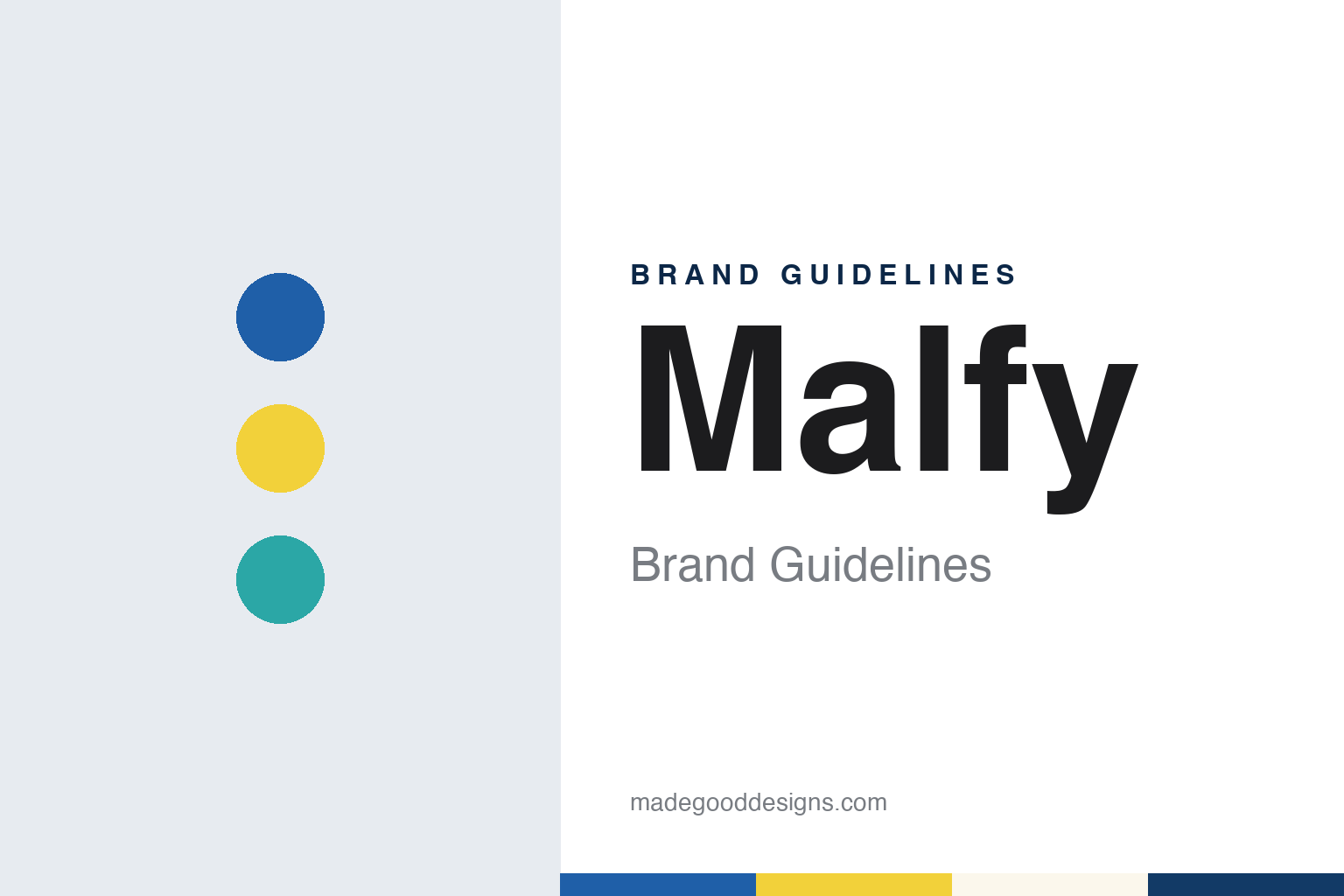
Malfy Brand Guidelines
The Italian lemon gin from Moncalieri, launched 2016.
Aa
Two constants: an Amalfi blue, lemon and turquoise palette and a geometric sans register. Abstract homage — not a Malfy product or mark; no label, logo or bottle is reproduced.
A Seagram plant near Turin
An Italian distilling family and an importer with a gin idea.
Malfy is an Italian gin made at Moncalieri, a town on the edge of Turin in Piedmont, by the Vergnano family at their distillery, Torino Distillati. English Wikipedia says the family has distilled gin there since the 1970s. The trade magazine Four reported in July 2018 that the distillery had once belonged to Seagram Italia, a company with a long tradition of Italian vermouths and amari, and that the family, who had worked for Seagram, bought the facility when Seagram sold it. Four named Carlo Vergnano, a trained winemaker, as the owner with his wife Piera, and their daughter Rita as the manager of operations.
The brand itself came from outside the family. Elwyn Gladstone, a drinks executive, set up Biggar & Leith, a spirits company based in New Jersey, to build brands with small, family-owned European distillers; English Wikipedia dates the company to 2015, and a 2019 profile in Market Watch dates it to 2016, when Malfy was its first launch. Biggar & Leith approached the Vergnanos, and the gin that came out of the partnership was Malfy.
The launch came in March 2016. The Spirits Business reported on 7 March 2016 that Malfy was arriving on American shelves, presented by Biggar & Leith as a “first luxury” Italian gin, with Europe, Australia and other markets to follow. Harpers reported the same month that the first batch shipped to the United Kingdom in early March had sold out within a week. In May 2016 Bevnet reported that Breakthru Beverage Group would distribute the gin in the United States, and by October 2017 The Drinks Report counted Malfy in 40 countries, English Wikipedia notes.
Colour
Lemons, a blue label and an oak stopper.
The product idea is citrus. English Wikipedia says that for Malfy Gin Con Limone lemon peel from the Amalfi Coast and Sicily is steeped in a spirit made from Italian grain before distillation, and that the gins are distilled under vacuum at low temperature; Four described the still in 2018 as a stainless-steel vacuum still. The first gin, Originale, uses Italian juniper and five other botanicals, and the company points to spring water from Monviso, the Alpine peak west of Turin. By 2019 the range had four gins — Originale, Con Limone, Gin Rosa, with Sicilian pink grapefruit, and Con Arancia, with Sicilian blood orange — Drinks International and Market Watch reported.
The packaging set out the brand’s Mediterranean story from the start. The Spirits Business described the launch bottle in March 2016 as carrying a blue label meant to evoke the Mediterranean, closed with a stopper made of Italian oak.
The story the company tells about gin itself is the one point of debate. Gladstone told The Spirits Business in 2016 that gin was reportedly invented in Italy before the British and Dutch versions, and the company points to Italian monks distilling juniper spirits around the year 1050; English Wikipedia notes that gin is generally traced to 17th-century Holland.
In September 2025 Pernod Ricard gave Malfy Originale a new bottle. Drinks Intel reported on 4 September 2025 that the new look used silver and turquoise, a frosted glass ring around the bottle and a “sunburst” logo, and that it was developed with the agency Nude; it rolled out first in Australia, Italy, Turkey, the United Arab Emirates and the United Kingdom.
Typography
Design and documentation.
The seven brands in this group are all gin and vodka names: The Botanist, Bulldog, Malfy, Gin Mare, Brockmans, Cîroc and Skyy. Gin and vodka brands in general sit at many different points in the trade, from small distilleries that still carry a founder’s name to labels that now belong to much larger drinks groups, and a single brand can be sold everywhere from a corner shop to a cocktail bar.
A gin or vodka brand’s identity is usually carried less by the spirit itself than by a bottle, a name and the place it promises, because the company behind the name may have changed hands, moved its production or grown far beyond the place where it started. That makes the questions behind each name worth asking plainly: who started it, who owns it now, and where its gin or vodka is actually distilled and bottled.
Each guide separates what independent sources record from what the company says about itself — its founding story, its owners over time, where its spirit is made and how its bottles and labels have changed — and marks plainly what rests only on the company’s own word.
Aa
A clean geometric sans for a sun-and-sea gin. (Specimen set in Jost, a sans-serif STAND-IN; NOT the Malfy logo.)
Malfy
From an importer’s launch to a Pernod Ricard gin.
Three years after the launch Malfy changed hands. On 17 April 2019 Pernod Ricard announced that it had agreed to buy the brand from Biggar & Leith, Drinks International, The Drinks Business and Shanken News Daily reported. Christian Porta, Pernod Ricard’s managing director of global business development, called the deal “true to our long-standing strategy of investing in brands with strong potential in growing categories,” and the group placed it alongside its earlier gin purchases, Monkey 47 in 2016 and Ungava in 2018. Shanken News Daily reported that the acquisition was completed on 21 June 2019. At the time of the deal Drinks International reported that the gins were distilled by the Vergnano family in Moncalieri.
Under Pernod Ricard the brand has leaned on Italian design partners. In July 2024 a limited-edition Malfy Gin Rosa bottle in the zigzag pattern of the Italian fashion house Missoni went on sale in Italy, the United Kingdom, Greece and travel retail, The Moodie Davitt Report and GTR Magazine reported; a second phase dressed Malfy Originale in a design by Missoni’s creative director, Alberto Caliri, according to Pernod Ricard’s Absolut Company. The Pentawards directory credits the London agency Nude Brand Creation with the Malfy × Missoni editions.
The gin’s own site is malfygin.com.
For a design guide, Malfy shows how a gin with no long history of its own built an identity from a place — the Amalfi Coast, its lemons and its sea — and then refined it with a silver-and-turquoise bottle and fashion collaborations. Compare Monkey 47, Pernod Ricard’s Black Forest gin, and Beefeater, its London dry gin. For this guide we use Amalfi blue, lemon and turquoise with a geometric sans, an unofficial interpretation; no product or logo is reproduced.
Explore & save
Keep Malfy’s identity on hand — save it to a board in the Made Good inspiration library.
Malfy identity set
Pin the Malfy Amalfi blue, lemon and turquoise palette and the geometric sans register to your own board.